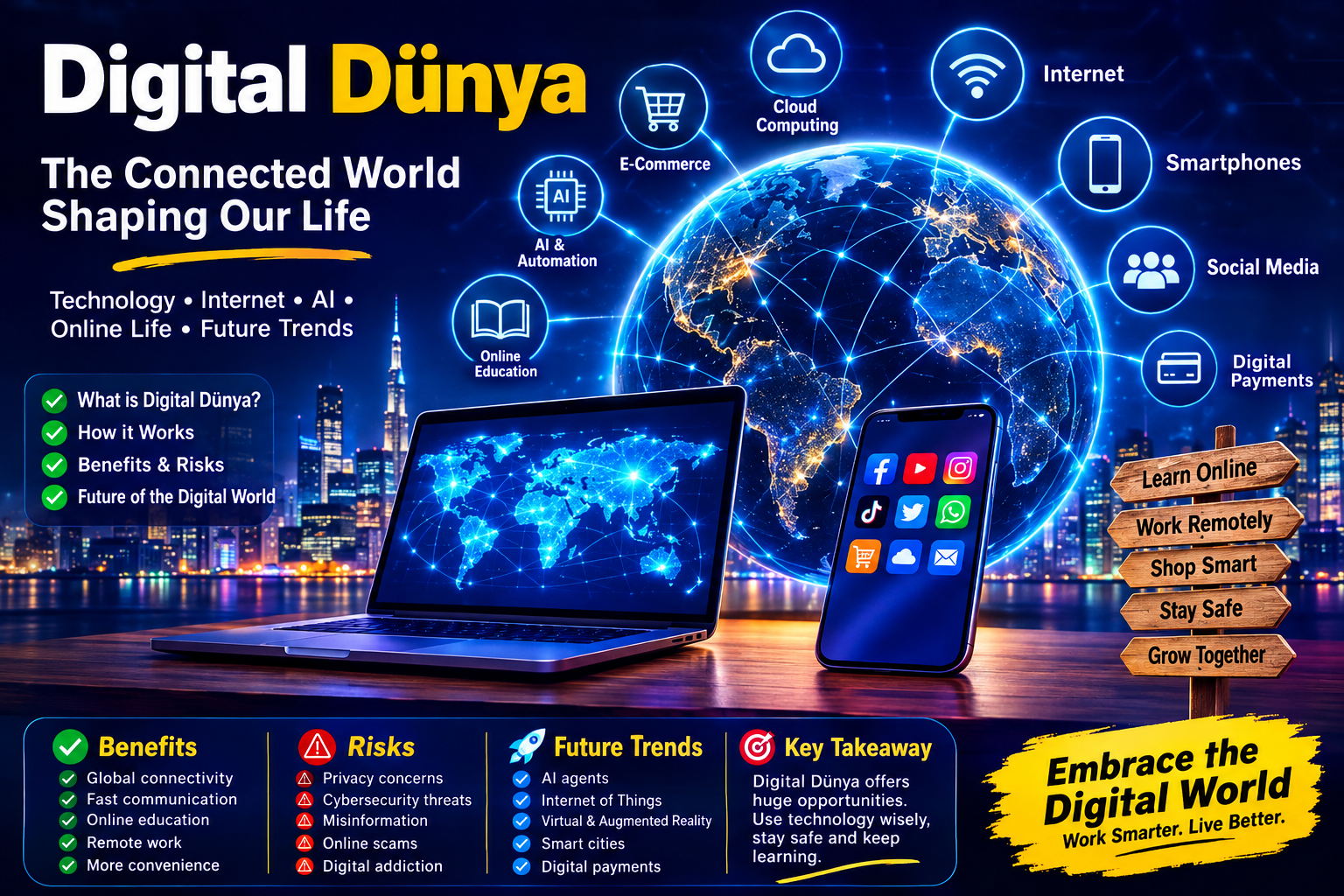
Digital Dünya: What Is the Digital World, How It Works, Its Benefits, Risks and Future
Digital Dünya refers to the connected digital environment created by the internet, smartphones, computers, software, cloud services, artificial intelligence, social platforms, digital payments, online communities, and connected devices. It has changed how people communicate, learn, work, shop, travel, manage money, access entertainment, and interact with businesses across the world. The digital world is not simply the internet. It is a broader ecosystem where physical activities and digital technologies increasingly work together ExploreTech
What Is Digital Dünya?
The phrase Digital Dünya literally refers to the digital world.
In simple terms, it describes the environment where digital technology connects people, information, businesses, services, and devices.
This environment includes:
- Websites
- Mobile applications
- Social media
- Search engines
- Cloud computing
- Online banking
- E-commerce
- Digital entertainment
- Artificial intelligence
- Online education
- Digital communication
- Smart devices
- Internet-connected machines
- Digital communities
- Online workplaces
The digital world does not exist separately from physical life anymore.
Instead, the two are becoming increasingly connected.
A Simple Example
Consider a simple restaurant visit.
In the physical world, you might enter a restaurant, read a menu, order food, and pay.
In the digital world, the same experience could involve:
- Finding the restaurant through a search engine.
- Checking reviews online.
- Viewing the digital menu.
- Making a reservation through an app.
- Ordering through a tablet.
- Paying digitally.
- Receiving an electronic receipt.
- Leaving an online review.
The restaurant experience is physical, but digital technology supports almost every stage.
This is one of the most important characteristics of Digital Dünya: digital systems increasingly surround and support physical activities.
How the Digital World Developed
The digital world did not appear overnight.
It developed through several major technological changes.
The Computer Era
Early computers were primarily used for calculations and specialized tasks.
Over time, computers became smaller, faster, cheaper, and more accessible.
Personal computers eventually entered homes, schools, and offices.
The Internet Era
The internet dramatically changed how computers communicated.
Instead of using computers as isolated machines, people could connect to information and other users around the world.
Email, websites, forums, search engines, and online services gradually became mainstream.
The Mobile Era
Smartphones changed digital technology again.
People no longer needed to sit in front of a desktop computer to access digital services.
The internet became available from almost anywhere with a suitable connection.
Mobile applications also created new ways to communicate, shop, work, travel, and consume content.
The Cloud Era
Cloud computing moved many digital services away from individual devices and into remotely managed infrastructure.
This allowed people and organizations to access:
- Files
- Applications
- Databases
- Computing resources
- Collaboration tools
from different locations and devices.
The AI Era
Artificial intelligence is adding another layer to the digital world.
AI systems can analyze information, recognize patterns, understand language, generate content, and assist with different tasks.
This means the digital world is increasingly becoming not only connected, but also automated and intelligent.
The Main Components of Digital Dünya
The digital world is made up of many interconnected technologies.
Internet
The internet is one of the foundations of Digital Dünya.
It allows computers and devices to communicate and gives users access to online services and information.
People use the internet for:
- Communication
- Research
- Shopping
- Education
- Entertainment
- Banking
- Business
- News
- Travel
- Social interaction
Without widespread internet connectivity, much of today’s digital ecosystem would not function in its current form.
Smartphones
Smartphones have made digital technology portable.
A modern smartphone can combine:
- Camera
- Computer
- GPS
- Communication device
- Payment tool
- Entertainment system
- Work device
- Authentication device
This makes smartphones one of the most important gateways to the digital world.
Cloud Computing
Cloud computing allows organizations and individuals to use computing resources and services over networks rather than relying entirely on local hardware.
Cloud technology supports many familiar services, including:
- Online storage
- Collaboration platforms
- Business software
- Streaming services
- Websites
- AI applications
- Databases
Cloud computing also allows businesses to scale digital services without building every part of their infrastructure themselves.
Artificial Intelligence
AI is becoming a major part of Digital Dünya.
AI can help systems:
- Understand language
- Analyze data
- Recognize images
- Make predictions
- Generate content
- Detect unusual activity
- Recommend products
- Automate workflows
AI is especially important because it changes the way people interact with digital systems.
Instead of navigating complicated menus, users can increasingly communicate with software using natural language.
Data
Data is another foundation of the digital economy.
Everyday digital activities can generate different types of information.
Examples include:
- Search queries
- Purchases
- Website interactions
- Location signals
- App activity
- Customer records
- Business transactions
Data can help organizations understand customers and improve services.
However, data collection also creates important questions about privacy, consent, security, and ownership.
Digital Dünya in Everyday Life
The easiest way to understand the digital world is to look at everyday activities.
Digital Communication
Communication has changed dramatically.
People can now communicate across borders almost instantly through:
- Messaging applications
- Video calls
- Social media
- Online communities
A person in one country can communicate with someone thousands of kilometers away without waiting for physical mail.
This has made international collaboration much easier.
Digital Shopping
E-commerce has changed the shopping experience.
Consumers can:
- Search for products
- Compare prices
- Read reviews
- Watch product videos
- Order products
- Pay online
- Track deliveries
The physical store is no longer the only place where product discovery happens.
For many businesses, the customer’s first interaction occurs online.
Digital Banking
Banking has also moved heavily into the digital environment.
Users can often:
- Check balances
- Transfer money
- Pay bills
- Receive notifications
- Manage accounts
- Make online purchases
Digital banking can make financial services more convenient, although users must remain alert to scams and account-security threats.
Digital Entertainment
Entertainment is now highly digital.
Examples include:
- Streaming video
- Music platforms
- Podcasts
- Online gaming
- Digital books
- Social video
- Live streaming
Instead of purchasing physical media, users can access large libraries through connected services.
Digital Travel
Travel has become closely connected with digital technology.
Travelers can use digital tools to:
- Research destinations
- Compare hotels
- Book flights
- Reserve accommodation
- Navigate cities
- Translate languages
- Store travel documents
- Track transportation
Digital maps and navigation systems have particularly changed how people move through unfamiliar places.
Digital Healthcare
Technology is also changing healthcare experiences.
Depending on the country and service, digital tools can support:
- Appointment scheduling
- Telehealth
- Electronic records
- Health information
- Medical research
- Administrative work
Healthcare remains a high-stakes area, so digital convenience must be balanced with privacy, security, accuracy, and professional oversight.
Digital Dünya and Business
Businesses are among the biggest users of digital technology.
A small company can now reach customers in other countries without opening physical stores in each market.
E-Commerce
Online stores allow businesses to sell products beyond their local geography.
A typical digital sales process may include:
Discovery → Product page → Comparison → Checkout → Digital payment → Delivery → Review
Each stage can involve different technologies.
Digital Marketing
Businesses use digital channels to reach potential customers.
These can include:
- Search
- Social media
- Websites
- Online advertising
- Video
- Content marketing
Digital marketing also provides businesses with data that can help measure customer engagement.
Business Automation
Automation can reduce repetitive manual work.
For example, software may automatically:
- Send confirmation emails
- Organize customer information
- Generate reports
- Route support requests
- Process certain transactions
- Schedule tasks
AI can add another layer by assisting with tasks that involve language, classification, analysis, or content generation.
Remote Work
Digital technology has also changed the traditional workplace.
Teams can collaborate through:
- Video conferencing
- Cloud documents
- Project management platforms
- Messaging systems
- Digital calendars
- Online databases
This allows some organizations to operate with distributed teams.
However, remote work also creates challenges involving communication, management, cybersecurity, and employee connection.
Digital Dünya and Education
Education has also become increasingly digital.
Online Learning
Students can access:
- Video courses
- Digital textbooks
- Online lectures
- Learning platforms
- Virtual classrooms
- Educational applications
This can make education more flexible.
Someone who cannot attend a traditional classroom may be able to study online.
Digital Skills
Digital literacy is becoming increasingly important.
Students and workers may need skills in:
- Computer use
- Online research
- Digital communication
- Data handling
- Cybersecurity awareness
- AI literacy
- Information evaluation
Knowing how to use a device is no longer enough.
People also need to know how to evaluate digital information.
AI in Education
AI can support education through:
- Personalized explanations
- Practice questions
- Language learning
- Study assistance
- Content organization
- Feedback
However, students should not use AI as a shortcut that replaces learning.
The best use of AI in education is often as a learning assistant rather than a replacement for thinking.
Digital Culture
Digital technology does not only change tools.
It changes culture.
Social Media Culture
Social platforms allow people to create and distribute content without traditional media organizations.
This has created:
- Influencer culture
- Creator economies
- Viral trends
- Online communities
- Digital fandoms
A person with a smartphone can potentially reach an international audience.
Digital Identity
People increasingly maintain digital identities.
These may include:
- Social profiles
- Professional profiles
- Online portfolios
- Gaming identities
- Creator accounts
Your online presence can influence how others perceive you.
This makes digital reputation increasingly important.
Memes and Viral Culture
Internet culture can spread extremely quickly.
A joke, image, phrase, or video can move from one community to another and become globally recognized.
This creates a new form of cultural exchange.
However, viral content can also spread misinformation quickly.
Benefits of Digital Dünya
The digital world offers significant advantages.
Global Connectivity
Geographic distance has become less important for many forms of communication.
Businesses can work with international teams.
Families can communicate across borders.
Students can access educational resources from other countries.
Access to Information
The internet provides access to an enormous amount of information.
Users can learn about:
- Science
- History
- Technology
- Business
- Languages
- Culture
- Travel
- Skills
But access does not automatically mean accuracy.
People still need information literacy.
Convenience
Digital services can save time.
Examples include:
- Online banking
- Online shopping
- Digital bookings
- Navigation
- Electronic documents
Many activities that once required physical visits can now be completed remotely.
New Business Opportunities
Digital technology has created new business models.
Examples include:
- SaaS
- E-commerce
- Digital products
- Online education
- Content businesses
- Freelancing
- Creator businesses
A person can potentially build a business with customers across multiple countries.
Greater Flexibility
Digital tools allow people to work and learn from different locations.
This flexibility can benefit people with different schedules and circumstances.
Problems and Risks of Digital Dünya
The digital world also has significant disadvantages.
Privacy Risks
Companies and platforms may collect information about users.
The more services become digital, the more important privacy becomes.
Users should understand:
- What information they provide
- What permissions applications request
- How accounts are protected
- What information is publicly visible
Cybersecurity
Digital systems can be targeted by criminals.
Common threats include:
- Phishing
- Malware
- Password theft
- Identity theft
- Account takeover
- Fake websites
- Online scams
Basic cybersecurity practices can reduce many common risks.
Misinformation
The internet has made information easier to publish and distribute.
This is positive for freedom of expression and access to information, but it also means false information can spread quickly.
A responsible digital user should ask:
- Who published this?
- Is there evidence?
- Is the source trustworthy?
- Does another reliable source confirm it?
- Is the information current?
Digital Addiction
Digital technology can become excessive.
Constant notifications, social media feeds, games, and entertainment can make it difficult to disconnect.
Healthy digital habits are therefore important.
Digital Divide
Not everyone has equal access to technology.
Differences can involve:
- Internet availability
- Device affordability
- Digital skills
- Infrastructure
- Language
- Education
A truly inclusive digital world requires more than simply putting services online.
People must also be able to access and use those services.
Digital Dünya for Different Groups
Digital Dünya for Students
Students can benefit from digital resources for:
- Research
- Online learning
- Collaboration
- Skill development
- Language learning
The main challenge is learning to distinguish reliable information from low-quality content.
Digital Dünya for Professionals
Professionals can use digital tools to improve:
- Productivity
- Communication
- Networking
- Research
- Collaboration
- Career development
Digital skills can also increase employability.
Digital Dünya for Businesses
Businesses can use digital technology to:
- Reach customers
- Automate operations
- Analyze data
- Improve customer support
- Sell internationally
The most successful strategy is not necessarily using the most technology.
It is using the right technology for a measurable business problem.
Digital Dünya for Older Adults
Older adults can benefit from digital technology for:
- Communication
- Banking
- Healthcare access
- Entertainment
- Family connections
However, interfaces should be simple and digital safety education should be accessible.
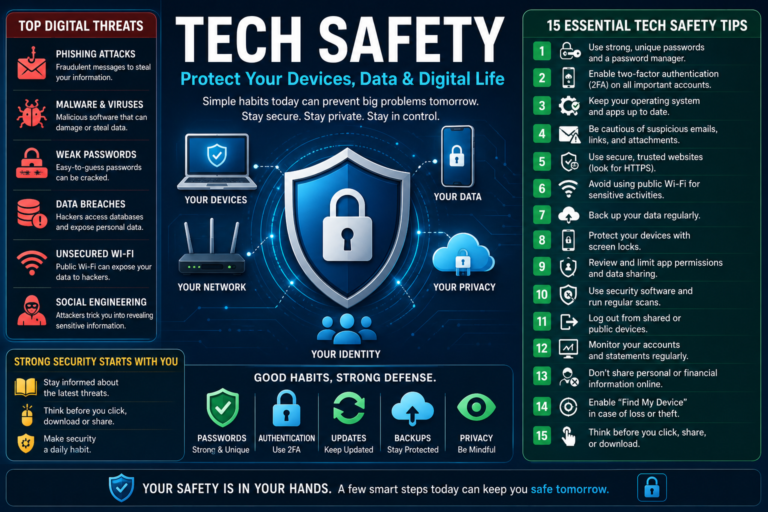
How to Stay Safe in Digital Dünya
Digital literacy should include cybersecurity.
Use Strong, Unique Passwords
Do not reuse the same password across important accounts.
A password manager can make unique passwords easier to manage.
Enable Two-Factor Authentication
Two-factor authentication adds another security layer beyond the password.
Where available, users should consider enabling it for important accounts.
Be Careful With Links
Do not automatically trust links received through:
- Messages
- Social media
- Unexpected notifications
Check the destination before entering login information.
Update Your Devices
Software updates often include security improvements.
Keeping operating systems and applications updated is an important basic security practice.
Protect Personal Information
Think before sharing:
- Identification details
- Financial information
- Passwords
- Private documents
- Exact personal information
Online convenience should not come at the cost of unnecessary exposure.
Common Mistakes in the Digital World
Mistake 1: Believing Everything Online
Not everything published online is true.
Solution: Verify important claims.
Mistake 2: Using One Password Everywhere
If one account is compromised, multiple accounts may become vulnerable.
Solution: Use unique passwords.
Mistake 3: Ignoring Privacy Settings
Many users accept default settings without reviewing them.
Solution: Regularly check account privacy and application permissions.
Mistake 4: Oversharing
Public posts can remain accessible or be copied even after deletion.
Solution: Think about the long-term impact before publishing.
Mistake 5: Following Every Digital Trend
New technology is released constantly.
Solution: Adopt technology based on usefulness rather than hype.
Digital Dünya: Pros and Cons
| Advantages | Disadvantages |
|---|---|
| Global communication | Privacy concerns |
| Fast access to information | Misinformation |
| Online education | Digital divide |
| Remote work | Isolation for some users |
| E-commerce | Online scams |
| Digital banking | Cybersecurity threats |
| Global business | Increased competition |
| Entertainment access | Excessive screen time |
| Automation | Job disruption |
| Convenience | Dependence on technology |
Ten Major Brands Shaping Digital Dünya
The digital world is influenced by companies working across search, software, social media, commerce, entertainment, cloud computing, and creative technology.
| Brand | Main Digital Area | Major Role | Typical Users |
|---|---|---|---|
| Search, Cloud, AI | Information and digital services | General users and businesses | |
| Microsoft | Software, Cloud, AI | Productivity and enterprise technology | Professionals and businesses |
| Apple | Devices and Services | Digital consumer ecosystem | Consumers |
| Amazon | E-commerce and Cloud | Online shopping and cloud infrastructure | Consumers and businesses |
| Meta | Social Media | Social networking and digital communities | Consumers and creators |
| YouTube | Video | Digital video and creator platform | Viewers and creators |
| TikTok | Short-form Video | Digital culture and entertainment | Consumers and creators |
| Netflix | Streaming | Digital entertainment | Viewers |
| Adobe | Creative Technology | Digital content creation | Designers and businesses |
| Salesforce | Business Software | CRM and business workflows | Businesses and sales teams |
These brands do not represent the entire digital world. Thousands of other companies contribute to areas such as cybersecurity, fintech, logistics, telecommunications, gaming, cloud infrastructure, and digital publishing.
Problem-Solving Modifiers for Digital Dünya
One useful way to understand digital technology is to connect it with a specific problem.
Digital Dünya for Beginners
Beginners should focus on:
- Basic internet skills
- Online privacy
- Password security
- Digital communication
- Online research
- Safe payments
Digital Dünya for Businesses
Businesses should focus on:
- Digital transformation
- Customer experience
- E-commerce
- Automation
- Data analysis
- Cybersecurity
Digital Dünya for Students
Students should focus on:
- Digital literacy
- Online research
- AI literacy
- Information verification
- Productivity tools
Digital Dünya for Remote Workers
Remote workers should focus on:
- Digital collaboration
- Cloud tools
- Communication
- Cybersecurity
- Time management
Digital Dünya for Travelers
Travelers can benefit from:
- Digital maps
- Online booking
- Translation tools
- Digital tickets
- Travel applications
- Secure digital payments
Practical Guide to Building Better Digital Habits
A healthy relationship with technology does not mean avoiding technology.
It means using it intentionally.
Step 1: Audit Your Digital Life
Look at the applications, websites, subscriptions, and accounts you use.
Ask:
Do I actually need this?
Step 2: Secure Important Accounts
Start with:
- Banking
- Primary social accounts
- Cloud storage
- Work accounts
Use strong passwords and additional authentication where available.
Step 3: Reduce Unnecessary Notifications
Not every application needs permission to interrupt you.
Keep important alerts and reduce unnecessary ones.
Step 4: Organize Digital Information
Use clear folders, file names, and backups.
Digital clutter can become just as problematic as physical clutter.
Step 5: Verify Important Information
Do not allow convenience to replace critical thinking.
Step 6: Review Your Digital Footprint
Search your name occasionally and review what information about you is publicly available.
Step 7: Learn Continuously
Digital technology changes quickly.
Developing the habit of learning new tools can be more valuable than mastering one tool forever.
Future Trends in Digital Dünya
The digital world will likely continue moving toward deeper integration between software, AI, physical devices, and human activities.
AI Agents
AI systems are increasingly moving beyond simple question-and-answer interactions.
Future systems may perform longer sequences of tasks using multiple digital tools.
This could affect:
- Customer service
- Research
- Business administration
- Software development
- Personal productivity
Reliability and human oversight will remain important.
Multimodal Technology
Digital systems are increasingly able to work with multiple forms of information.
A single system may interact with:
- Text
- Images
- Audio
- Video
- Documents
This could make digital interfaces more natural.
Internet of Things
More physical objects can become connected.
Examples include:
- Smart appliances
- Wearable devices
- Connected vehicles
- Industrial sensors
- Smart buildings
This creates a bridge between the physical and digital worlds.
Digital Payments
Cashless and digital payment systems are likely to continue developing.
Convenience will increase, but security and financial literacy will remain essential.
Virtual and Augmented Reality
Virtual reality can create immersive digital environments.
Augmented reality can place digital information into physical environments.
Potential applications include:
- Education
- Gaming
- Retail
- Training
- Tourism
- Design
Smart Cities
Cities can increasingly use connected systems for:
- Transportation
- Energy management
- Public services
- Infrastructure
- Environmental monitoring
The challenge will be balancing efficiency with privacy and responsible data use.
The Most Important Future Skill: Digital Judgment
Many discussions about the future of technology focus on technical skills.
But another skill may become equally important: digital judgment.
Digital judgment means knowing:
- When to trust technology
- When to verify information
- When not to share data
- When automation is appropriate
- When human judgment is necessary
- Which technology solves a real problem
- Which technology is simply hype
As digital tools become more powerful, the ability to use them wisely may matter as much as the ability to operate them.
Digital Dünya Is Becoming More Human, Not Less
It may seem that increasing digitalization will make life less human.
But technology can also strengthen human relationships.
A video call can connect families separated by countries.
An online course can give someone access to education that was previously unavailable.
A digital business can allow a small entrepreneur to reach customers internationally.
A translation tool can help people communicate across language barriers.
The real question is therefore not whether society should become more digital.
The more useful question is:
How can digital technology improve human life without creating unnecessary dependence, inequality, or risk?
That question will shape the next stage of Digital Dünya.
FAQs
What is Digital Dünya?
Digital Dünya, or the digital world, refers to the connected environment created by the internet, smartphones, computers, software, AI, social media, cloud services, digital payments, and other digital technologies.
Why is Digital Dünya important?
Digital Dünya is important because it has changed how people communicate, work, study, shop, travel, manage money, and access information.
What are examples of Digital Dünya?
Examples include social media, online shopping, digital banking, websites, mobile apps, streaming services, online education, cloud computing, AI tools, and digital communication platforms.
How has the digital world changed everyday life?
It has made many activities faster and more convenient. People can communicate instantly, shop online, attend virtual classes, work remotely, make digital payments, and access information from almost anywhere.
What is digital transformation?
Digital transformation is the process of using digital technologies to change and improve how an organization operates, serves customers, manages information, and delivers products or services.
What role does AI play in Digital Dünya?
AI helps digital systems analyze data, recognize patterns, understand language, generate content, make predictions, personalize experiences, and automate certain tasks.
What are the benefits of Digital Dünya?
Major benefits include global connectivity, faster communication, online education, remote work, e-commerce, digital services, greater convenience, automation, and access to information.
What are the risks of the digital world?
Important risks include privacy problems, cybersecurity threats, misinformation, online scams, digital addiction, data misuse, and unequal access to technology.
How can I stay safe in Digital Dünya?
Use strong and unique passwords, enable two-factor authentication, avoid suspicious links, keep software updated, protect personal information, and verify important information before trusting or sharing it.
What is digital culture?
Digital culture refers to the habits, behaviors, communities, trends, communication styles, and social practices that develop through digital technology and online platforms.
How does Digital Dünya affect businesses?
Digital technology allows businesses to reach global customers, sell online, automate processes, analyze data, communicate remotely, provide digital services, and improve customer experiences.
Conclusion
Digital Dünya is much more than smartphones and social media. It is a broad ecosystem that connects people, businesses, information, devices, software, and services. The digital transformation of society has created major advantages, including convenience, global communication, online education, remote work, digital business, and rapid access to information.