Akasaka, Tokyo: The Ultimate Guide to History, Luxury, Food, Culture, Hotels, and Things to Do
Akasaka is a central Tokyo neighborhood in Minato City known for upscale hotels, restaurants, nightlife, historic shrines, international connections, and its proximity to Japan’s political center. For travelers, Akasaka offers a more refined and less obvious side of Tokyo, where traditional religious sites and historic architecture sit beside modern offices, entertainment complexes, luxury accommodation, and excellent dining Istanbul
What Is Akasaka?
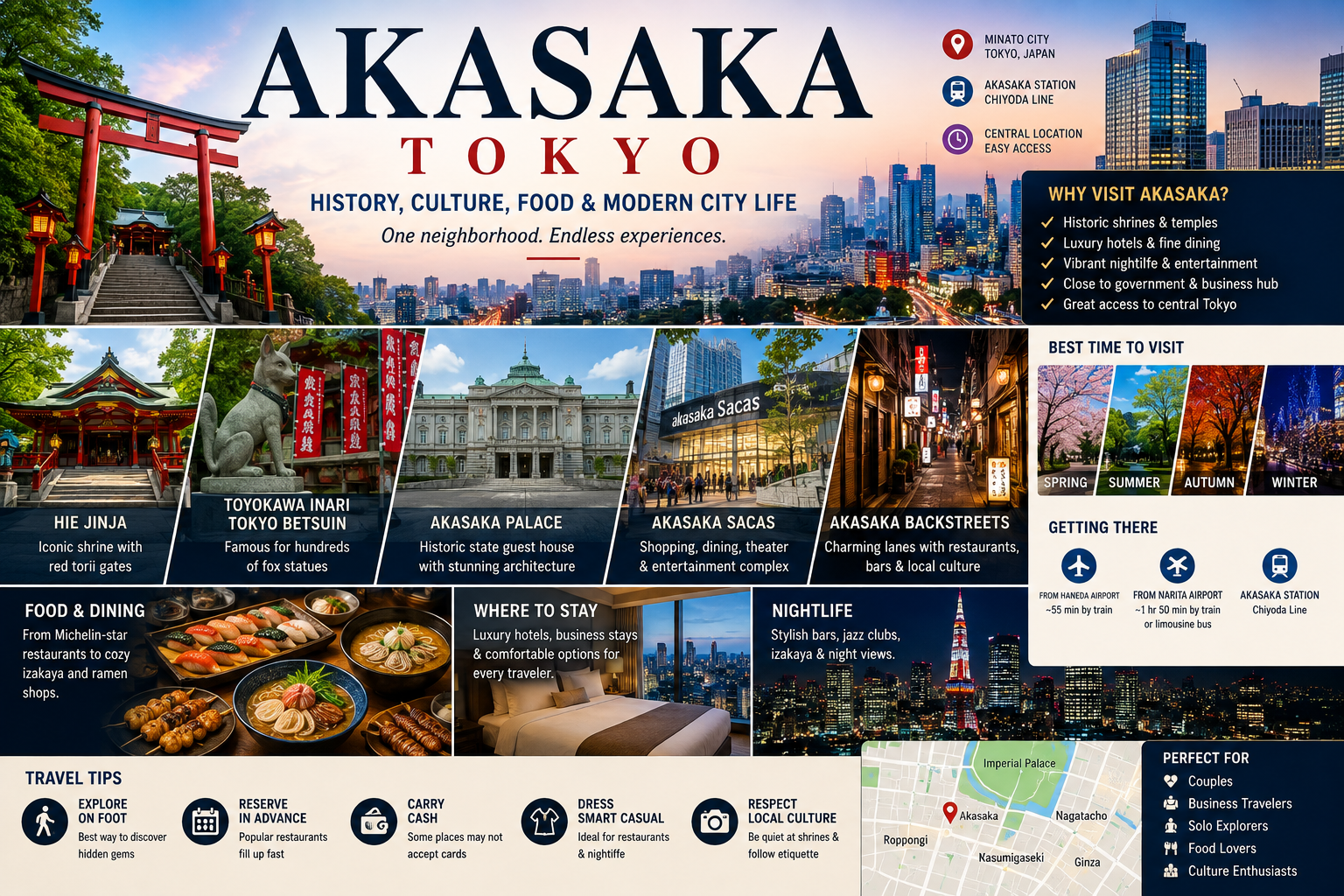
Akasaka is a neighborhood in central Tokyo, primarily associated with Minato City, located close to important areas including Nagatacho, Roppongi, Kasumigaseki, and the Imperial Palace area.
The district sits in an unusually influential part of the capital.
To one side are government institutions and Japan’s political center.
To another are the entertainment, art, shopping, and nightlife districts of Roppongi.
Within Akasaka itself are luxury hotels, restaurants, shrines, offices, media organizations, and residential areas.
The Japan National Tourism Organization characterizes Akasaka as an upscale neighborhood positioned between the government center of Nagatacho and the nightlife and gallery-rich streets of Roppongi.
Where Is Akasaka Located?
Akasaka is in central Tokyo and is well positioned for travelers who want to explore several major parts of the city.
Its location makes it possible to reach areas such as:
- Roppongi
- Nagatacho
- Kasumigaseki
- Ginza
- Tokyo Station
- Shibuya
- Shinjuku
- Imperial Palace surroundings
This central position is one reason Akasaka has developed such a strong hotel and business presence.
Is Akasaka a Tourist Area?
Yes, but it feels different from Tokyo’s most heavily tourism-oriented neighborhoods.
Akasaka does not depend entirely on giant attractions.
Instead, much of its appeal comes from the combination of small discoveries and major landmarks.
A traveler can visit a major palace in the morning, explore a shrine, eat lunch in a modern complex, walk through a quiet side street, visit a traditional temple, and finish the day at an upscale restaurant or entertainment venue.
The History of Akasaka
Understanding Akasaka requires understanding its relationship with Edo and the development of Tokyo.
The district’s location near the former Edo Castle area helped shape its historical importance.
Akasaka and the Edo Era
During the Edo period, Tokyo was known as Edo and functioned as the political center of the Tokugawa shogunate.
Akasaka developed near important residences, roads, religious institutions, and areas associated with political power.
The neighborhood’s historical character can still be experienced through its shrines, temples, old street patterns, and relationship with the former castle and government districts.
This is one of the reasons Akasaka feels different from newer Tokyo developments.
The modern skyline does not completely erase the historical landscape.
Instead, the two layers exist together.
From Political Neighborhood to Modern Business District
Over time, Akasaka became increasingly associated with politics, business, entertainment, hospitality, and international activity.
The area is home to numerous embassies and has long attracted visitors, business executives, politicians, entertainers, and international guests. JNTO notes that the neighborhood includes embassies representing countries including Canada, Mexico, Spain, San Marino, Syria, Cambodia, and the United States.
This international presence has contributed to Akasaka’s cosmopolitan identity.
Akasaka and Traditional Entertainment
Akasaka also developed a reputation for traditional entertainment and geisha culture.
The district once had hundreds of geisha entertainers.
Today, only a small number remain, but traces of that history can still be found in traditional restaurants and the character of some backstreets.
This history is important because it helps explain why Akasaka contains such a distinctive mixture of refined dining, hospitality, nightlife, and traditional architecture.
What Makes Akasaka Different From Other Tokyo Neighborhoods?
Tokyo has many famous neighborhoods, but each offers a different experience.
Akasaka vs Shibuya
Shibuya is strongly associated with youth culture, fashion, shopping, nightlife, and its famous crossing.
Akasaka feels more mature and business-oriented.
It can still be lively, especially at night, but its atmosphere is generally more refined.
Akasaka vs Shinjuku
Shinjuku is enormous and energetic, with department stores, skyscrapers, entertainment, nightlife, and transportation hubs.
Akasaka is smaller and more intimate.
Its backstreets are easier to explore on foot.
Akasaka vs Roppongi
Roppongi is famous for international nightlife, art, luxury shopping, and large-scale urban developments.
Akasaka shares some of this upscale character but offers more visible traditional and political history.
Akasaka vs Ginza
Ginza is famous for luxury shopping, department stores, sophisticated dining, and polished streets.
Akasaka is less formal in places.
Its narrow streets, izakaya, traditional restaurants, and historic religious sites provide more contrast.
Best Things to Do in Akasaka
Akasaka rewards travelers who combine famous landmarks with slow exploration.
Visit Hie Jinja
Hie Shrine is one of the area’s most important religious landmarks.
The shrine sits on a hill between Akasaka and Nagatacho and is closely associated with the Tokugawa clan and the famous Sanno Matsuri. Its western entrance is particularly recognizable for its tunnel of red torii gates.
The red torii create an excellent visual experience, especially for photographers.
But the shrine is more than a photo opportunity.
It remains a functioning place of worship.
Visitors should behave respectfully, keep noise low, and follow shrine customs.
Explore Toyokawa Inari Tokyo Betsuin
Toyokawa Inari Tokyo Betsuin offers another distinctive spiritual experience.
The temple is famous for its large collection of fox statues, red flags, lanterns, and atmospheric grounds. It is particularly interesting because the site reflects the complicated historical relationship between Buddhist and Shinto traditions in Japan.
The fox imagery makes this one of the most visually memorable religious sites around Akasaka.
Visit Akasaka Palace
State Guest House Akasaka Palace is one of the most impressive architectural attractions associated with the area.
The building was originally constructed in 1909 as a residence for the Crown Prince and is now used as a state guest house for distinguished visitors. Portions of the property are open to the public.
The palace is particularly interesting because it combines Western architectural influence with Japanese decorative elements.
Explore Akasaka Sacas
Akasaka Sacas is a modern entertainment, dining, shopping, and media complex connected directly to Akasaka Station.
The development centers on the TBS Broadcasting Center and includes multiple buildings, restaurants, retail spaces, and a theater.
It is a good example of modern Akasaka.
The area is not simply preserving history.
It is continuously reinventing itself.
Walk the Backstreets
One of the best ways to experience Akasaka is simply to walk.
Leave the main road.
Explore smaller streets.
Look for:
- Traditional restaurants
- Izakaya
- Small bars
- Cafes
- Japanese signs
- Hidden entrances
- Historic buildings
- Local businesses
The official Tokyo tourism guide specifically highlights Akasaka’s narrow and sometimes cobbled backstreets as an important part of its character.
Akasaka for Food Lovers
Food is one of Akasaka’s strongest attractions.
The district is particularly associated with high-quality restaurants, upscale dining, traditional Japanese cuisine, international food, ramen, izakaya, wine bars, and refined establishments.
Fine Dining in Akasaka
Akasaka has long attracted high-end restaurants because of its wealthy residents, corporate customers, political connections, international visitors, and luxury hotels.
Fine dining options can include Japanese cuisine, sushi, kaiseki-style experiences, French cuisine, Italian cuisine, and other international formats.
Traditional Japanese Restaurants
For travelers looking for a more traditional experience, seek out restaurants in the quieter side streets.
Some establishments may have very limited seating and may require advance reservations.
Izakaya Culture
Izakaya are especially useful for travelers who want a less formal experience.
They are generally associated with casual food, drinks, conversation, and a social atmosphere.
Akasaka’s evening streets can provide a completely different atmosphere from the neighborhood during business hours.
Ramen and Casual Food
Akasaka is not only about expensive restaurants.
You can also find casual dining, noodle shops, cafes, and quick meals.
This variety makes the neighborhood practical for travelers with different budgets.
Akasaka Nightlife
Akasaka becomes particularly interesting after dark.
The business district changes character as office workers leave buildings and restaurants begin filling.
Evening Dining
Dinner is one of the easiest ways to experience Akasaka at night.
Choose a side street rather than automatically eating inside a large shopping complex.
Bars and Jazz
Akasaka has historically been associated with sophisticated nightlife, including bars and jazz venues.
The district’s smaller streets can feel intimate compared with the large-scale nightlife zones elsewhere in Tokyo.
Respect Local Etiquette
Nightlife should be enjoyed responsibly.
Avoid:
- Excessive noise
- Blocking narrow sidewalks
- Entering private premises
- Photographing people without permission
- Ignoring restaurant rules
A quiet and respectful traveler will generally have a much better experience.
Akasaka Hotels and Accommodation
Akasaka is particularly strong for accommodation because of its central location and established luxury hospitality industry.
The official Tokyo tourism guide highlights the neighborhood’s luxury hotels and describes it as an area with many prominent hotels and restaurants.
Luxury Hotels
Luxury accommodation is a major part of Akasaka’s identity.
High-end properties can offer:
- Fine dining
- Concierge services
- Business facilities
- Fitness centers
- Spa facilities
- Premium rooms
- City views
Business Hotels
Travelers on business may prefer practical hotels near train stations.
Family Accommodation
Families should prioritize:
- Room size
- Transportation
- Nearby restaurants
- Laundry access
- Breakfast
- Quiet rooms
Budget Travelers
Akasaka is not necessarily Tokyo’s cheapest neighborhood, but travelers can find smaller hotels and practical accommodation if they search beyond the most prestigious properties.
Ten Hotel Brands to Consider for an Akasaka-Area Stay
Because hotel suitability changes according to dates, room type, promotions, and availability, the following is a brand-level comparison rather than a ranking of specific Akasaka properties.
| Hotel Brand | Best For | Typical Strength | Consideration |
|---|---|---|---|
| Marriott | Luxury and business | Broad international standards | Premium properties can be expensive |
| Hilton | Business and leisure | Strong full-service offering | Rates vary significantly by date |
| Hyatt | Luxury travelers | Service and upscale positioning | Some properties have higher prices |
| InterContinental | International luxury | Premium business and leisure experience | Usually positioned at the upper end |
| The Prince | Tokyo-focused luxury | Strong Japanese hospitality identity | Property experience varies |
| Hotel New Otani | Classic luxury | Established Tokyo hospitality | Traditional style may not suit everyone |
| Mitsui Garden | Modern comfort | Practical upscale accommodation | Amenities differ by property |
| Tokyu Hotels | Business and leisure | Strong urban locations | Room styles vary |
| ANA Hotels | Business and international travel | Familiar Japanese hospitality | Pricing depends on location and season |
| Dormy Inn | Practical travelers | Comfortable facilities and local feel | More casual than luxury brands |
The best hotel is not necessarily the most expensive.
For many travelers, a convenient location near a station is more valuable than a larger room several kilometers away.
How to Choose a Hotel in Akasaka
Before booking, consider the following.
Transportation
A hotel near a convenient station can save substantial time.
Room Size
Japanese hotel rooms can be smaller than travelers from some countries expect.
Families should check the actual room dimensions.
Breakfast
If breakfast is included, calculate its value against the cost of eating elsewhere.
Cancellation Policy
Flexible reservations can be valuable when travel plans are uncertain.
Noise
A nightlife-oriented street may be convenient but potentially noisier.
Read recent reviews carefully.
Getting Around Akasaka
Akasaka is well connected to Tokyo’s transportation network.
Akasaka Station is served by the Tokyo Metro Chiyoda Line.
Akasaka-mitsuke is also within walking distance and connects to major subway services.
The official Tokyo tourism guide states that Akasaka Station is on the Chiyoda Line and that Akasaka-mitsuke is about a 10-minute walk away.
Akasaka Station
This is the obvious station for exploring the central Akasaka area.
Akasaka-mitsuke Station
Useful for reaching other parts of Tokyo.
Tameike-sanno Station
This provides additional access around the southern side of the neighborhood.
Walking
Walking is one of the best ways to experience Akasaka.
Distances between attractions may look short on a map but involve hills, staircases, crossings, and busy streets.
Wear comfortable shoes.
Akasaka From Haneda Airport
According to the official Tokyo tourism guide, the journey from Haneda Airport to Akasaka can take around 55 minutes by train, depending on the exact route and conditions.
Travelers should check current railway schedules immediately before traveling because service patterns can change.
Akasaka From Narita Airport
The official Tokyo tourism guide gives an approximate travel time of around one hour and 50 minutes by limousine bus or around that general range by train, depending on the route.
The best option depends on:
- Luggage
- Arrival time
- Budget
- Number of transfers
- Hotel location
Best Time to Visit Akasaka
Akasaka can be visited throughout the year.
However, each season produces a different experience.
Spring
Spring brings pleasant walking conditions and seasonal flowers.
Akasaka Sacas is particularly attractive during cherry blossom season, when its surroundings feature approximately 100 cherry trees representing 11 varieties, according to JNTO.
Summer
Summer can be hot and humid.
Plan sightseeing earlier in the day and take advantage of indoor dining, museums, shopping, and entertainment.
Autumn
Autumn is excellent for walking.
The combination of cooler weather and changing foliage can make shrine visits especially enjoyable.
Winter
Winter can provide crisp weather and excellent visibility.
The holiday and illumination atmosphere around central Tokyo can also add another dimension to an evening visit.
Akasaka Festivals and Cultural Events
Events can transform the atmosphere of the neighborhood.
Sanno Matsuri
Hie Jinja is closely associated with the Sanno Matsuri, one of Tokyo’s major festivals. JNTO identifies it as an important festival connected to the shrine and the area’s history.
Akasaka Hikawa Matsuri
The Akasaka Hikawa Shrine hosts a major three-day festival in mid-September on odd-numbered years, according to GO TOKYO. The festival features floats and portable shrines.
Visitors should check official event schedules because festival dates and programs can vary.
Akasaka for History Lovers
Akasaka is an excellent choice for travelers interested in Japanese history.
The neighborhood provides access to:
- Hie Jinja
- Akasaka Hikawa Shrine
- Toyokawa Inari
- Akasaka Palace
- Former Edo-era landscapes
- Nearby government and political landmarks
- Historic religious traditions
Why the History Feels Different Here
In some Tokyo districts, history is concentrated inside museums.
In Akasaka, history is embedded in the streets.
You can encounter a shrine while surrounded by office towers.
You can walk past a luxury hotel and reach a centuries-old religious site.
You can move from a modern media complex to a traditional restaurant within minutes.
That contrast is one of Akasaka’s greatest strengths.
Akasaka for Architecture Lovers
Architecture is another reason to explore the district.
Historic Japanese Architecture
Shrines and temples demonstrate traditional Japanese design principles.
Look for:
- Torii gates
- Wooden structures
- Roof forms
- Lanterns
- Stone arrangements
- Gardens
Western Influences
Akasaka Palace provides a dramatic contrast with traditional religious architecture.
Its European-inspired architectural character makes it one of Tokyo’s most distinctive historic buildings.
Contemporary Architecture
Modern Akasaka includes offices, hotels, shopping complexes, and media buildings.
Akasaka Sacas is a strong example of this modern urban environment.
Akasaka for Art and Design Lovers
The neighborhood’s location near Roppongi provides access to major cultural attractions.
Tokyo Midtown, for example, combines shopping, dining, art, green spaces, and design-oriented attractions.
21_21 DESIGN SIGHT
21_21 DESIGN SIGHT focuses on design and everyday objects through exhibitions and creative projects.
The institution was founded with designer Issey Miyake and opened in 2007.
Suntory Museum of Art
Suntory Museum of Art focuses on Japanese art and has a collection covering areas including painting, ceramics, lacquerware, textiles, and glass.
A Perfect One-Day Akasaka Itinerary
A one-day Akasaka itinerary should balance culture, walking, food, and relaxation.
Morning: Hie Jinja
Begin early at Hie Jinja.
Morning is a good time for a quieter shrine experience.
Take your time with the torii gates, grounds, and surrounding streets.
Late Morning: Akasaka Backstreets
Walk toward the smaller streets.
Explore cafes and local businesses.
Do not rush.
Lunch: Japanese Cuisine
Choose a restaurant based on your budget and interests.
This is an excellent time to try a local Japanese meal.
Afternoon: Akasaka Palace
Visit the State Guest House Akasaka Palace if its public access arrangements fit your schedule.
Check current opening information before going.
Late Afternoon: Akasaka Sacas
Return toward Akasaka Station and explore Akasaka Sacas.
Browse shops, restaurants, and entertainment options.
Evening: Dinner and Night Walk
Finish with dinner in the backstreets.
Afterward, walk through the illuminated streets and experience Akasaka’s nighttime atmosphere.
A Two-Day Akasaka Itinerary
A two-day visit allows a slower pace.
Day One
Focus on:
- Hie Jinja
- Akasaka Palace
- Traditional restaurants
- Akasaka Sacas
- Evening dining
Day Two
Explore:
- Akasaka Hikawa Shrine
- Toyokawa Inari
- Tokyo Midtown
- Art and design venues
- Local cafes
- Roppongi connections
- Evening entertainment
This approach avoids trying to see everything in one exhausting day.
Akasaka for Families
Families can enjoy Akasaka, although the district is not specifically designed as a children’s theme destination.
What Families May Enjoy
- Parks and green spaces
- Cultural attractions
- Spacious hotel facilities
- Restaurants
- Shopping complexes
- Seasonal events
- Easy public transportation
Family Planning Tip
Avoid scheduling too many shrines and museums consecutively.
Mix cultural activities with food, shopping, outdoor walking, and entertainment.
Akasaka for Couples
Akasaka can be particularly attractive for couples.
The neighborhood offers:
- Romantic restaurants
- Luxury hotels
- Evening walks
- Quiet backstreets
- Historic shrines
- City lights
- Fine dining
- Cultural experiences
A couple could spend the afternoon exploring temples and shrines before enjoying a refined dinner.
Akasaka for Solo Travelers
Solo travelers can explore Akasaka comfortably by combining walking with public transportation.
The neighborhood is especially suitable for travelers who enjoy:
- Food exploration
- Photography
- Architecture
- History
- Quiet observation
- Independent travel
One advantage of traveling alone is the ability to stop at small restaurants without needing to coordinate with a group.
Akasaka for Business Travelers
Akiasaka is one of Tokyo’s strong choices for business accommodation.
Its location near government institutions, corporate offices, embassies, transportation, hotels, and restaurants makes it highly practical.
A business traveler can conduct meetings during the day and still have access to excellent dining and cultural experiences in the evening.
This combination explains much of the neighborhood’s upscale hospitality environment.
Is Akiasaka Expensive?
Akiasaka can be expensive, particularly for luxury hotels and fine dining.
However, the neighborhood is not exclusively luxury.
Travelers can reduce costs by:
- Eating lunch instead of expensive dinners
- Choosing casual restaurants
- Staying farther from premium hotel clusters
- Using public transportation
- Visiting free shrines
- Walking between attractions
- Booking accommodation strategically
Free Experiences
Several cultural sites can be visited without admission fees, although visitors should always check current conditions.
For example, GO TOKYO currently lists Hie Jinja and Akiasaka Hikawa Shrine as free to enter.
Common Mistakes Travelers Make in Akaisaka
Mistake 1: Thinking Akiasaka Is Only for Luxury Travelers
The neighborhood has luxury properties, but travelers can also find casual food, free cultural sites, and less expensive options.
Mistake 2: Only Visiting Akiasaka Sacas
Akiasaka Sacas is convenient, but it represents only the modern side of the neighborhood.
The backstreets are equally important.
Mistake 3: Ignoring the Shrines
Travelers focused on shopping and dining can miss some of Akiasaka’s most culturally significant places.
Mistake 4: Eating Only Inside Hotels
Akaisaka’s local restaurants are a major reason to visit.
Mistake 5: Treating Shrines Like Photo Sets
Religious sites should be approached respectfully.
Mistake 6: Planning Too Much
Akiasaka is best experienced slowly.
Practical Tips for Visiting Akiasaka
Wear Comfortable Shoes
The best experiences often involve walking.
Carry a Small Bag
Small restaurants and narrow streets can be easier to navigate without large luggage.
Learn Basic Japanese Phrases
Simple phrases such as greetings, thank you, and asking for the bill can make interactions easier.
Carry a Payment Backup
Japan is highly convenient for travelers, but having more than one payment method is sensible.
Check Opening Hours
Museums, attractions, restaurants, and cultural sites may have different schedules.
Reserve Popular Restaurants
High-demand restaurants may have limited seating.
Respect Local Quiet Areas
Akiasaka combines residential areas with nightlife.
Be mindful of noise.
Is Akiasaka Safe for Tourists?
Tokyo is generally regarded as a safe destination for international travelers, but normal urban precautions remain appropriate.
Travelers should:
- Protect valuables
- Be cautious with alcohol
- Watch belongings in crowded areas
- Use licensed transportation
- Avoid accepting suspicious offers
- Follow local laws
- Keep emergency contacts available
Nightlife areas deserve the same caution travelers should use in any major city.
The Hidden Side of Akiasaka
Perhaps the most interesting feature of Akiasaka is what happens between the major attractions.
Walk away from the famous buildings.
You may find a tiny restaurant.
Turn another corner and discover a traditional entrance.
Continue uphill and encounter a shrine.
Walk farther and suddenly see a modern tower.
This constant transition is what makes Akiasaka feel distinctly Tokyo.
It is not a neighborhood frozen in history.
It is a neighborhood where history continues to coexist with modern life.
Akiasaka and the Future of Tokyo
Akiiasaka provides an interesting window into Tokyo’s future.
The district already combines:
- Traditional culture
- International business
- Luxury hospitality
- Entertainment
- Technology
- Media
- Modern architecture
- Historic preservation
Future development is likely to continue this balancing act.
More Integrated Urban Spaces
Tokyo increasingly favors developments that combine offices, retail, hotels, restaurants, residences, cultural spaces, and green areas.
Akiasaka already demonstrates this model through major mixed-use developments.
Technology and Hospitality
Hotels and restaurants are increasingly using digital reservation systems, multilingual services, smart facilities, and cashless payment options.
Cultural Tourism
Travelers are becoming increasingly interested in neighborhoods rather than only famous landmarks.
That trend benefits places such as Akiasaka because its appeal is distributed across many smaller experiences.
Sustainable Urban Tourism
As Tokyo continues managing tourism demand, neighborhoods with strong public transportation and walkable attractions can become increasingly attractive.
Pros and Cons of Staying in Akiasaka
Advantages
ioffers excellent transportation connections.
It has high-quality accommodation.
Dining is a major strength.
The neighborhood has historic attractions.
It is close to government and business districts.
It provides convenient access to Roppongi.
It offers both luxury and casual experiences.
Its backstreets are interesting to explore.
Disadvantages
Some hotels and restaurants can be expensive.
The neighborhood can feel business-oriented during the day.
Nightlife can create noise in certain areas.
Some attractions require checking opening schedules.
The district is less immediately recognizable to first-time visitors than Shibuya or Shinjuku.
For travelers looking for traditional old Tokyo everywhere they look, another neighborhood may be more suitable.
Who Should Visit Akiasaka?
Best for Luxury Travelers
Akiasaka is excellent for visitors who value premium hotels, restaurants, and service.
Best for Food Lovers
The range of dining options is one of the neighborhood’s strongest advantages.
Best for History Lovers
Shrines, temples, palaces, and Edo-related heritage provide plenty to explore.
Best for Business Travelers
The central location and hotel infrastructure make Akiasaka highly practical.
Best for Couples
Dining, hotels, cultural sites, and nighttime atmosphere create a strong combination.
Best for Repeat Tokyo Visitors
Travelers who have already seen Shibuya, Shinjuku, Asakusa, and Ginza may appreciate Akiasaka’s more nuanced personality.
Akiasaka for Different Travel Problems
If You Want a Central Hotel
Akiasaka can be an excellent base because of its transportation connections.
If You Want Luxury Without Being in Ginza
Akiasaka offers a sophisticated alternative.
If You Want Traditional Culture Near Modern Tokyo
The combination of shrines, temples, offices, and luxury developments is ideal.
If You Want Great Food
Akiasaka provides options ranging from casual meals to high-end dining.
If You Want Nightlife Without Shibuya’s Youth-Centered Atmosphere
Akiasaka can offer a more mature evening environment.
If You Have Only One Day
Focus on one or two cultural attractions, the backstreets, a good meal, and one modern complex.
What to Photograph in Akiasaka
Photography opportunities include:
- Hie Jinja torii gates
- Akiasaka Palace
- Traditional restaurant entrances
- Narrow backstreets
- Akiasaka Sacas architecture
- Tokyo skyline
- Seasonal flowers
- Shrine details
- Evening streets
- Japanese signage
The strongest photographs often come from contrasts.
Try photographing traditional architecture with modern buildings in the background.
A Practical Akiasaka Walking Strategy
Instead of trying to cover the neighborhood randomly, divide it into zones.
Zone One: Akiasaka Station
Focus on:
- Akiiasaka Sacas
- Restaurants
- Shopping
- Entertainment
Zone Two: Hie Jinja and Nagatacho
Focus on:
- Shrine
- Government-area architecture
- Historic atmosphere
Zone Three: Moto-Akiasaka
Focus on:
- Akiasaka Palace
- Toyokawa Inari
- Traditional streets
Zone Four: Roppongi Connection
Continue toward:
- Tokyo Midtown
- Art
- Design
- Shopping
- Dining
This creates a natural route without repeatedly crossing the same streets.
FAQs
What is Akiasaka famous for?
Akiasaka is famous for luxury hotels, high-quality restaurants, nightlife, embassies, business centers, historic shrines, Akiasaka Palace, Akiiasaka Sacas, and its proximity to Tokyo’s political center.
Is Akiasaka worth visiting?
Yes. Akiasaka is particularly worthwhile for travelers interested in food, history, luxury hospitality, architecture, Japanese culture, nightlife, and less-obvious Tokyo neighborhoods.
Is Akiasaka a good place to stay in Tokyo?
Akiiasaka can be an excellent base because it offers strong transportation connections, restaurants, hotels, cultural attractions, and convenient access to central Tokyo.
What is the best thing to do in Akiasaka?
There is no single best activity, but visiting Hie Jinja, exploring the backstreets, experiencing local food, and visiting Akiasaka Palace provide a strong introduction to the area.
Is Akiasaka close to Roppongi?
Yes. Akiasaka is located close to Roppongi and the two areas can be combined during a Tokyo itinerary. JNTO treats Roppongi and Akiasaka as a connected tourism area.
Is Akiasaka expensive?
Akiiasaka includes many premium hotels and restaurants, so it can be expensive, but visitors can also find casual restaurants, free cultural attractions, and more affordable accommodation options.
What train station serves Akiasaka?
Akiasaka Station is served by the Tokyo Metro Chiyoda Line. Akiasaka-mitsuke and Tameike-sanno also provide useful access to surrounding parts of the district.
Can you walk around Akiasaka?
Absolutely. Walking is one of the best ways to discover its narrow streets, restaurants, shrines, historic buildings, and modern developments.
Is Akiasaka good for nightlife?
Yes. Akaisaka has a long association with restaurants, bars, entertainment, and sophisticated nightlife.
What is Akiasaka Palace?
Akiasaka Palace is a grand state guest house originally built in 1909 as a residence for the Crown Prince. Parts of the property are open to visitors under applicable access arrangements.
What is Akiasaka Sacas?
Akiasaka Sacas is a mixed-use entertainment, shopping, dining, theater, and media complex centered around the TBS Broadcasting Center and directly connected to Akiasaka Station.
What is Hie Jinja?
Hie Jinja is a major Shinto shrine near Akiasaka and Nagatacho, known for its connection to the Tokugawa clan, Sanno Matsuri, and its striking red torii gates.
What is Toyokawa Inari famous for?
Toyokawa Inari Tokyo Betsuin is famous for its numerous fox statues, red flags, lanterns, and distinctive spiritual atmosphere.
Is Akiasaka good for families?
Yes, although families should balance cultural sightseeing with restaurants, shopping, green spaces, and entertainment rather than planning an entire day around formal attractions.
Is Akiasaka suitable for solo travelers?
Yes. Its walkable streets, food options, public transportation, cultural sites, and independent dining opportunities make it suitable for solo visitors.
How many days should I spend in Akiasaka?
One full day can cover the major highlights. Two days are better for travelers who want to explore slowly, dine locally, visit cultural attractions, and combine Akiasaka with Roppongi.
What should I eat in Akiasaka?
Consider Japanese cuisine, sushi, ramen, izakaya dishes, traditional restaurant experiences, and international cuisine. Akiasaka is particularly strong for travelers who want a wide range of dining styles.
When is the best time to visit Akiasaka?
Spring and autumn are particularly comfortable for walking, but Akiasaka works throughout the year. Summer can be hot and humid, while winter offers cooler walking conditions.
Conclusion
Akasaka is a remarkable part of Tokyo where history, culture, modern city life, fine dining, entertainment, and traditional Japanese experiences come together in one central neighborhood. From the peaceful grounds of Hie Jinja and Toyokawa Inari to the impressive architecture of Akasaka Palace and the modern atmosphere of Akasaka Sacas, the area offers something for almost every type of traveler.