AI Agents: How Autonomous AI Systems Are Transforming Work, Business, and Technology
What if artificial intelligence could do more than answer a question? Imagine giving a digital system a goal such as researching competitors, organizing information, preparing a report, checking multiple business systems, or resolving a customer request—and having it plan the work, use the appropriate tools, complete multiple steps, and report the result. AI agents are intelligent software systems designed to pursue goals by interpreting information, reasoning about what to do, using tools, and taking actions with varying levels of human supervision. Unlike conventional chatbots that primarily respond to prompts, AI agents can manage multi-step workflows and interact with external systems to accomplish defined objectives Foefox
What Are AI Agents?
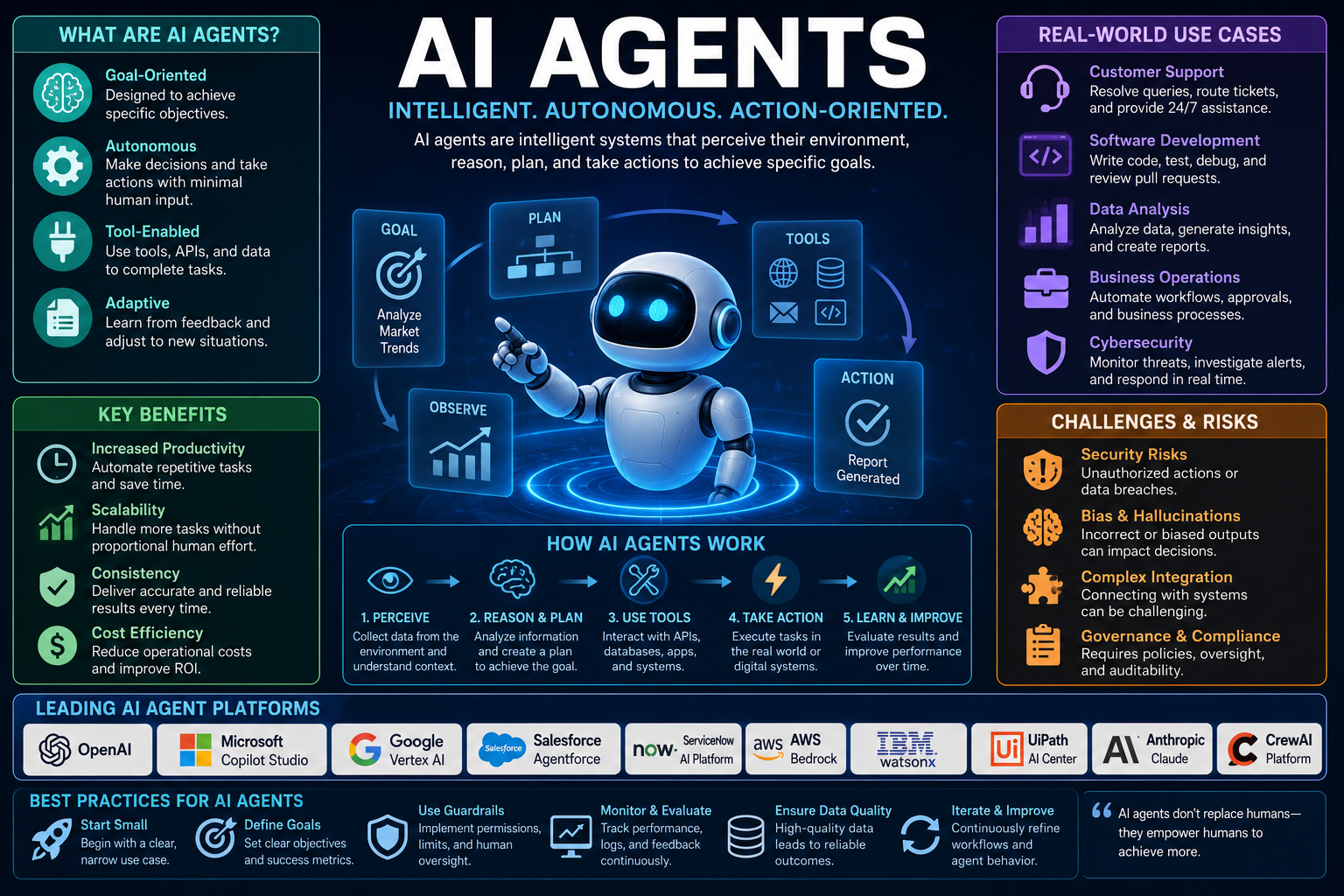
An AI agent is a software system capable of receiving a goal, interpreting its environment, deciding what steps may be necessary, and taking actions through available tools or systems.
Microsoft describes an AI agent as an intelligent software system that interacts with its environment, makes decisions, and takes actions to achieve defined business goals. Agentic systems can combine reasoning, planning, adaptability, integrations, and action rather than merely returning a static response.
The exact architecture differs between products, but most practical AI agents contain several common elements.
Goals and instructions
Every useful agent needs a defined objective. The objective might be answering customer questions, reviewing invoices, monitoring security alerts, organizing research, helping developers, or coordinating an internal workflow.
A vague objective can produce unreliable behavior. A strong objective establishes what the agent is trying to accomplish, what it should not do, what information it can access, and when it should ask a human.
Reasoning and planning
The agent interprets the request and determines a sequence of actions.
For example, a research agent might need to:
- Understand the research question.
- Identify relevant information sources.
- Gather information.
- Compare conflicting information.
- Organize findings.
- Produce a structured report.
- Identify areas requiring human verification.
The exact internal reasoning process varies by model and implementation, and organizations should not assume that an agent’s internal reasoning is automatically correct.
Tools and integrations
An agent becomes considerably more useful when it can interact with external tools.
These may include:
- Search systems
- Databases
- CRM platforms
- Email systems
- Calendars
- Enterprise applications
- APIs
- Code execution environments
- Document repositories
- Inventory systems
- Payment or billing systems
- Analytics platforms
- Customer support systems
Without tools, an AI system may be limited to information available within its context. With tools, it can potentially interact with the environment.
Context and memory
Agents often need context to perform useful work.
Context can include the current conversation, documents, business rules, customer information, previous actions, application state, or other approved information.
Memory is a separate design question. An agent should not automatically retain every piece of information forever. Organizations need clear rules about what information is stored, why it is stored, who can access it, and how long it should remain available.
Actions
The defining characteristic of an agentic system is its ability to take action.
An action could be as simple as retrieving information or as consequential as changing a record, sending a message, creating a support ticket, or initiating a workflow.
The more consequential the action, the more important permissions, approvals, audit logs, testing, and safeguards become.
How Do AI Agents Work?
AI agents typically operate through a loop involving perception, planning, tool use, observation, and adjustment.
Step one: Understand the goal
The agent receives an instruction or event.
For example, a company might configure an agent to investigate customer complaints that meet certain conditions.
The system first determines what the request means and what successful completion looks like.
Step two: Gather context
The agent retrieves relevant information from approved sources.
For a customer-service workflow, this could include:
- Customer history
- Previous support conversations
- Product information
- Order status
- Warranty rules
- Current policies
The agent should not automatically have unrestricted access to every business database.
Step three: Plan the work
The system determines which actions are likely to move it toward the goal.
A simple request might require only one action. A complex workflow could require multiple tool calls.
For example, an agent investigating an order problem could check the order record, inspect shipping information, review the applicable policy, determine the available options, and prepare a response.
Step four: Use tools
The agent calls approved tools or APIs.
This is where agentic systems differ significantly from basic text-generation systems. Instead of only describing what a user could do, the agent may actually perform permitted operations.
Step five: Observe the result
The agent receives the output of the tool.
If a database returns unexpected information or an API reports an error, the system may need to adjust its next action.
Step six: Continue or stop
The agent evaluates whether the goal has been completed.
If additional steps are necessary, it continues. If the task is complete, it returns a result. If it encounters uncertainty or a high-risk decision, a well-designed system can pause and request human intervention.
AI Agents vs Chatbots
AI agents and chatbots overlap, but they are not identical.
A traditional chatbot is usually designed around conversation. A user asks something, and the system generates an answer.
An AI agent can go further by using tools and executing multi-step tasks.
Traditional chatbot
A traditional chatbot may answer:
“Your order is currently in transit.”
An agent could potentially retrieve the order status, check shipping information, identify a delay, determine whether company policy permits an intervention, create a support case, and prepare a customer notification.
The important difference is not simply intelligence. It is agency and controlled action.
AI assistant
An AI assistant generally helps a person complete work.
The human may remain deeply involved in deciding what happens.
An agent can be more proactive and workflow-oriented, although the degree of autonomy depends on the implementation.
Traditional automation
Traditional automation normally follows predefined rules.
For example:
“If an invoice arrives, save it to this folder.”
An AI agent can potentially interpret less-structured information and determine which approved workflow should apply.
However, deterministic automation remains extremely valuable. If a process is predictable and rule-based, conventional automation can often be easier to test and control.
Agentic automation
Agentic automation combines flexible AI decision-making with software workflows and controlled actions.
This hybrid approach is increasingly important because fully autonomous behavior is not always the best engineering solution.
Why AI Agents Matter
AI agents matter because organizations have enormous amounts of repetitive digital work that requires coordination across systems.
Employees often spend time searching for information, moving data between applications, summarizing documents, checking records, preparing drafts, monitoring queues, and following established procedures.
An agent can potentially connect these activities.
The opportunity is not simply to reduce typing. The bigger opportunity is to reduce the friction between information and execution.
ServiceNow’s 2026 strategy, for example, focuses on allowing AI agents to interact with governed enterprise workflows and actions rather than merely retrieving records. Its Action Fabric approach connects agents to controlled business actions while emphasizing identity, permissions, auditability, and governance.
This illustrates an important shift: the value of AI agents increasingly depends on what they can safely do inside real systems.
Major Types of AI Agents
There is no single universal classification system for AI agents. Different researchers and vendors use different terminology. However, several practical categories are useful.
Reactive agents
Reactive agents respond to current inputs without maintaining extensive historical context.
They are useful for relatively straightforward tasks where the current state contains most of the information required.
Goal-based agents
Goal-based agents receive an objective and determine actions that can help achieve it.
For example, an agent might be asked to find suitable meeting times for a team based on defined constraints.
Planning agents
Planning agents break complex objectives into smaller tasks.
They can be useful for research, project coordination, software development, operations, and other multi-step activities.
Tool-using agents
Tool-using agents can interact with external systems.
This category is especially important in enterprise environments because the agent can potentially move from generating recommendations to performing authorized actions.
Multi-agent systems
A multi-agent system uses multiple specialized agents.
One agent might handle research, another analysis, another verification, and another communication.
This can create useful specialization, but it also introduces additional coordination and security complexity.
Autonomous agents
Autonomous agents are designed to operate with relatively little human intervention within defined boundaries.
Autonomy should not be treated as a binary concept. An agent can be highly autonomous for low-risk tasks while requiring approval for financial, legal, security, or customer-impacting actions.
AI Agent Architecture
A practical AI agent can be viewed as a stack rather than a single model.
Foundation model
The foundation model provides language understanding, reasoning, generation, and other capabilities.
The model is important, but it is only one component of the overall system.
Agent orchestration layer
The orchestration layer manages how the agent moves through tasks.
It may determine when to call tools, how to handle errors, when to retry, and when to request approval.
Tool layer
Tools allow the agent to interact with software systems.
Examples include search, databases, APIs, code execution, document retrieval, and business applications.
Data and context layer
The agent needs access to relevant information.
Good data architecture is therefore critical. A powerful model cannot compensate for inaccessible, outdated, inconsistent, or poorly governed enterprise information.
Identity and permissions
Agents should operate with defined identities and permissions.
An agent that can read financial records should not automatically have permission to modify them.
Monitoring and evaluation
Organizations need to know what agents are doing.
Monitoring can include:
- Tool calls
- Errors
- Decisions
- Completion rates
- Escalations
- Costs
- Response times
- Policy violations
- Human corrections
Human oversight
Human intervention is not necessarily a failure of agentic design.
For high-impact workflows, human approval can be a deliberate control.
Real-World Uses of AI Agents
AI agents can be applied across many industries.
Customer service agents
Customer-service agents can help answer questions, retrieve account information, classify requests, troubleshoot common issues, and route complex cases.
The strongest implementations do not simply produce better answers. They connect answers to the systems required to resolve the underlying problem.
Software development agents
Development agents can help developers understand codebases, create drafts, test code, investigate errors, document systems, and work through development tasks.
Human review remains important, particularly for production systems, security-sensitive code, and architectural changes.
Research agents
Research agents can collect information from approved sources, organize findings, compare evidence, and produce structured research outputs.
Their biggest limitation is that fluent writing does not guarantee factual accuracy. Verification remains essential.
Sales agents
Sales agents can assist with lead research, account preparation, customer follow-up, CRM updates, meeting preparation, and proposal drafting.
Organizations should be careful about allowing autonomous external communication because incorrect messages can damage customer relationships.
Marketing agents
Marketing agents can help with content research, campaign analysis, audience segmentation, creative drafts, reporting, and workflow coordination.
Human editorial oversight is particularly valuable for brand-sensitive content.
Finance and accounting agents
Agents can assist with invoice processing, reconciliation support, financial reporting workflows, document classification, and anomaly detection.
High-risk financial actions should generally require strong controls and appropriate human approval.
Human resources agents
HR agents can help employees locate policies, answer routine questions, guide onboarding processes, and coordinate administrative workflows.
Because HR systems contain sensitive information, access controls and privacy requirements are particularly important.
Cybersecurity agents
Security agents can assist with threat detection, investigation, alert triage, and response workflows.
Microsoft describes agentic cybersecurity as using autonomous agents to detect, investigate, and respond to threats with limited human intervention. It also emphasizes that autonomy creates additional security considerations.
IT operations agents
IT agents can monitor systems, investigate incidents, retrieve technical information, suggest remediation, and in controlled environments execute predefined operational actions.
This is one of the areas where agentic systems can potentially provide significant value because IT work already involves structured systems, logs, workflows, and APIs.
Travel and hospitality agents
Travel agents powered by AI can potentially help users compare options, build itineraries, organize reservations, monitor changes, and manage trip information.
However, autonomous booking should include safeguards for price, cancellation terms, traveler preferences, identity, and payment authorization.
AI Agents for Small Businesses
AI agents are not only for large enterprises.
A small business might use an agent to organize leads, answer common customer questions, summarize inquiries, prepare reports, monitor inventory information, or assist with administrative work.
The key is to begin with a narrow process.
A small company does not need an elaborate multi-agent architecture to benefit from agentic AI.
A better starting point may be one repetitive process with clear inputs, measurable outputs, limited risk, and accessible data.
AI Agents for Professionals
Professionals can use agents as digital workflow assistants.
For writers
An agent can research topics, organize source material, create outlines, identify missing sections, and prepare editorial checklists.
The writer should remain responsible for accuracy, originality, and final editorial decisions.
For developers
Agents can assist with code investigation, debugging, testing, documentation, and repetitive implementation tasks.
For researchers
Agents can help organize large information collections and identify patterns for further investigation.
For managers
Agents can summarize operational information, track project updates, identify missing information, and prepare decision-support materials.
For entrepreneurs
Entrepreneurs can use agents to automate parts of market research, customer support, administrative workflows, and reporting.
The biggest opportunity is often not replacing an employee but allowing a small team to operate with less administrative friction.
How to Build an AI Agent
Building an AI agent should begin with the workflow, not the model.
Define the problem
Start with one specific problem.
Instead of saying:
“Build an AI agent for our company.”
Define:
“Create an agent that reviews incoming support requests, retrieves relevant customer information, classifies the issue, drafts a response, and escalates cases involving refunds above a defined threshold.”
The second description is much easier to design and evaluate.
Map the workflow
Document:
- Inputs
- Required information
- Available tools
- Decisions
- Actions
- Exceptions
- Approval points
- Desired output
This exposes gaps before development begins.
Choose the right level of autonomy
Ask which actions the agent can perform without approval.
A useful approach is to divide actions into three groups.
Low risk: autonomous.
Moderate risk: autonomous with monitoring.
High risk: human approval required.
This framework can be adapted to the organization’s risk profile.
Connect only necessary tools
Do not give an agent access to every system simply because integrations are available.
Least-privilege access reduces potential damage if the agent behaves incorrectly or is manipulated.
Create clear instructions
Agent instructions should define:
- Objective
- Scope
- Available tools
- Restrictions
- Escalation rules
- Data-handling requirements
- Success criteria
Test difficult scenarios
Do not test only ideal inputs.
Test:
- Missing information
- Contradictory information
- Malicious instructions
- Tool failures
- API errors
- Unusual requests
- Ambiguous requests
- Permission failures
- Outdated information
Monitor production behavior
An agent that works well in testing may behave differently at scale.
Production monitoring should therefore be part of the design rather than an afterthought.
Best Practices for AI Agent Deployment
Start narrow
A narrowly defined agent is easier to test, secure, and measure.
Use deterministic controls where possible
Not every decision needs to be made by a language model.
For example, an organization can use deterministic rules to prevent an agent from exceeding a financial limit.
Salesforce’s 2026 discussion of agent trends highlights deterministic guardrails as an important part of making agents reliable in production.
Require approval for consequential actions
A human approval step can be appropriate when actions involve money, legal commitments, sensitive data, security changes, or major customer consequences.
Maintain audit trails
Organizations should be able to reconstruct important agent activity.
Useful records may include:
- Who initiated the task
- Which agent performed it
- Which tools were called
- What actions occurred
- What approvals were given
- What errors happened
- What final outcome was produced
Evaluate outcomes rather than impressive demonstrations
A successful demo is not proof of production readiness.
Measure real outcomes such as:
- Completion rate
- Error rate
- Escalation rate
- Human correction rate
- Time saved
- Cost per task
- Customer satisfaction
- Security incidents
- Policy violations
Common AI Agent Mistakes
Giving agents too much autonomy
More autonomy does not automatically mean more value.
A badly designed autonomous agent can turn a small mistake into a large operational problem.
Connecting too many tools
Every additional integration can introduce another failure mode.
Start with the smallest tool set needed to accomplish the task.
Ignoring data quality
If the underlying information is incorrect, incomplete, or outdated, an agent may produce incorrect results even when its reasoning appears sophisticated.
Treating generated text as verified truth
An agent can communicate confidently while being wrong.
Verification is especially important for legal, financial, medical, security, and other high-impact information.
Forgetting security
Agent security must account for more than the model itself.
The complete attack surface can include:
- Instructions
- Tools
- APIs
- Credentials
- Retrieved documents
- External content
- Plugins
- Memory
- Communication channels
Failing to plan for errors
Every agent needs a failure strategy.
What happens when a tool is unavailable? What happens when information conflicts? What happens when the agent cannot confidently complete the task?
The answer should not simply be “try again forever.”
AI Agent Security Risks
AI agents create a different security model because they can take actions.
Prompt injection
An attacker may attempt to manipulate an agent through instructions contained in external content.
For example, a malicious webpage or document could contain instructions designed to influence the agent.
Systems should treat untrusted content as data rather than automatically treating every instruction encountered during a workflow as authoritative.
Excessive permissions
If an agent has access to more systems than necessary, a compromised or misbehaving agent can cause greater damage.
Credential exposure
Agent tools may require credentials or authorization tokens.
These credentials must be protected and scoped appropriately.
Data leakage
Agents can potentially retrieve sensitive information and include it in outputs or send it through connected systems.
Data access policies therefore need to extend into agent workflows.
Unauthorized actions
An agent may interpret an ambiguous instruction too broadly.
Approval gates and action boundaries can reduce this risk.
Lack of auditability
If an organization cannot determine what an agent did, it becomes difficult to investigate failures.
Microsoft’s 2026 guidance on agentic AI security emphasizes that autonomous behavior changes the security model and requires dedicated governance and controls.
AI Agents and Privacy
Privacy becomes especially important when agents interact with personal or confidential information.
Organizations should establish clear policies around:
- Data collection
- Data retention
- Access permissions
- Third-party processing
- User consent where applicable
- Data deletion
- Auditability
- Cross-border data handling
A useful principle is simple: an agent should only access information necessary for its authorized task.
Pros of AI Agents
Higher productivity
Agents can reduce repetitive administrative work and help people complete multi-step workflows faster.
24/7 availability
Software agents can operate continuously, subject to infrastructure and policy constraints.
Scalability
One workflow can potentially serve many users or process many requests without requiring proportional manual effort.
Better workflow coordination
Agents can connect information and actions across multiple systems.
Reduced repetitive work
Employees can spend less time on routine information gathering and data movement.
Faster response times
Agents can potentially react to events immediately rather than waiting for a person to notice them.
Personalized assistance
Agents can adapt workflows based on authorized context and user requirements.
Cons of AI Agents
Errors can become actions
A conventional chatbot may give a wrong answer.
An agent with permissions may potentially turn a wrong interpretation into a real-world action.
Security complexity
Every integration increases the security surface.
Implementation cost
Building, integrating, evaluating, and monitoring reliable agents requires technical and operational investment.
Unpredictable behavior
Language-model-based systems can sometimes behave differently across inputs that appear similar.
Governance requirements
Organizations need policies, access controls, testing, monitoring, and accountability.
Over-automation
Some processes genuinely require human judgment.
Automation should not become an excuse to remove appropriate oversight.
AI Agents vs Traditional Automation
Traditional automation remains extremely useful.
If a process can be represented as:
“Every Monday at 9:00 AM, export this report and send it to these three addresses.”
A conventional scheduler may be ideal.
If the process is:
“Review incoming requests, determine which policy applies, collect information from several systems, decide which workflow is relevant, and escalate unusual cases.”
An agent may be more appropriate.
The future is therefore unlikely to be purely agentic.
Instead, the strongest architectures may combine:
Rules + workflows + AI models + APIs + human oversight.
Ten Leading AI Agent Brands and Platforms
The AI agent market changes quickly, and products differ considerably in purpose. The following comparison focuses on major technology brands and their current positioning rather than suggesting that one platform is universally best.
| Brand | Agent / Platform Focus | Best Suited For | Key Strength | Main Consideration |
|---|---|---|---|---|
| OpenAI | Agentic AI and developer tooling | Developers, businesses, AI applications | Strong general-purpose AI ecosystem | Requires careful application-level governance |
| Anthropic | Claude and agentic workflows | Enterprise, coding, knowledge work | Strong focus on capable AI assistants and enterprise use | Tool and workflow design still matters |
| Gemini and agentic AI ecosystem | Cloud, enterprise, developers | Broad integration with Google’s AI and cloud ecosystem | Platform selection can be complex | |
| Microsoft | Copilot Studio and agentic Microsoft ecosystem | Enterprise productivity | Deep integration with Microsoft business tools | Governance is essential at enterprise scale |
| Salesforce | Agentforce | CRM, sales, service | Strong business workflow integration | Best value often comes within Salesforce environments |
| ServiceNow | AI Agents and AI Platform | IT, HR, operations, enterprise workflows | Governed workflow execution | Primarily oriented toward enterprise operations |
| AWS | Bedrock agent infrastructure | Developers and cloud enterprises | Cloud infrastructure and model flexibility | Requires technical architecture and cloud expertise |
| IBM | watsonx Orchestrate and enterprise AI | Regulated enterprises | Enterprise data, governance, hybrid environments | Enterprise deployments can require substantial planning |
| UiPath | Agentic automation | Business process automation | Combination of AI and automation | Best suited to organizations already using automation |
| CrewAI | Multi-agent development | Developers and agent teams | Multi-agent orchestration approach | More technical and development-oriented |
These companies are pursuing different parts of the agent ecosystem. For example, Salesforce has expanded Agentforce across enterprise workflows and reported substantial growth in agent deployments in its 2026 Agentic Enterprise Index. ServiceNow is emphasizing governed execution across enterprise workflows, while AWS is combining cloud infrastructure with agent development and governance capabilities.
OpenAI, Anthropic, Google, Microsoft, AWS, and other technology organizations have also supported efforts toward more open and interoperable agent infrastructure. OpenAI announced the Agentic AI Foundation under the Linux Foundation in 2025, with the goal of supporting open-source agentic infrastructure and standards.
How to Choose an AI Agent Platform
There is no single best AI agent platform for every organization.
For individual users
Prioritize ease of use, privacy, reliability, integrations, and cost.
For developers
Look for:
- APIs
- Tool calling
- SDK support
- Observability
- Evaluation tools
- Model flexibility
- Authentication options
- Deployment controls
For enterprises
Consider:
- Identity management
- Permission controls
- Audit logs
- Data governance
- Integration depth
- Compliance requirements
- Human approval workflows
- Monitoring
- Vendor support
For highly regulated industries
Governance may be more important than raw model capability.
An agent that is slightly less capable but easier to control may be preferable to a more capable system that cannot meet organizational requirements.
AI Agents for Different Demographics and Problems
AI agents for students
Students can use agents to organize research, explain difficult concepts, generate study plans, create practice questions, and identify gaps in understanding.
The best use is as a learning partner rather than a replacement for thinking.
AI agents for teachers
Teachers can use agents to prepare lesson materials, organize resources, draft exercises, and assist with administrative tasks.
Human educators should remain responsible for educational judgment and student-sensitive decisions.
AI agents for entrepreneurs
Entrepreneurs can use agents for research, lead qualification, customer support, documentation, reporting, and repetitive administration.
AI agents for large companies
Large organizations can use agents across customer service, IT, finance, HR, security, sales, and operations.
The challenge is governance across many agents and systems.
AI agents for developers
Developers can use agents for coding assistance, testing, documentation, debugging, and repository analysis.
AI agents for customer support teams
Support teams can use agents to handle routine requests and provide human agents with relevant context.
AI agents for small teams
Small teams can benefit from agents that reduce repetitive work without requiring a large automation department.
AI agents for remote workers
Agents can help organize tasks, summarize information, prepare meetings, and coordinate digital workflows.
AI agents for researchers
Research agents can help gather, structure, compare, and summarize information while leaving source verification to the researcher.
AI agents for security professionals
Security agents can assist with alert investigation, threat analysis, incident workflows, and repetitive security operations, with appropriate controls and human oversight.
A Practical Framework for Evaluating an AI Agent
Before adopting an agent, ask five questions.
What is the goal?
If the goal cannot be clearly measured, the agent will be difficult to evaluate.
What information does it need?
Identify exactly which data sources are necessary.
What actions can it take?
List every action and classify its risk.
What happens when it is wrong?
Create an explicit failure and escalation process.
How will success be measured?
Define metrics before deployment.
A simple scorecard can include:
| Metric | Question |
|---|---|
| Accuracy | How often does the agent produce a correct result? |
| Completion | How often does it complete the assigned task? |
| Escalation | How often does it require human intervention? |
| Cost | What does each successful task cost? |
| Speed | How long does the workflow take? |
| Safety | Does it stay within defined permissions? |
| Quality | Does the final result meet business requirements? |
| User satisfaction | Do people trust and value the result? |
Common Challenges When Implementing AI Agents
Integration complexity
Connecting an agent to existing business systems can be harder than creating the conversational interface.
Many organizations operate older systems that were not designed for AI-driven interaction.
IBM and ServiceNow highlighted legacy applications and AI-ready data as major barriers to scaling enterprise AI in their 2026 collaboration.
Poor context
An agent may fail because it lacks the information required to make a good decision.
Unclear ownership
Someone must own the agent after deployment.
Ownership includes monitoring, updates, security, evaluation, and incident response.
Changing models
AI models improve rapidly, but model changes can affect agent behavior.
Organizations should evaluate important workflows after significant model or system changes.
Cost management
Agentic workflows may require multiple model calls and tool interactions.
A process that looks inexpensive in a demonstration can become costly at high volume.
The Economics of AI Agents
The financial value of an agent depends on the relationship between automation cost and the value of the work performed.
A useful equation is:
Net value = labor or opportunity savings + quality or revenue gains − AI and infrastructure costs − governance and maintenance costs.
This should be evaluated at the workflow level.
Suppose an agent reduces a repetitive process from 20 minutes to 5 minutes. That sounds valuable.
But if humans must spend another 10 minutes correcting the agent’s output, the actual saving is much smaller.
The correct question is therefore not:
“How much work did the AI perform?”
The better question is:
“How much useful work was completed with acceptable quality and risk?”
The Role of Humans in Agentic AI
The idea that AI agents will eliminate all human work is too simplistic.
Many jobs contain a mixture of:
- Routine work
- Judgment
- Communication
- Creativity
- Relationship management
- Accountability
- Exception handling
Agents are generally better suited to some of these activities than others.
A practical future may involve humans becoming supervisors, reviewers, decision-makers, strategists, and owners of AI-assisted workflows.
The human role may shift rather than simply disappear.
Multi-Agent Systems
A multi-agent system divides a complex problem among specialized agents.
For example:
Research agent
Collects and organizes information.
Analysis agent
Examines the collected information.
Verification agent
Checks important claims or identifies uncertainty.
Writing agent
Creates a structured output.
Coordinator agent
Manages the overall workflow.
This structure can be powerful, but it is not automatically better.
Each additional agent introduces more communication, coordination, cost, and potential failure.
A single well-designed agent may outperform a complicated multi-agent system for a simple task.
AI Agents and Open Standards
Interoperability is likely to become increasingly important.
Organizations do not want every AI system to operate as an isolated island.
Open protocols can make it easier for agents to interact with tools and enterprise systems.
The Agentic AI Foundation is one example of the industry’s interest in open agentic infrastructure. OpenAI announced the foundation in 2025 with Anthropic, Block, and support from organizations including Google, Microsoft, AWS, Bloomberg, and Cloudflare.
Model Context Protocol and similar approaches are also becoming increasingly relevant to agent-tool connectivity.
The broader direction is clear: agents need standardized ways to discover context, use tools, authenticate, and operate within controlled environments.
Future of AI Agents
AI agents are likely to become more capable, more integrated, and more specialized.
Agents will move deeper into software
Instead of opening an application and manually navigating every screen, users may increasingly ask AI systems to perform specific tasks across applications.
Salesforce’s 2026 Headless 360 strategy explicitly describes a future in which enterprise capabilities can be consumed by authorized AI agents rather than requiring users to interact with every application directly.
Agents will become more specialized
Rather than one giant agent doing everything, organizations may use specialized agents for finance, customer service, security, development, research, and operations.
Agent governance will become a major discipline
As more agents gain access to real systems, organizations will need tools for:
- Agent identity
- Permission management
- Monitoring
- Auditing
- Evaluation
- Policy enforcement
- Incident response
Human-agent teams will become normal
The most practical future may involve people and agents working together.
An employee may assign a goal, an agent may execute routine steps, and the human may review exceptions and make high-impact decisions.
Agent creation will become easier
As development platforms mature, more non-developers will be able to build specialized agents.
IBM’s 2026 technology outlook similarly describes a shift toward AI-orchestrated teams and broader access to agent creation.
Enterprise architecture will change
Businesses may increasingly design systems around reusable capabilities that can be accessed by humans, applications, and agents.
This could influence how companies build APIs, databases, permissions, workflows, and user interfaces.
What AI Agents May Look Like by the End of the Decade
It is risky to make precise predictions about AI because the technology changes rapidly.
However, several broad developments are plausible.
Agents may become better at long-running tasks, tool selection, error recovery, context management, and collaboration.
They may also become more deeply integrated into enterprise software.
At the same time, governance may become just as important as intelligence.
The competitive advantage may not belong to the organization with the most impressive model. It may belong to the organization that has the best combination of models, data, workflows, tools, permissions, evaluation, and human expertise.
Are AI Agents Safe?
AI agents can be made safer, but no complex software system should be assumed to be perfectly safe.
Safety depends on design.
A well-designed agent should have:
- Limited permissions
- Clear instructions
- Tool restrictions
- Monitoring
- Human approval for high-risk actions
- Strong authentication
- Data governance
- Testing
- Error handling
- Auditability
The level of protection should increase with the potential impact of mistakes.
An agent that recommends a restaurant does not need the same controls as an agent that can approve a large financial transaction.
Should Businesses Use AI Agents?
For many businesses, experimenting with AI agents can make sense, but experimentation should be structured.
A good candidate process has several characteristics:
- Repetitive
- Digital
- Well-defined
- Measurable
- Relatively low risk
- Supported by accessible data
- Capable of human escalation
Businesses should avoid starting with the most sensitive process simply because it appears exciting.
A small successful deployment can provide lessons for more complex workflows.
How to Prepare for an Agentic Future
Organizations should start preparing even if they are not ready for full agent deployment.
Improve data quality
Clean, structured, accessible data will become increasingly valuable.
Build reliable APIs
Agents need dependable ways to interact with systems.
Establish identity and permissions
Every agent should have appropriate authorization.
Document workflows
If employees cannot clearly explain a process, automating it may be premature.
Develop AI governance
Create rules for data, access, monitoring, approvals, and accountability.
Train employees
Workers should understand what agents can do, where they can fail, and how to review their outputs.
Measure outcomes
Treat agents as operational systems, not novelty demonstrations.
FAQs
What is an AI agent in simple terms?
An AI agent is software that can receive a goal, understand relevant information, decide what steps to take, use connected tools, and perform actions within its permissions. Unlike a basic chatbot, an agent can potentially complete multi-step workflows rather than only generate conversational responses.
What is the difference between AI and an AI agent?
AI is a broad field covering technologies that perform tasks associated with intelligence. An AI agent is a specific type of AI-powered system designed to pursue goals and take actions within an environment.
Are AI agents the same as chatbots?
No. A chatbot generally focuses on conversation and answering questions. An AI agent can use tools, interact with software systems, make workflow decisions, and execute authorized actions.
Can AI agents work without humans?
Some agents can operate with limited human intervention, but the appropriate level of autonomy depends on the task. High-impact actions should generally have appropriate approval and oversight.
Can AI agents access company databases?
They can if the organization provides the required integration and permissions. However, agents should receive only the access necessary for their tasks.
Are AI agents expensive?
Costs vary significantly. A simple agent may be relatively inexpensive, while enterprise deployments can involve model usage, infrastructure, integrations, security, monitoring, development, and maintenance costs.
Can AI agents replace employees?
AI agents can automate some tasks previously performed by employees, but jobs usually contain many different activities. In many cases, agents are more useful as tools that augment workers rather than as complete replacements for human roles.
What industries use AI agents?
AI agents can be used in customer service, software development, cybersecurity, finance, healthcare administration, sales, marketing, logistics, education, human resources, IT operations, research, and many other fields.
What are the biggest risks of AI agents?
Major risks include incorrect actions, excessive permissions, prompt injection, data leakage, privacy problems, unreliable outputs, security vulnerabilities, poor monitoring, and insufficient human oversight.
What is agentic AI?
Agentic AI refers to AI systems that have a degree of agency and can plan, reason, and act toward goals. The term is commonly used for systems that go beyond simple question-and-answer interactions.
Are AI agents the future of software?
AI agents are likely to become an important part of software, particularly for workflow automation and natural-language interaction. However, conventional applications, rules, databases, and deterministic automation will remain important because reliable systems often require a combination of technologies.
What is the best AI agent platform?
There is no universally best platform. Developers may prioritize APIs and flexibility, while enterprises may prioritize governance, integrations, security, workflow capabilities, and support. The best choice depends on the problem being solved.
Conclusion
AI agents are changing the conversation around artificial intelligence from “What can AI generate?” to “What useful work can AI safely complete?” That distinction is significant. A system that can research, plan, retrieve information, interact with software, execute approved actions, evaluate results, and escalate uncertainty can become part of a real workflow rather than remaining a standalone conversational tool. However, greater autonomy creates greater responsibility. The same capabilities that make agents useful can make their mistakes more consequential. An agent with access to business systems must therefore be treated as a software system with permissions, security requirements, monitoring needs, and operational accountability.