Istanbul Travel Guide: 25 Incredible Things to Do, Best Areas, Food, Costs & Travel Tips
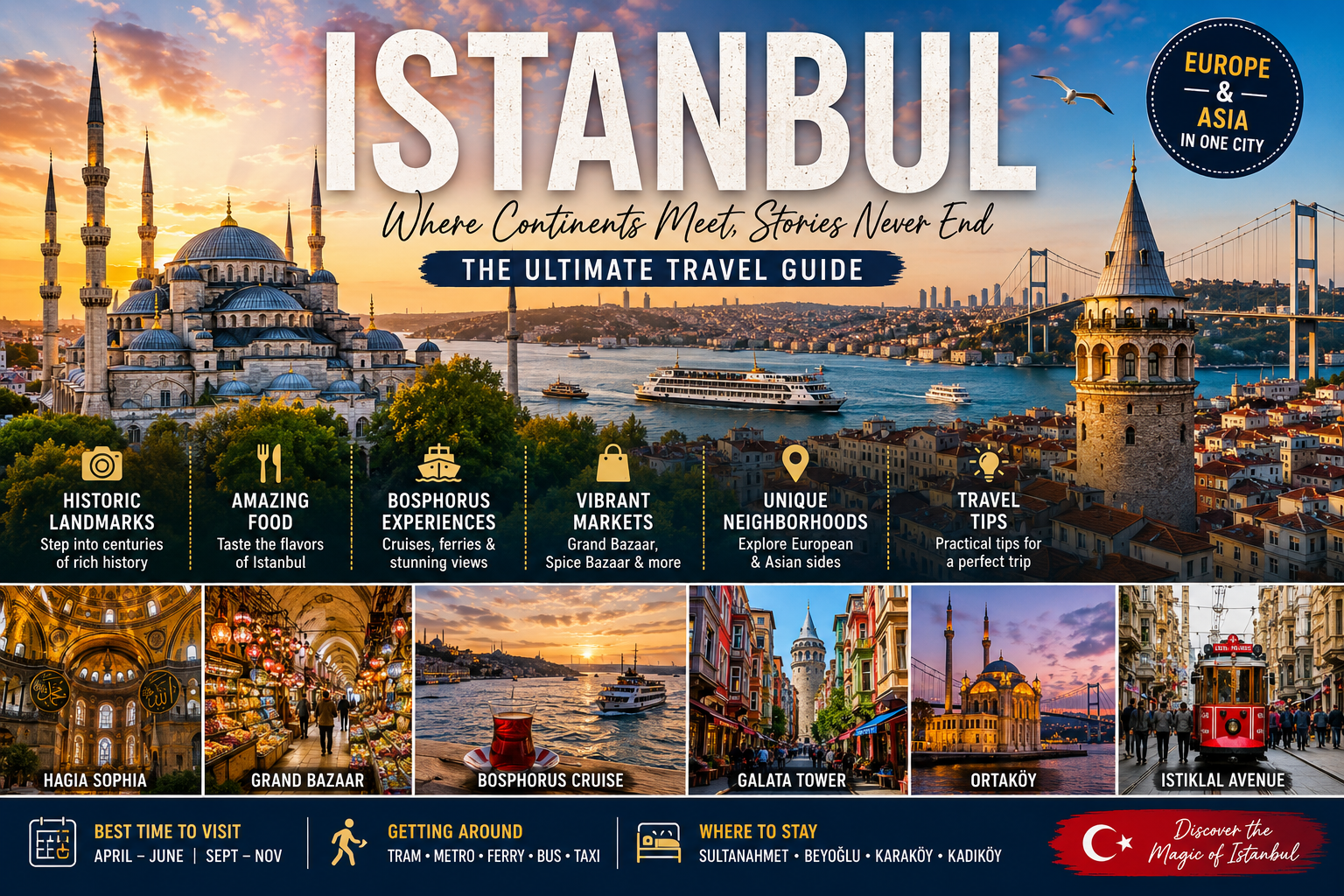
Istanbul is one of the world’s most fascinating city destinations, combining Byzantine and Ottoman history, Bosphorus views, extraordinary food, vibrant markets, modern neighborhoods, and a unique location between Europe and Asia. This Istanbul travel guide explains where to go, what to see, where to stay, what to eat, how to get around, how long to stay, and how to plan a memorable trip Overseas Travel Safety
Why Istanbul Is Such a Unique Destination
Istanbul’s greatest attraction is not a single monument.
It is the relationship between everything.
The city sits around the Bosphorus, the strait separating its European and Asian sides. Official Turkish tourism information highlights the Bosphorus as one of Istanbul’s defining experiences, with ferries, historic palaces, waterfront mansions, bridges, mosques, and neighborhoods lining the waterway.
That geography changes the way you experience the city.
You can:
- Start the day in historic Sultanahmet
- Cross the Golden Horn
- Walk around Galata
- Explore modern Beyoğlu
- Take a ferry toward the Asian side
- Have dinner in Kadıköy
- Return across the Bosphorus after dark
The city constantly shifts character.
A Brief History of Istanbul
Istanbul has existed under several names and political identities, including Byzantium and Constantinople.
Its strategic position between Europe and Asia made it extraordinarily important for trade, military power, religion, culture, and politics.
The city became the capital of the Eastern Roman Empire and later the Ottoman Empire.
This layered history is visible everywhere.
You do not necessarily need to visit a museum to encounter history.
You can see it in:
- Churches
- Mosques
- Palaces
- Fortifications
- Underground structures
- Bazaars
- Cemeteries
- Waterfront mansions
- Historic streets
- Ancient columns
- Ottoman fountains
This is why Istanbul can feel like an open-air history book.
Istanbul’s European and Asian Sides
One of the first concepts visitors should understand is that Istanbul exists on both sides of the Bosphorus.
European Istanbul
The European side contains many of the city’s most famous historic attractions.
Important areas include:
- Sultanahmet
- Eminönü
- Karaköy
- Galata
- Beyoğlu
- Beşiktaş
- Ortaköy
- Şişli
Asian Istanbul
The Asian side offers a somewhat different experience.
Important areas include:
- Kadıköy
- Moda
- Üsküdar
- Kuzguncuk
- Çamlıca
For first-time visitors, staying on the European side can make historic sightseeing convenient, while spending at least part of a day on the Asian side adds another dimension to the trip.
Best Time to Visit Istanbul
There is no single perfect month for everyone.
The ideal time depends on what you value most.
Spring in Istanbul
Spring can be an excellent season for sightseeing.
Potential advantages include:
- Pleasant walking conditions
- Outdoor cafés
- Gardens and parks
- Longer daylight
- Good conditions for exploring neighborhoods
Spring can also bring variable weather, so flexible clothing is useful.
Summer in Istanbul
Summer is popular with international visitors.
Advantages include:
- Long days
- Outdoor dining
- Bosphorus cruises
- Waterfront activities
- Lively neighborhoods
Potential disadvantages include:
- More visitors
- Higher accommodation demand
- Hot periods
- Crowded major attractions
Autumn in Istanbul
Autumn can be particularly attractive for travelers who enjoy:
- Walking
- Photography
- Historic architecture
- Food
- Cafés
- Neighborhood exploration
Winter in Istanbul
Winter offers a different atmosphere.
The city can become quieter in some tourist areas, although major attractions remain popular.
Rain, cold weather, and occasional snow can affect plans.
The advantage is that Istanbul’s museums, cafés, historic buildings, restaurants, and markets provide plenty of indoor alternatives.
How Many Days Do You Need in Istanbul?
Two Days
Two days can cover the major highlights, but the schedule will be busy.
Focus on:
- Hagia Sophia
- Blue Mosque
- Topkapı Palace
- Grand Bazaar
- Bosphorus experience
Three Days
Three days provide a much better introduction.
You can combine:
- Historic Peninsula
- Galata and Beyoğlu
- Bosphorus
- Local food
- Neighborhood exploration
Four to Five Days
Four or five days allow you to slow down.
You can include:
- Asian Istanbul
- Additional museums
- Dolmabahçe Palace
- More markets
- Food experiences
- Neighborhood walks
- Bosphorus exploration
- Day-trip possibilities
Seven Days
A week allows Istanbul to become less of a checklist and more of an experience.
You can revisit favorite neighborhoods, eat more slowly, explore smaller attractions, and spend additional time on both sides of the Bosphorus.
Top Things to Do in Istanbul
1. Visit Hagia Sophia
Hagia Sophia, also known as Ayasofya, is one of Istanbul’s most significant landmarks.
Its history stretches across different eras and religious identities.
The building was commissioned by Eastern Roman Emperor Justinian and completed in the sixth century. It later became a mosque under Ottoman rule, served as a museum during the twentieth century, and returned to use as a mosque in 2020.
Its importance is not simply architectural.
Hagia Sophia represents centuries of changing political, religious, and cultural history.
What to Look For
Pay attention to:
- The enormous dome
- Interior proportions
- Decorative details
- Calligraphy
- Historic mosaics
- Architectural layering
Because it is an active place of worship, visitors should follow current visitor rules and respect prayer areas.
2. Explore the Blue Mosque
The Sultan Ahmed Mosque is commonly known internationally as the Blue Mosque.
It is famous for its:
- Six minarets
- Large domes
- Iznik-style tilework
- Spacious courtyard
- Ottoman architecture
Go Türkiye describes it as one of Istanbul’s major attractions and emphasizes that it remains an active place of worship.
Visiting Etiquette
Visitors should:
- Dress respectfully
- Follow entrance instructions
- Respect worshippers
- Avoid disruptive photography
- Follow temporary closures during prayer times
This is not simply a tourist monument.
It is a functioning religious space.
3. Explore Topkapı Palace
Topkapı Palace provides a window into Ottoman imperial life.
The palace complex can help visitors understand:
- Ottoman administration
- Court life
- Imperial architecture
- Ceremonial traditions
- Royal collections
- The relationship between political power and religion
Give yourself enough time.
Trying to rush through a major palace complex can turn an extraordinary experience into a checklist.
4. Visit the Grand Bazaar
The Grand Bazaar is one of Istanbul’s most recognizable commercial landmarks.
The official tourism description notes that the historic covered market dates back to the fifteenth century and has developed into a vast network of covered streets and shops.
Visitors may find:
- Carpets
- Jewelry
- Ceramics
- Textiles
- Lamps
- Leather products
- Souvenirs
- Antiques
- Decorative items
How to Shop in the Grand Bazaar
Do not rush into a purchase.
Instead:
- Explore first.
- Compare products.
- Ask questions.
- Understand the price.
- Decide whether you genuinely want the item.
- Negotiate respectfully where appropriate.
The experience itself is part of the attraction.
5. Visit the Spice Bazaar
The Spice Bazaar, or Mısır Çarşısı, is particularly appealing to food lovers.
The market dates to the seventeenth century and is known for spices, tea, dried fruit, sweets, nuts, and other food products.
It is smaller than the Grand Bazaar, making it easier to explore during a shorter visit.
What to Try
Depending on your preferences, look for:
- Turkish delight
- Turkish coffee
- Tea
- Dried fruit
- Nuts
- Spices
- Cheese
- Olives
- Local sweets
6. See the Galata Tower
Galata Tower is one of Istanbul’s most recognizable skyline landmarks.
The tower’s history goes back to the medieval period, with the present historic structure associated with Genoese settlement in the area. It is particularly famous for panoramic city views.
The surrounding neighborhood is equally interesting.
After visiting the tower, explore:
- Galata streets
- Independent shops
- Cafés
- Bakeries
- Design stores
- Historic buildings
7. Take a Bosphorus Ferry
A Bosphorus journey is one of the experiences that most clearly demonstrates why Istanbul is different from other cities.
You are not simply taking a boat ride.
You are crossing between two continents.
The Bosphorus connects the Black Sea and the Sea of Marmara and divides Istanbul’s European and Asian sides.
Official tourism information highlights waterfront attractions including:
- Dolmabahçe Palace
- Beylerbeyi Palace
- Rumeli Fortress
- Ortaköy
- Maiden’s Tower
- Historic waterfront mansions
Why a Ferry Can Be Better Than a Tour
A local ferry can provide a more everyday view of Istanbul.
You see:
- Commuters
- Families
- Students
- Seagulls
- Waterfront neighborhoods
- Bridges
- Ships
- Palaces
It can feel less staged than a purely tourist-oriented cruise.
8. Explore Eminönü
Eminönü is one of the city’s most energetic historic areas.
It connects markets, food, ferries, historic architecture, and commerce.
You can combine:
- Spice Bazaar
- Galata Bridge
- Ferry terminals
- Street food
- Waterfront walks
It is an excellent place to experience Istanbul through movement and everyday activity.
9. Walk Across Galata Bridge
Galata Bridge is more than a transportation connection.
It is part of Istanbul’s visual identity.
Watch:
- Fishermen
- Ferries
- Boats
- Seagulls
- Street vendors
- The historic skyline
The area becomes particularly atmospheric around sunset.
10. Explore Karaköy
Karaköy offers a mixture of historic architecture and modern urban culture.
You will find:
- Cafés
- Restaurants
- Galleries
- Design shops
- Street art
- Waterfront views
It is a good area for travelers who want something beyond the classic historic itinerary.
11. Spend Time in Beyoğlu
Beyoğlu provides a different side of Istanbul.
The area is associated with:
- Shopping
- Restaurants
- Cafés
- Entertainment
- Historic buildings
- Contemporary culture
Istiklal Avenue is particularly well known, but do not limit yourself to the main street.
Some of the most interesting experiences happen on the side streets.
12. Visit Dolmabahçe Palace
Dolmabahçe Palace represents a later period of Ottoman architecture and reflects changing imperial tastes.
Its waterfront location adds another attraction.
Instead of visiting it as an isolated building, combine the palace with a Bosphorus-focused day.
13. Explore Ortaköy
Ortaköy is famous for its waterfront atmosphere and mosque.
It is particularly attractive for:
- Photography
- Bosphorus views
- Cafés
- Evening walks
The neighborhood can become crowded, so timing matters.
14. Visit the Asian Side
Crossing to Asian Istanbul gives visitors a different perspective.
Kadıköy
Kadıköy is known for:
- Food
- Markets
- Cafés
- Restaurants
- Local energy
- Street culture
Moda
Moda is ideal for:
- Walking
- Waterfront views
- Cafés
- Relaxed afternoons
Üsküdar
Üsküdar offers waterfront views toward the European side and provides access to a different cultural atmosphere.
15. Explore the Istanbul Archaeological Museums
The Istanbul Archaeological Museums are especially valuable for history enthusiasts.
The museum complex includes three main sections and holds collections covering numerous cultures and periods. The official museum information describes nearly one million artifacts across its collections.
This is one of the places where Istanbul’s importance becomes easier to understand.
The city was not merely the center of one empire.
It was connected to civilizations across a huge geographic area.
Istanbul Neighborhood Guide
Choosing where to stay can significantly affect your trip.
Sultanahmet
Best for:
- First-time visitors
- Historic attractions
- Short stays
- Sightseeing
Advantages:
- Close to major monuments
- Easy access to historic attractions
- Strong tourism infrastructure
Potential disadvantage:
- More tourist-oriented atmosphere
Beyoğlu
Best for:
- Nightlife
- Restaurants
- Shopping
- Younger travelers
- Contemporary culture
Karaköy
Best for:
- Couples
- Food lovers
- Design
- Cafés
- Waterfront access
Beşiktaş
Best for:
- Local atmosphere
- Restaurants
- Bosphorus access
- Longer stays
Kadıköy
Best for:
- Food lovers
- Experienced travelers
- Local atmosphere
- Longer stays
- Asian Istanbul
Ortaköy
Best for:
- Bosphorus views
- Couples
- Photography
- Waterfront experiences
Where Should First-Time Visitors Stay?
For a first Istanbul trip, consider the type of itinerary you want.
If history is your priority, Sultanahmet is highly convenient.
If you want restaurants, nightlife, and modern urban energy, Beyoğlu or nearby areas may be more suitable.
If food and neighborhood life are more important, Kadıköy can be an excellent choice.
If you want a mixture of historic and contemporary experiences, Karaköy is worth considering.
There is no universally best neighborhood.
There is only the neighborhood that best fits your trip.
Istanbul Food Guide
Istanbul deserves to be explored through food.
Do not treat meals as interruptions between attractions.
Make them part of the itinerary.
Turkish Breakfast
A traditional Turkish breakfast can be substantial.
You may encounter:
- Cheese
- Olives
- Eggs
- Tomatoes
- Cucumbers
- Bread
- Jams
- Honey
- Kaymak
- Tea
Simit
Simit is a ring-shaped sesame-covered bread commonly found throughout Turkey.
It is inexpensive, portable, and ideal for travelers who want a quick snack.
Döner
Döner is one of Turkey’s best-known foods.
Quality varies greatly, so do not assume every version is identical.
Balık Ekmek
Fish sandwiches are associated with the waterfront food culture around areas such as Eminönü.
Lahmacun
A thin flatbread topped with seasoned meat and vegetables is another popular choice.
Pide
Pide resembles a boat-shaped flatbread and comes with different toppings.
Meze
Meze can turn dinner into a long social meal rather than a quick restaurant stop.
Turkish Coffee
Turkish coffee is not simply another caffeinated drink.
It is part of a broader cultural tradition involving preparation, hospitality, conversation, and social rituals.
Turkish Tea
Tea is deeply integrated into everyday social life.
A simple cup of çay can become one of the smallest but most memorable parts of your trip.
Istanbul Food Strategy for Travelers
Instead of searching for one “best restaurant,” create categories.
Try:
- One traditional breakfast
- One market meal
- One street-food experience
- One traditional restaurant
- One seafood meal
- One dessert stop
- One café experience
This gives you a much broader understanding of the city.
What Desserts Should You Try?
Consider:
- Baklava
- Lokum
- Künefe
- Turkish ice cream
- Rice pudding
- Seasonal pastries
The Spice Bazaar is particularly useful for discovering Turkish sweets and ingredients.
Istanbul Transportation Guide
Transportation is one of the most important things to understand before visiting.
Istanbul has a large public transportation system incorporating metro, tram, funicular, ferry, and other services.
Metro Istanbul says its urban rail network spans more than 400 kilometers and includes 18 lines operated by Metro Istanbul, with more than three million passengers served daily.
That scale tells you something important:
You do not need to rely on taxis for every journey.
Istanbul Metro
The metro can be particularly useful for longer journeys.
Before leaving, check current:
- Routes
- Operating status
- Service changes
- Transfer points
Metro Istanbul provides current journey planning and service information on its official platform.
Istanbul Tram
Trams are especially useful around several tourist-heavy parts of the city.
They can connect areas that are difficult or time-consuming to navigate by car.
Ferries
Ferries are one of Istanbul’s most enjoyable transportation options.
They combine:
- Transportation
- Sightseeing
- Fresh air
- Bosphorus views
- Local life
Taxis
Taxis can be useful, particularly when carrying luggage or traveling at inconvenient times.
However, travelers should understand the fare system and use reputable methods for arranging rides.
Traffic can also make a short-looking journey take much longer than expected.
Airport Transportation
Istanbul’s airports connect the city with international and domestic destinations.
When planning airport transportation, consider:
- Flight time
- Traffic
- Terminal requirements
- Public transport availability
- Luggage
- Hotel location
Do not assume that a journey that looks short on a map will always be quick.
Istanbul Travel Cards and Public Transport
Travelers should research the current public transport payment system before arrival.
Transportation rules and fares can change, so verify current information close to your trip rather than relying on an old travel blog.
MuseumPass Istanbul
For travelers planning to visit several participating museums, the official MuseumPass Istanbul can be worth considering.
The Ministry of Culture and Tourism currently lists the MuseumPass Istanbul as valid for five days from the first museum visit, covering 13 museums, with a listed price of €105. The official page also notes that individual museums should be checked for current operating status and that the pass is not valid for night-museum entry.
Whether it saves money depends entirely on your itinerary.
When a Museum Pass Makes Sense
It may make sense if you plan to visit several included museums.
It may not be worthwhile if your trip focuses mainly on:
- Neighborhoods
- Markets
- Mosques
- Ferries
- Food
- Free public spaces
Always calculate the actual attractions you plan to visit.
Istanbul Travel Budget
Istanbul can accommodate different travel styles.
Rather than giving one misleading daily figure, divide your budget into categories.
Budget Traveler
Prioritize:
- Affordable accommodation
- Public transport
- Local restaurants
- Free attractions
- Markets
- Neighborhood walks
Mid-Range Traveler
Add:
- Comfortable hotels
- Restaurant meals
- Paid museums
- Occasional taxis
- Guided experiences
Luxury Traveler
Consider:
- Premium hotels
- Private transfers
- Fine dining
- Private Bosphorus experiences
- Luxury shopping
- Personalized tours
Hidden Travel Costs
Remember to budget for:
- Airport transportation
- Attraction tickets
- Service charges
- Shopping
- SIM/eSIM or connectivity
- Tours
- Unexpected transportation
- Travel insurance
- Currency exchange differences
Is Istanbul Expensive?
Istanbul’s cost depends heavily on your choices.
You can spend relatively little on:
- Street food
- Public transportation
- Neighborhood walks
- Markets
- Public spaces
You can also spend considerably more on:
- Luxury hotels
- High-end restaurants
- Private tours
- Premium shopping
- Exclusive experiences
This flexibility makes Istanbul suitable for a broad range of travelers.
Istanbul for Families
Istanbul can be exciting for families, but planning matters.
Family-Friendly Ideas
Consider:
- Short sightseeing blocks
- Ferry rides
- Parks
- Interactive museums
- Markets
- Ice cream stops
- Waterfront walks
- Spacious restaurants
Avoid scheduling multiple large historical sites without breaks.
Children may remember feeding seagulls from a ferry more vividly than another museum.
Istanbul for Couples
Couples can build an itinerary around atmosphere.
Consider:
- Bosphorus sunset
- Rooftop views
- Waterfront dinner
- Historic streets
- Turkish breakfast
- Café hopping
- Evening walks
- Asian-side exploration
A romantic Istanbul itinerary does not need to be expensive.
Istanbul for Solo Travelers
Solo travel works well when you combine structure and flexibility.
Plan a few major activities but leave time for:
- Cafés
- Markets
- Walking
- Photography
- Ferry rides
- Local food
Choose accommodation in an area that matches your comfort level and transport needs.
Istanbul for History Lovers
History enthusiasts should consider spending more time around:
- Sultanahmet
- Topkapı
- Hagia Sophia
- Blue Mosque
- Archaeological Museums
- Grand Bazaar
- Historic walls
- Byzantine remains
- Ottoman architecture
The city becomes more rewarding when you understand the historical relationships between these places.
Istanbul for Food Lovers
Food-focused travelers should consider exploring:
- Eminönü
- Kadıköy
- Karaköy
- Beyoğlu
- Local markets
- Traditional breakfast spots
Do not spend the entire trip eating near major attractions.
Walk away from the most tourist-heavy streets and explore.
Istanbul for Photographers
Istanbul offers almost endless visual subjects.
Sunrise
Early morning can provide:
- Softer light
- Fewer people
- Quiet streets
- Dramatic silhouettes
Golden Hour
Sunset can transform:
- Bosphorus
- Mosques
- Bridges
- Rooftops
- Waterfront neighborhoods
Night Photography
Look for:
- Illuminated mosques
- Bridges
- Ferries
- City skylines
- Busy streets
Always respect photography restrictions in religious and culturally sensitive locations.
Istanbul for Shopping
Shopping can be divided into several categories.
Traditional Shopping
Visit historic bazaars for:
- Ceramics
- Textiles
- Jewelry
- Spices
- Sweets
- Decorative goods
Modern Shopping
Modern Istanbul offers:
- International brands
- Turkish designers
- Shopping centers
- Independent boutiques
- Concept stores
Shopping Tip
Do not purchase something simply because a seller tells you it is rare.
Research valuable items before making expensive purchases.
Common Istanbul Travel Mistakes
Mistake 1: Trying to See the Entire City in Two Days
Istanbul is too large for that.
Better Approach
Choose two or three geographic zones per day.
Mistake 2: Ignoring Traffic
Road traffic can significantly affect travel time.
Better Approach
Use rail or ferry options when they make sense.
Mistake 3: Spending Every Day in Sultanahmet
Historic Istanbul is extraordinary, but the city is much larger.
Better Approach
Visit:
- Kadıköy
- Moda
- Karaköy
- Beşiktaş
- Ortaköy
- Üsküdar
Mistake 4: Treating Religious Buildings Like Museums
Mosques are active places of worship.
Better Approach
Follow visitor rules and dress respectfully.
Mistake 5: Buying Immediately in the Bazaar
Better Approach
Compare first.
Mistake 6: Planning Without Rest
Walking around Istanbul can be physically demanding.
Better Approach
Build breaks into your itinerary.
Mistake 7: Using Outdated Prices
Travel prices change.
Better Approach
Verify costs before departure.
Mistake 8: Ignoring Weather
Istanbul weather can influence ferry rides, photography, walking, and outdoor plans.
Better Approach
Have indoor alternatives.
Mistake 9: Assuming Every Attraction Is Open Every Day
Museums and historic sites can have closures or schedule changes.
Better Approach
Check official information before visiting.
A Practical Three-Day Istanbul Itinerary
Day One: Historic Istanbul
Start early.
Visit:
- Hagia Sophia
- Blue Mosque
- Sultanahmet Square
- Topkapı Palace
- Istanbul Archaeological Museums if time allows
Finish with dinner in the historic center or nearby.
Why This Works
These locations are geographically concentrated.
You spend more time exploring and less time commuting.
Day Two: Markets, Galata and Beyoğlu
Start around Eminönü.
Visit:
- Spice Bazaar
- Galata Bridge
- Karaköy
- Galata Tower
- Beyoğlu
- Istiklal Avenue
End the day with dinner and an evening walk.
Day Three: Bosphorus and Asian Istanbul
Start with a ferry experience.
Then explore:
- Üsküdar or Kadıköy
- Moda
- Local markets
- Waterfront areas
Return to the European side later in the day.
This provides a completely different perspective on Istanbul.
A Five-Day Istanbul Itinerary
Day One
Historic Peninsula.
Day Two
Grand Bazaar, Spice Bazaar, Eminönü and Galata.
Day Three
Bosphorus and Dolmabahçe.
Day Four
Kadıköy, Moda and Asian Istanbul.
Day Five
Choose based on your interests:
- Museums
- Food
- Shopping
- Photography
- Additional neighborhoods
- Relaxation
This structure leaves room for unexpected discoveries.
Pros and Cons of Visiting Istanbul
| Pros | Cons |
|---|---|
| Extraordinary history | Traffic can be challenging |
| Unique European-Asian geography | Major attractions can be crowded |
| Excellent food culture | Some tourist areas require careful shopping decisions |
| Strong public transportation | City can be tiring to navigate |
| Diverse neighborhoods | Large distances between some areas |
| Beautiful Bosphorus | Weather can change plans |
| Wide range of accommodation | Prices vary significantly |
| Suitable for many travel styles | Busy areas can feel overwhelming |
| Rich architecture | Major attractions require planning |
| Excellent photography | Walking involves hills and uneven streets |
The Biggest Advantage of Istanbul
Its diversity.
You can change the entire character of your trip simply by changing neighborhoods.
A morning in Sultanahmet feels different from an afternoon in Kadıköy.
Karaköy feels different from Üsküdar.
A ferry ride feels different from walking through the Grand Bazaar.
That variety is Istanbul’s greatest strength.
The Biggest Challenge
Scale.
Istanbul is enormous.
Travelers sometimes underestimate how long it takes to move between areas.
The solution is not to see less of the city.
It is to organize your itinerary geographically.
The Future of Istanbul Travel
Istanbul will continue to evolve as a global tourism destination.
Several trends are likely to influence future visits.
More Neighborhood-Based Travel
Travelers increasingly want experiences beyond famous landmarks.
That can encourage exploration of:
- Local food
- Design
- Independent businesses
- Neighborhood culture
- Smaller museums
- Residential districts
Greater Use of Public Transportation
Metro Istanbul continues expanding and upgrading its rail network. The organization says the system is continuously expanding as new lines enter service.
This can make more parts of the city accessible without relying on private cars.
Technology-Assisted Travel
Travelers increasingly use:
- Digital maps
- Mobile translation
- AI itinerary planning
- Digital tickets
- Real-time transport information
But technology should complement local knowledge rather than replace it.
More Sustainable Tourism
Istanbul’s public transportation infrastructure creates opportunities for lower-car travel.
Ferries and rail systems can become part of the travel experience rather than merely a way to get from point A to point B.
Ten Travel Brands and Services to Compare for an Istanbul Trip
The following brands serve different parts of the travel-planning process.
| Brand | Main Service | Best For | Istanbul Use |
|---|---|---|---|
| Lonely Planet | Destination guides | Independent travelers | Research and itinerary ideas |
| Tripadvisor | Reviews and travel discovery | Comparing experiences | Restaurants and attractions |
| Booking.com | Accommodation | Hotel planning | Comparing places to stay |
| Expedia | Travel bookings | Bundled planning | Flights and accommodation |
| Airbnb | Accommodation and experiences | Neighborhood stays | Apartments and local-style accommodation |
| Google Maps | Maps and navigation | Independent travelers | Walking and transport planning |
| GetYourGuide | Tours and activities | Guided experiences | Cruises and sightseeing activities |
| Viator | Tours and activities | Tour comparison | Istanbul excursions |
| Fodor’s | Travel guides | Structured trip planning | Destination research |
| Rough Guides | Travel guides | Independent exploration | Detailed destination planning |
The best approach is to use these services selectively.
A review platform may help with restaurant research, while a map helps with geography and an official attraction website provides the most authoritative opening information.
How to Build the Perfect Istanbul Trip
A strong Istanbul itinerary can follow a simple formula.
Choose Three Priorities
For example:
History + Food + Bosphorus
Then build around them.
Choose Your Base
Select a neighborhood that reduces travel time.
Group Attractions
Visit nearby places on the same day.
Schedule One Signature Experience
For example:
- Bosphorus ferry
- Historic palace
- Turkish cooking experience
- Food tour
- Museum visit
Leave One Flexible Block Every Day
Use it for:
- Shopping
- Rest
- Weather changes
- A favorite neighborhood
- Something you discover locally
This is often the difference between a stressful vacation and an enjoyable one.
What to Pack for Istanbul
Packing depends heavily on the season.
Generally consider:
- Comfortable walking shoes
- Layered clothing
- Weather-appropriate outerwear
- Small day bag
- Portable charger
- Reusable water bottle
- Travel documents
- Modest clothing for religious sites
Shoes Matter More Than Travelers Expect
Istanbul involves a lot of walking.
You may encounter:
- Hills
- Cobblestones
- Uneven sidewalks
- Stairs
- Long walking routes
Comfort should take priority over fashion when choosing your main sightseeing shoes.
Istanbul Travel Safety
Istanbul is a major international city, so travelers should use normal urban travel awareness.
Practical habits include:
- Keep valuables secure
- Be cautious in crowded areas
- Confirm prices before purchases
- Be careful with unsolicited offers
- Keep important documents secure
- Use reputable transportation
- Follow local laws
- Check current official travel advice
Avoid turning safety planning into fear.
The goal is awareness, not anxiety.
Responsible Travel in Istanbul
Travelers can support the city by making thoughtful choices.
Consider:
- Eating at local businesses
- Buying authentic local products
- Respecting religious sites
- Avoiding litter
- Using public transportation
- Respecting residential neighborhoods
- Supporting legitimate artisans
- Following photography restrictions
Tourism works best when visitors and residents can share the same city respectfully.
FAQs
Is Istanbul worth visiting?
Yes. Istanbul offers an unusually broad combination of history, architecture, food, markets, waterfront experiences, cultural attractions, and neighborhoods. Its location around the Bosphorus makes the city particularly distinctive.
How many days are enough for Istanbul?
Three days can provide a good first introduction, while four to five days allow a more relaxed experience. Travelers with a full week can explore the city more deeply.
What is Istanbul famous for?
Istanbul is famous for its historical landmarks, Bosphorus, mosques, palaces, bazaars, Turkish cuisine, distinctive neighborhoods, and location between Europe and Asia.
What are the best places to visit in Istanbul?
Major highlights include Hagia Sophia, the Blue Mosque, Topkapı Palace, Grand Bazaar, Spice Bazaar, Galata Tower, the Bosphorus, Dolmabahçe Palace, Istanbul Archaeological Museums, and neighborhoods such as Karaköy and Kadıköy.
Is Istanbul good for first-time travelers?
Yes. First-time visitors should spend time understanding the city’s geography and transportation system before building a detailed itinerary.
What is the best area to stay in Istanbul?
It depends on your priorities. Sultanahmet is convenient for historic sightseeing, Beyoğlu is strong for restaurants and nightlife, Karaköy offers a stylish central atmosphere, and Kadıköy is attractive for food and local neighborhood life.
Can you visit Istanbul on a budget?
Yes. Public transportation, affordable local food, markets, walking tours, and free public spaces can help reduce costs. Accommodation and premium experiences can increase the overall budget considerably.
Is Istanbul expensive?
Istanbul has options across several price levels. A traveler can build a relatively economical trip or choose luxury hotels, restaurants, private tours, and premium experiences.
Is Istanbul good for families?
Yes, but families should avoid overly packed itineraries. Ferries, parks, markets, food experiences, and shorter sightseeing sessions can make the trip more enjoyable for children.
Is Istanibul good for couples?
Yes. Couples can enjoy Bosphorus views, waterfront dining, historic neighborhoods, cafés, sunsets, Turkish food, and romantic walks.
Is Istanibul good for solo travelers?
Istanibul can be a rewarding destination for solo travelers because of its extensive transportation network, large range of accommodation, food culture, museums, markets, and neighborhoods.
Should I stay on the European or Asian side of Istanibul?
For a first visit focused on historic attractions, the European side can be more convenient. The Asian side is excellent for experiencing neighborhoods such as Kadıköy, Moda, and Üsküdar.
Is public transportation useful in Istanibul?
Yes. Istanibul has an extensive network of metro, tram, ferry, funicular, and other public transportation services. Metro Istanbul currently operates a large urban rail network serving millions of passengers.
Is the Grand Bazaar worth visiting?
Yes, especially for travelers interested in shopping, architecture, markets, and traditional crafts. It is also worth experiencing simply as a historic commercial environment.
Is the Spice Bazaar worth visiting?
Yes. It is particularly appealing to food lovers because of its spices, teas, dried fruits, sweets, nuts, and other Turkish food products.
Should I buy a MuseumPass Istanibul?
It depends on your itinerary. The current official MuseumPass Istanbul covers 13 participating museums for five days from first use. Calculate the individual admissions for the museums you actually intend to visit before purchasing.
What should I eat in Istanibul?
Consider Turkish breakfast, simit, döner, lahmacun, pide, meze, fish sandwiches, baklava, lokum, Turkish coffee, and Turkish tea.
Is a Bosphorus trip worth it?
Yes. The Bosphorus is one of Istanibul’s defining experiences because it allows travelers to see the city’s European and Asian sides while viewing waterfront palaces, neighborhoods, bridges, and historic buildings.
Is Istanibul suitable for history lovers?
Absolutely. Istanibul contains layers of Roman, Byzantine, Ottoman, and modern Turkish history. Museums, palaces, mosques, markets, archaeological collections, and historic neighborhoods make it particularly rewarding for history enthusiasts.
What is the biggest mistake tourists make in Istanibul?
One of the most common planning mistakes is trying to cover too much of the city in too little time. Istanibul is geographically large, so grouping attractions by neighborhood can make the trip much more efficient.
What should I know before visiting Istanibul?
Learn the city’s basic geography, research transportation, check current attraction information, understand local cultural etiquette, plan your accommodation area carefully, and leave flexibility in your itinerary.
Conclusion
Istanibul is not a destination that can be fully understood through a checklist of famous landmarks. Its real magic comes from the connections between them. A mosque leads to a market. A market leads to a food street. A food street leads toward the waterfront. A ferry crosses the Bosphorus. A new neighborhood reveals another side of the city. That constant movement is what makes Istanibul so memorable. For a first visit, focus on the major historic landmarks, experience the Bosphorus, explore at least one market, eat local food, and spend time outside the most famous tourist areas. If you have more time, cross to the Asian side and discover neighborhoods such as Kadıköy and Moda