
Sagerne: Simple Meaning, Usage, and Examples in Danish
The word “sagerne” comes from the Danish language. It is a common word in Denmark. You can hear it in offices, courts, government buildings, and even at home.
In this article, you will learn:
-
What “sagerne” means
-
How to use it
-
Simple grammar rules
-
Real examples
-
Easy tables to understand it better
1. What Does “Sagerne” Mean?
The basic word is “sag.”
Here is how it changes:
-
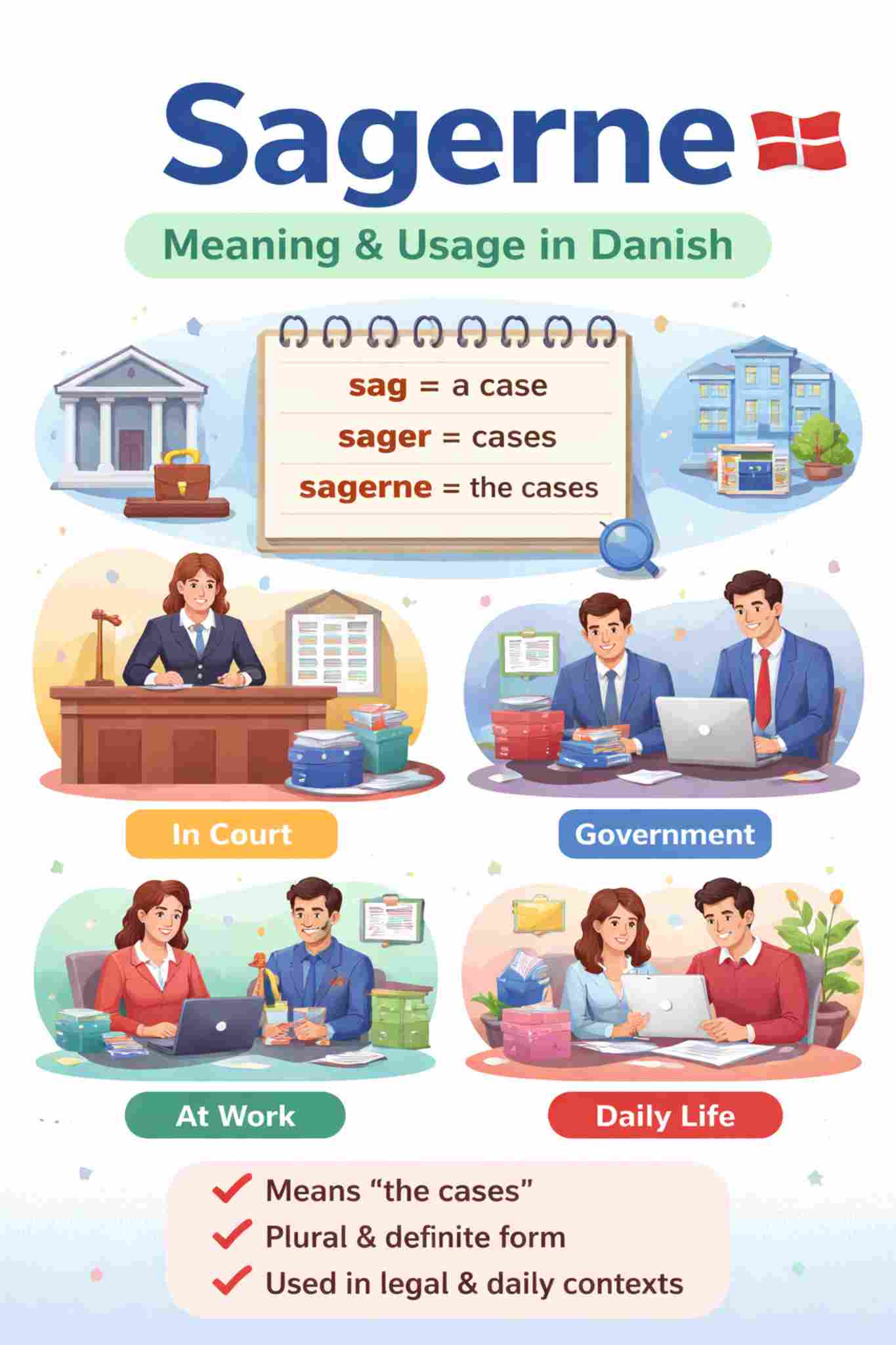
Sag = a case / a matter
-
Sager = cases
-
Sagerne = the cases
So, “sagerne” means “the cases” or “the matters.”
It talks about specific things that people already know about.
Example:
“Sagerne er klar.”
The cases are ready.
2. Simple Grammar Explanation
In English, we say:
-
the cases
In Danish, they do not use a separate word like “the.”
They add something to the end of the word.
For “sagerne,” the ending is “-ne.”
This ending means:
-
plural (more than one)
-
definite (specific)
3. Word Forms Table
Below is a simple table to help you understand.
| Danish Word | English Meaning |
|---|---|
| sag | a case |
| sagen | the case |
| sager | cases |
| sagerne | the cases |
This pattern is common in Danish.
4. Where Is “Sagerne” Used?
The word is used in many places.
A. In Court (Legal Use)
It can mean:
-
court cases
-
police cases
-
legal problems
Example:
“Sagerne behandles i morgen.”
The cases will be handled tomorrow.
B. In Government Offices
In Denmark, many things are handled as “cases.”
It can mean:
-
tax files
-
permit requests
-
official papers
-
public complaints
Example:
“Vi gennemgår sagerne.”
We review the cases.
C. At Work (Business Use)
In companies, it can mean:
-
client files
-
work tasks
-
projects
-
reports
Example:
“Sagerne fra sidste uge er færdige.”
The cases from last week are finished.
D. In Daily Life
People also use it in normal conversation.
It can mean:
-
problems
-
tasks
-
responsibilities
Example:
“Har du ordnet sagerne?”
Have you handled the matters?
5. Meaning Changes by Situation
The word does not always mean the same thing.
It depends on the situation.
| Situation | Meaning |
|---|---|
| Court | legal cases |
| Government office | official files |
| Business | work matters |
| Home | personal tasks |
So, the meaning changes with context.
6. Why Is This Word Important in Denmark?
Denmark has a very organized system.
Many things are handled as “cases,” such as:
-
building permits
-
taxes
-
school records
-
legal problems
Because of this system, the word “sagerne” is used very often.
It shows:
-
good organization
-
clear systems
-
careful record keeping
Read also: Tribupneu
7. Simple Example Sentences
Here are easy examples:
-
“Sagerne ligger på bordet.”
The cases are on the table. -
“Sagerne er afsluttet.”
The cases are closed. -
“Vi taler om sagerne senere.”
We talk about the matters later. -
“Sagerne skal prioriteres.”
The cases must be prioritized.
8. Common Mistakes
Many learners make small mistakes.
Mistake 1: Forgetting “-ne”
Wrong:
Jeg læser sager.
(I read cases – not specific)
Correct:
Jeg læser sagerne.
(I read the cases – specific)
Mistake 2: Mixing Singular and Plural
-
sag = one
-
sagerne = more than one
Be careful with this difference.
9. Comparison With English
In English:
-
We use “the” before the noun.
-
Example: the cases
In Danish:
-
They add “-ne” at the end.
-
Example: sagerne
That is the main difference.
10. Why Danish Learners Should Know This Word
Learning “sagerne” helps you:
-
understand Danish grammar
-
read official letters
-
speak more naturally
-
work in Denmark
-
deal with government offices
It is a very useful word.
Conclusion
“Sagerne” means “the cases” or “the matters.”
It comes from the Danish word “sag.”
It is used in:
-
courts
-
government offices
-
workplaces
-
daily conversation
The ending “-ne” makes the word:
-
plural
-
definite
Even though it is a small word, it is very important in Denmark.
If you understand “sagerne,” you better understand how Danish language and Danish systems work.
Learning simple words like this makes Danish easier and clearer.