TravelAware: Essential Travel Safety Tips, Alerts & Smart Planning Guide
TravelAware is a practical approach to international travel that encourages people to understand destination risks, entry requirements, local laws, insurance needs, health concerns, and emergency procedures before leaving home. The idea is simple: better information leads to better decisions, helping travelers reduce avoidable problems while remaining flexible when conditions change AI Techn
What Is TravelAware?
TravelAware is best understood as a travel preparedness and safety framework designed to help travelers make informed decisions before and during international trips.
The official Travel Aware campaign provides destination travel advice and practical guidance covering safety, security, entry requirements, travel warnings, insurance, health-related concerns, emergencies, and specific holiday risks.
The concept is broader than simply checking whether a destination is “safe.”
A destination can be generally welcoming while still presenting specific risks. For example, a country may have excellent tourist infrastructure but experience seasonal flooding. Another destination may have low crime in major tourist districts but strict laws concerning photography, medication, dress, or public behavior.
TravelAware therefore encourages travelers to ask more useful questions.
What are the actual risks?
Which risks apply to my trip?
What documents do I need?
What does my insurance cover?
What local laws should I know?
What happens if transportation is disrupted?
Who do I contact during an emergency?
These questions transform travel preparation from a generic checklist into a risk-management process.
Why Travel Awareness Matters
Travel changes your normal environment.
At home, you probably understand the language, transportation system, emergency services, payment methods, weather patterns, and social expectations. Abroad, many of those assumptions disappear.
That creates what can be called an information gap.
The larger the information gap, the more difficult it can be to react quickly when something unexpected happens.
The difference between risk and uncertainty
Risk and uncertainty are related but not identical.
Risk is a potential problem that you can identify and prepare for. Uncertainty is what happens when you do not know enough about the situation to make a good decision.
For example, knowing that a destination regularly experiences heavy seasonal rainfall is a risk. Not knowing whether your planned mountain road is open after a storm is uncertainty.
TravelAware-style preparation reduces uncertainty by encouraging travelers to check official information before departure and continue checking it during the trip.
Small mistakes can create large consequences
Many travel problems begin with something that seems minor.
A traveler forgets to check passport validity. Another assumes their insurance automatically covers motorbike rental. Someone else relies entirely on a phone for important documents and then loses access to their device.
The original mistake may take seconds to make.
The consequences can last hours or days.
This is why travel preparation should focus on high-impact mistakes, rather than trying to memorize hundreds of rules.
The TravelAware Mindset
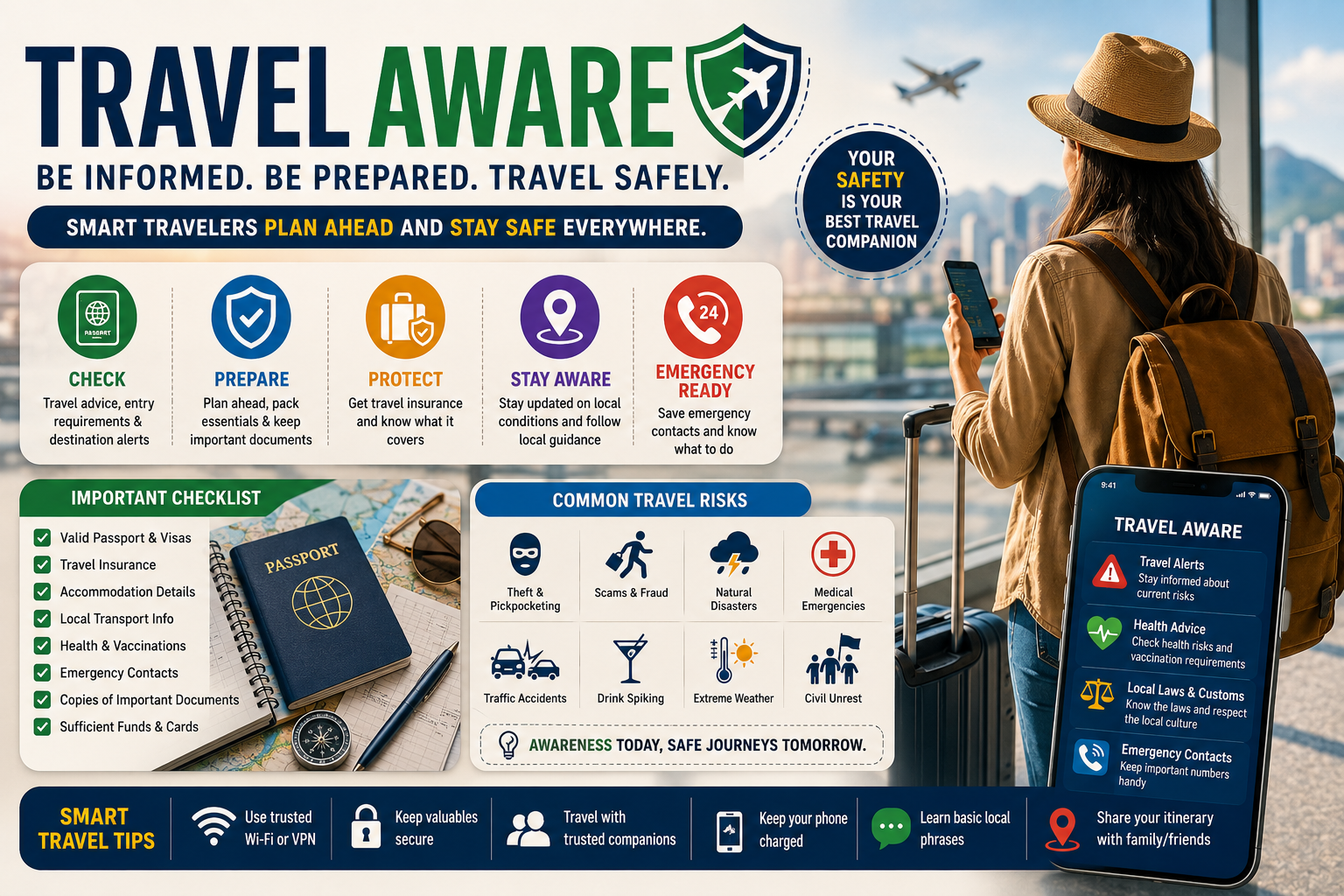
A useful TravelAware mindset can be summarized with five principles: Check, Prepare, Protect, Monitor, and Respond.
Check before you leave
Review destination-specific information, including entry requirements, local laws, health considerations, transportation conditions, and security advice.
Prepare for predictable problems
Arrange appropriate insurance, organize documents, save emergency contacts, and understand how you will access money and communication.
Protect yourself and your belongings
Use sensible security habits, protect important documents, and avoid unnecessary exposure to preventable risks.
Monitor conditions
Travel conditions can change after you book your trip. Weather, political developments, transport disruptions, natural disasters, and other events can affect a destination.
Respond intelligently
If something goes wrong, avoid panic. Move toward safety, contact appropriate local services, communicate with people you trust, and use your insurance or consular resources when appropriate.
This five-step model is useful because it recognizes that travel safety is a process, not a single pre-departure action.
TravelAware Before Your Trip
The strongest travel safety strategy begins before the suitcase is packed.
The official Travel Aware campaign recommends checking travel advice for your destination and understanding risks, entry requirements, and local laws. It also recommends obtaining suitable travel insurance and signing up for relevant updates.
Research your destination
Start with the exact places you intend to visit rather than researching only the country as a whole.
A country can contain dramatically different environments.
Capital cities, rural regions, islands, border areas, mountain districts, resort zones, and remote communities may have very different transportation, healthcare, security, and weather conditions.
Research:
- Your arrival city
- Every overnight destination
- Day-trip locations
- Transit countries
- Border crossings
- Remote areas
- Planned outdoor activities
- Major transportation routes
The more complicated the itinerary, the more important destination-level research becomes.
Check entry requirements
Entry requirements can include passports, visas, electronic travel authorizations, vaccination requirements, proof of onward travel, customs restrictions, and other documentation.
Never assume that a requirement that applied during your previous trip still applies today.
Rules can change.
The safest approach is to verify requirements using official government or embassy sources close to your departure date.
Understand local laws
One of the most underestimated aspects of international travel is the difference between what is socially acceptable and what is legally permitted.
A behavior that feels harmless at home may be restricted elsewhere.
Depending on the destination, travelers may need to pay attention to rules involving:
- Photography
- Drones
- Prescription medicines
- Alcohol
- Smoking
- Public behavior
- Religious sites
- Dress
- Driving
- Identification documents
- Currency
- Importing food
- Wildlife products
- Antiques
- Electronic equipment
“I didn’t know” is rarely a useful strategy after a legal problem has already occurred.
Check health considerations
Health preparation should be based on your itinerary rather than simply the country name.
Consider the climate, altitude, food and water environment, planned activities, length of stay, access to healthcare, and personal medical requirements.
Travelers should also know how they will obtain essential medicines and keep important medical information accessible.
Buy appropriate travel insurance
Travel insurance is not simply a document you purchase because a booking website recommends it.
It is a financial risk-management tool.
Travel Aware states that suitable insurance can provide protection for situations including medical emergencies and repatriation, lost or stolen baggage, trip cancellations or interruptions, and natural disasters.
The important word is suitable.
A cheap policy may not provide useful protection for your particular itinerary.
How to Choose Travel Insurance
Check medical coverage
Medical costs can become extremely expensive in some countries.
Your policy should provide appropriate medical coverage for the destination and activities you have planned.
Check medical evacuation
Medical evacuation can be especially important when traveling to remote areas or participating in activities far from major hospitals.
Travel Aware specifically recommends checking whether medical evacuation is included, noting that evacuation can cost thousands of pounds.
Check adventure activities
Do not assume a standard policy covers every activity.
Skiing, water sports, climbing, quad biking, motorcycling, and other activities may have special conditions or exclusions.
Check vehicle restrictions
If you intend to rent a motorcycle, scooter, moped, or car, examine the policy carefully.
Travel Aware notes that insurance may contain limits related to vehicle engine size and licensing requirements.
Being legally allowed to ride or drive does not automatically mean your insurance covers you.
Declare relevant medical information
Travel insurance policies can require travelers to disclose pre-existing medical conditions.
Travel Aware warns that failing to disclose relevant conditions can lead to rejected claims.
Always read your insurer’s requirements rather than assuming what needs to be declared.
Building a TravelAware Document System
One of the simplest ways to improve travel resilience is to organize your documents before leaving.
Keep three versions of critical information
For important documents, consider having:
- A secure digital copy
- An offline copy on your device
- A physical backup where appropriate
Important documents can include:
- Passport information
- Visa or entry authorization
- Travel insurance
- Emergency contacts
- Accommodation details
- Flight information
- Medication information
- Driving documents
- Important reservation numbers
The goal is redundancy.
If your phone disappears, you should still have access to critical information.
Do not depend entirely on cloud access
Cloud storage is useful, but it depends on connectivity and account access.
Download essential documents before traveling.
If your phone is lost or your account becomes inaccessible, an offline or physical backup can become extremely valuable.
Protect sensitive information
Travel documents contain personal information.
Avoid leaving passport scans, financial information, or other sensitive files in unsecured public locations.
Use device security features such as strong passwords, biometric authentication, and encryption where available.
TravelAware and Digital Safety
Modern travel is increasingly digital.
Flights, hotels, maps, payments, tickets, identification, communication, and travel planning may all depend on smartphones.
That creates convenience but also creates a new category of travel risk.
Protect your accounts
Use strong, unique passwords and enable multi-factor authentication where practical.
Before traveling, make sure you can recover access to your important accounts if your primary device is lost.
Be careful with public Wi-Fi
Public networks can be convenient, but travelers should avoid assuming that every public network is trustworthy.
Use secure websites and apps, keep your operating system updated, and avoid entering highly sensitive information on suspicious networks.
Beware of travel scams
Travel scams can appear through email, social media, messaging apps, fake booking websites, QR codes, and fraudulent customer-support accounts.
A common warning sign is urgency.
Messages saying “pay immediately,” “your booking will be cancelled,” or “verify your passport now” deserve careful verification.
Instead of clicking immediately, open the official website or app independently and check the booking there.
Use official travel applications and websites
If you receive a message claiming to come from an airline, hotel, government department, or travel provider, verify it through the organization’s official communication channel.
This simple habit can prevent many forms of digital fraud.
TravelAware and Personal Security
Travel security is not about behaving suspiciously everywhere.
It is about understanding your surroundings.
Know your arrival route
The first few hours in a new destination can be among the most confusing.
You may be tired, unfamiliar with the currency, unable to read signs, and uncertain about transportation.
Before arrival, know:
- Where you are staying
- How you will reach the accommodation
- The approximate travel time
- What legitimate transport options are available
- The address of your accommodation
- An alternative route if the first option fails
Travel Aware recommends saving or screenshotting your hotel address and becoming familiar with your surroundings. It also advises using licensed taxis or reputable ride-sharing services when appropriate.
Avoid displaying unnecessary valuables
You do not need to turn every trip into a security operation.
However, avoid unnecessarily displaying expensive watches, large amounts of cash, or other valuable items in environments where doing so could attract unwanted attention.
Divide important items
Keeping everything in one bag creates a single point of failure.
Consider separating:
- Cash
- Cards
- Passport
- Backup identification
- Electronic devices
- Important documents
If one item disappears, you should still have access to the essentials.
TravelAware for Solo Travelers
Solo travel can be deeply rewarding, but it changes the risk profile of a trip.
There is no companion to notice when something is wrong or help with luggage, navigation, translation, or emergency communication.
Share your itinerary
Give a trusted person your basic itinerary.
You do not necessarily need to report every coffee stop.
Instead, provide the important information:
- Arrival date
- Accommodation
- Major destinations
- Planned remote activities
- Expected return date
Establish a check-in routine
For longer or more remote trips, consider agreeing on reasonable check-in points with someone at home.
This is especially useful for hiking, road trips, remote destinations, or activities with limited connectivity.
Have a dead-phone plan
Do not assume your phone will always work.
Battery failure, damage, theft, roaming problems, or network outages can all occur.
Know how you will:
- Find your accommodation
- Contact emergency services
- Reach your travel companion
- Access your insurance information
- Navigate back to a safe location
TravelAware for Families
Family travel introduces another layer of planning.
Children can become separated from adults, become tired quickly, or struggle to communicate with unfamiliar people.
Teach children simple safety rules
Children should know:
- Their parent’s name
- The name of the accommodation
- How to identify trusted staff
- What to do if separated
- Where to wait
- How to ask for help
Create a meeting point
Travel Aware’s guidance for people traveling with friends emphasizes agreeing on a meeting point in case phones lose power or signal disappears.
The same idea works extremely well for families.
At a theme park, airport, shopping center, or festival, identify a recognizable meeting location.
Prepare for different needs
Families should consider medication, food requirements, accessibility, child seats, sleep schedules, weather, and emergency contacts.
A realistic itinerary is often safer than an ambitious one.
TravelAware for Older Travelers
Older travelers may have different priorities, particularly regarding healthcare access, mobility, medication, and travel pace.
Plan around energy rather than distance
A map may show that two attractions are close together.
That does not mean they are easy to visit consecutively.
Consider stairs, heat, walking surfaces, transportation access, rest opportunities, and hotel location.
Organize medication carefully
Carry essential medication in accordance with destination rules and keep relevant documentation accessible.
Check whether specific medicines are permitted in the destination before departure.
Prioritize healthcare access
For longer stays, identify where appropriate medical facilities are located.
This is especially useful when traveling to areas where healthcare access varies significantly between urban and remote locations.
TravelAware for Adventure Travelers
Adventure travel requires more specialized preparation because the environment itself may create significant risks.
Examples include:
- Hiking
- Skiing
- Scuba diving
- Mountain climbing
- Rafting
- Cycling
- Motorcycling
- Desert travel
- Remote road trips
Match insurance to the activity
A standard travel insurance policy may not automatically cover adventure activities.
Travel Aware specifically advises travelers to confirm that planned activities are covered.
Understand environmental risks
Adventure travelers should consider:
- Altitude
- Temperature
- Weather
- Terrain
- Water conditions
- Wildlife
- Remoteness
- Communication coverage
- Rescue availability
Tell someone where you are going
If you are entering a remote environment, someone should know your route and expected return time.
This is one of the lowest-cost safety measures available.
TravelAware and Transportation Safety
Transportation is an important part of travel risk.
Different countries have different road conditions, driving cultures, vehicle standards, traffic laws, and public transportation systems.
Research local transportation
Before using unfamiliar transport, learn how the system works.
Understand:
- Official taxi services
- Public transport cards
- Airport transfers
- Ride-hailing services
- Train systems
- Local driving rules
Be cautious with unfamiliar vehicles
If renting a car, motorcycle, or scooter, inspect the vehicle before use and understand the rental agreement.
Check the licensing requirements and insurance conditions.
Avoid impaired driving
Alcohol, fatigue, unfamiliar roads, and different traffic rules can create a dangerous combination.
Never drive while impaired.
Prepare for transport disruption
Travelers should not treat a scheduled journey as guaranteed.
Weather, mechanical problems, strikes, congestion, natural disasters, and other disruptions can change transportation plans.
UK government emergency-preparedness guidance recommends checking disruptions and weather, allowing extra time, carrying essentials such as water, food, medication, a charged phone and power bank, and keeping others informed when plans change.
TravelAware and Extreme Weather
Climate and weather can transform a normal trip into a difficult situation.
Potential hazards include:
- Extreme heat
- Heavy rainfall
- Flooding
- Hurricanes
- Tropical storms
- Snowstorms
- Wildfires
- Landslides
- Extreme cold
- Sandstorms
Check weather before activities
Do not rely only on the forecast you saw before leaving home.
Weather can change rapidly.
Check conditions before long drives, hikes, boat trips, mountain activities, or remote excursions.
Respect weather warnings
One of the most common travel mistakes is treating a warning as an inconvenience rather than a safety signal.
If local authorities advise against travel or evacuation, take the guidance seriously.
Understand flood risks
Floodwater can look shallow while hiding strong currents, damaged roads, debris, or open drains.
UK government guidance specifically advises people never to drive through floodwater because it may be deeper or faster flowing than it appears.
TravelAware and Food and Drink Safety
Food is one of the best parts of international travel, but unfamiliar food environments can sometimes create health problems.
Choose food carefully
You do not need to avoid local cuisine.
Instead, pay attention to hygiene, food handling, storage, cooking temperatures, and water safety.
Be cautious with unknown drinks
Travel Aware highlights risks including drink spiking and methanol poisoning.
Travelers should understand the risks associated with unregulated alcohol and drinks from unreliable sources.
Do not ignore unexpected symptoms
If you become seriously unwell, seek appropriate medical help rather than assuming every symptom will disappear on its own.
TravelAware and Nightlife Safety
Nightlife is part of travel for many people, but unfamiliar surroundings can increase vulnerability.
Stay connected with your group
Travel Aware’s “Stick with Your Mates” guidance emphasizes looking after each other, particularly when people become separated or have consumed alcohol.
Plan your return journey
Do not wait until the end of the night to decide how you will return.
Know which transportation options are legitimate and available.
Protect your drink and personal belongings
Avoid accepting drinks from strangers when you are uncertain about their source.
Keep your belongings under control and stay aware of your surroundings.
Agree on an emergency meeting point
Phones can fail.
A physical meeting point provides a backup communication method.
TravelAware and Emergencies
A good emergency plan should answer three questions:
Where do I go? Who do I contact? What information do I need?
Know local emergency services
Emergency numbers are not identical worldwide.
Research the relevant emergency services for your destination.
Understand what your government can do
Consular assistance can be useful in certain situations, but it does not replace local emergency services, travel insurance, or personal preparation.
Travel Aware advises travelers to understand what support is available and to use local emergency services and support when necessary.
Keep emergency information accessible
Store key numbers both digitally and offline.
A paper copy can be useful if your phone is lost.
What To Do If Your Passport Is Lost
A lost passport can be extremely stressful, but preparation can simplify the process.
Before traveling, keep a secure copy of your passport information.
If the passport is lost:
- Move to a safe location.
- Report the loss or theft as required.
- Contact your embassy or consular authority.
- Contact your travel insurer if appropriate.
- Follow instructions for replacement documentation.
- Keep records of relevant reports and communications.
Do not wait until the last minute to discover that you have no record of your passport information.
What To Do If Your Phone Is Lost
A phone can contain your entire travel life.
If it disappears, you may lose:
- Boarding passes
- Hotel information
- Maps
- Banking access
- Contacts
- Insurance documents
- Authentication codes
Prepare before departure by keeping offline copies and ensuring account-recovery methods are available.
If the phone is stolen, use available account security tools to lock or erase it remotely when appropriate.
What To Do If Your Money or Cards Are Lost
Carry more than one payment method.
A practical approach can include:
- Primary payment card
- Backup card
- Limited emergency cash
- Secure digital payment option
Do not keep every payment method in the same wallet.
If your primary card disappears, your backup can become essential.
Common TravelAware Mistakes
Even experienced travelers make avoidable mistakes.
Mistake: Checking travel advice only once
Conditions can change after booking.
Solution: Monitor relevant updates before departure and during your trip.
Mistake: Buying the cheapest insurance
Cheap does not necessarily mean appropriate.
Solution: Compare coverage, exclusions, medical protection, activities, cancellation terms, and evacuation provisions.
Mistake: Keeping everything on one phone
Phones can be lost or damaged.
Solution: Keep offline and physical backups of essential information.
Mistake: Ignoring local laws
Tourists sometimes assume normal behavior at home is acceptable everywhere.
Solution: Research important local rules before traveling.
Mistake: Overpacking the itinerary
A packed itinerary leaves little room for delays.
Solution: Build buffers between major activities.
Mistake: Treating weather as predictable
Forecasts are not guarantees.
Solution: Check conditions close to departure and before outdoor activities.
Mistake: Ignoring transportation risks
A destination can be safe while a particular road, vehicle, or activity is risky.
Solution: Evaluate the transportation method itself.
TravelAware for Budget Travelers
Safety does not have to mean luxury.
Many of the most useful safety measures cost little or nothing.
Free safety measures
You can:
- Research your destination
- Save emergency numbers
- Share your itinerary
- Download offline maps
- Screenshot accommodation information
- Check weather
- Read local laws
- Keep digital backups
- Tell someone your plans
Where not to cut costs
Avoid compromising on critical areas simply to save money.
These can include appropriate travel insurance, legitimate transportation, necessary medical preparation, and safe accommodation.
The cheapest option is not always the least expensive option after something goes wrong.
TravelAware and Sustainable Travel
Travel safety and sustainability increasingly overlap.
Responsible travelers should consider how their decisions affect local communities, ecosystems, wildlife, and infrastructure.
Respect local communities
Follow local customs and avoid treating residential neighborhoods as entertainment zones.
Protect natural environments
Follow park rules, remain on designated routes where required, and avoid disturbing wildlife.
Choose responsible operators
For tours and adventure activities, consider whether the operator appears properly licensed, trained, and equipped.
Safety and sustainability often reinforce each other.
TravelAware and Cultural Awareness
Cultural awareness can prevent misunderstandings.
You do not need to become an expert in every culture before visiting.
Start with the basics.
Learn important social expectations
Research:
- Greetings
- Dress expectations
- Religious customs
- Photography etiquette
- Dining behavior
- Public behavior
- Tipping practices
- Gender-related norms
- Appropriate language
Learn a few local phrases
Even basic phrases can make everyday interactions easier.
More importantly, showing an effort to communicate respectfully can improve your relationship with local people.
Ten Travel Safety Resources Compared
The following organizations and services can complement a TravelAware approach. They are not interchangeable, and travelers should prioritize sources relevant to their nationality and destination.
| Resource | Main Strength | Best For | Key Limitation |
|---|---|---|---|
| Travel Aware | Practical travel preparation | UK travelers and general safety guidance | UK-focused |
| UK FCDO Travel Advice | Destination-specific government advice | Security, entry rules and local risks | Primarily designed for UK travelers |
| U.S. State Department | Travel advisories and destination information | U.S. citizens | U.S.-specific |
| Smartraveller | Australian government travel advice | Australian travelers | Australia-specific |
| Government of Canada Travel Advice | Destination and security guidance | Canadian travelers | Canada-specific |
| CDC Travelers’ Health | Travel health information | Health preparation | Health-focused rather than general security |
| WHO | Global health information | International health context | Not a personal travel-advice service |
| IATA Travel Centre | Travel document information | Passport and visa checks | Not a comprehensive safety resource |
| Local Embassy or Consulate | Consular support | Citizens abroad | Services depend on nationality and situation |
| Local Emergency Services | Immediate emergencies | Police, medical and fire assistance | Only relevant within the destination |
The most effective strategy is not choosing one resource and ignoring everything else. It is cross-checking authoritative sources according to the type of risk you are evaluating.
TravelAware vs Traditional Travel Planning
Traditional travel planning often focuses on attractions, hotels, restaurants, flights, and budgets.
TravelAware adds another dimension: resilience.
A traditional plan asks:
“Where am I going?”
A resilient plan also asks:
“What if my flight is cancelled?”
“What if my phone dies?”
“What if I become sick?”
“What if the weather changes?”
“What if my luggage disappears?”
“What if the road is closed?”
“What if I lose my passport?”
This distinction is important because successful travel is not determined only by what happens when everything goes according to plan.
It is also determined by how well you handle the unexpected.
A Practical TravelAware Checklist
Four weeks before departure
Review passport validity, visa requirements, accommodation, transport arrangements, insurance, health considerations, and destination-specific advice.
One week before departure
Recheck entry requirements, travel advice, weather, transportation, insurance details, and planned activities.
One day before departure
Download documents, save offline maps, charge devices, prepare backup power, confirm transportation, and share your itinerary with a trusted person.
At arrival
Confirm your accommodation, familiarize yourself with the immediate area, understand local transport, and identify emergency options.
During the trip
Stay aware of changing conditions, protect important documents, maintain communication, and adjust plans when circumstances require it.
Before high-risk activities
Recheck weather, insurance, operator credentials, equipment, route conditions, communication availability, and emergency procedures.
A Simple Travel Risk Matrix travelaware
One useful way to think about travel safety is to classify risks by likelihood and impact.
Low likelihood and low impact travelaware
Examples might include a minor delay or small inconvenience.
Prepare a backup but do not allow these issues to dominate your trip.
High likelihood and low impact travelaware
Examples can include minor transportation delays, language misunderstandings, or small changes in plans.
Build flexibility into your itinerary.
Low likelihood and high impact travelaware
Examples can include serious medical emergencies or major natural disasters.
These are worth preparing for even if they are unlikely because the consequences can be significant.
High likelihood and high impact travelaware
These deserve the greatest attention.
If official sources identify a significant destination-specific risk that directly affects your itinerary, take it seriously and reconsider your plans when appropriate.
The 80/20 Approach to Travel Safety travelaware
Travelers can become overwhelmed by endless safety advice.
A better approach is to focus on the small number of preparations that provide the greatest benefit.
For most international travelers, the highest-value actions include:
- Checking official destination advice
- Confirming entry requirements
- Buying suitable travel insurance
- Understanding important local laws
- Keeping copies of critical documents
- Knowing emergency contacts
- Monitoring weather and local developments
- Using legitimate transportation
- Protecting money and devices
- Having a backup plan
This approach keeps safety practical instead of turning travel into a complicated risk-management project.
Pros and Cons of a TravelAware Approach
Advantages of TravelAware
The biggest benefit is preparedness without unnecessary fear.
Travelers can make better decisions when they understand actual risks.
It can also reduce financial exposure because appropriate insurance and document preparation can make unexpected situations easier to manage.
Another benefit is flexibility. A traveler who has already considered alternative transportation, emergency contacts, and document backups can respond more calmly when plans change.
TravelAware also encourages travelers to respect local laws and customs, which improves both safety and cultural understanding.
Potential disadvantages travelaware
Too much information can create anxiety.
Travelers may also misunderstand advisory systems by treating them as simple “safe” or “unsafe” labels.
Another limitation is that government advice may be broad while actual conditions can vary within a destination.
That is why travelers should read the details rather than relying solely on a headline or color-coded level.
How Travel Advisories Should Be Interpreted travelaware
Travel advisories are tools for decision-making, not universal guarantees.
For example, the U.S. State Department uses four advisory levels ranging from exercising normal precautions to “Do Not Travel,” with destination-specific risks explained in the detailed advisory. It also notes that conditions can change at any time.
The key lesson is to read the reason behind the advisory.
A traveler should ask:
What risk caused the warning?
Does that risk affect my destination?
Does it affect the activities I plan to undertake?
Is it concentrated in a particular region?
Could the situation change during my trip?
How does my travel insurance respond?
This is much more useful than asking whether a country is simply “safe.”
The Future of TravelAware
Travel safety is becoming increasingly connected to technology.
Travelers now have access to real-time alerts, digital maps, translation tools, mobile boarding passes, emergency notifications, weather information, and AI-powered travel planning.
Real-time travel intelligence travelaware
Future travel platforms will increasingly combine multiple information sources to provide more personalized warnings.
Instead of a generic statement about a country, travelers may receive notifications related specifically to their route, hotel area, transportation method, or planned activity.
AI-assisted travel planning travelaware
Artificial intelligence can help identify conflicts in itineraries, summarize regulations, translate information, and suggest alternatives.
However, AI should not replace authoritative sources.
An AI-generated answer can become outdated or misunderstand a legal requirement.
The safest approach is to use AI for organization and explanation while verifying critical information through official sources.
Digital identity and travel documents travelaware
Digital travel credentials are likely to become increasingly important.
This could simplify airport processing and document management, but it also increases the importance of cybersecurity and privacy.
Predictive weather and disruption alerts travelaware
Improved weather forecasting and transportation data can make travel planning more responsive.
Travelers may increasingly receive warnings before a disruption becomes a major problem.
The Biggest Future Challenge: Information Overload
The future problem may not be a lack of travel information.
It may be too much information.
Travelers can receive alerts from airlines, hotels, weather apps, government agencies, navigation systems, social media, news organizations, and AI tools.
The challenge will be determining:
Which information is authoritative?
Which information applies to my trip?
Which information requires action?
TravelAware’s fundamental principle remains valuable because it encourages travelers to focus on practical, destination-specific information rather than simply consuming endless travel content.
A Better Travel Planning Framework for 2026
A modern traveler can organize preparation around six questions.
Where am I going?
Know the exact cities, regions, transit points, and remote areas involved.
What could realistically go wrong?
Identify the risks relevant to your itinerary rather than worrying about everything imaginable.
What can I prevent?
Check documents, insurance, transportation, accommodation, weather, and local laws.
What can I prepare for?
Create backups for money, communication, documents, and transportation.
Who can help?
Know local emergency services, your insurer, your accommodation, and relevant consular contacts.
What will I do if plans change?
Build flexibility into your itinerary and remain willing to change plans when conditions require it.
This framework creates a balance between caution and freedom.
TravelAware for Different Types of Travelers
For first-time international travelers
Focus on documentation, insurance, transport, communication, and emergency planning.
You do not need an advanced security system.
You need a reliable foundation.
For frequent travelers
Focus on destination-specific changes.
Experienced travelers sometimes become less cautious because familiar routines feel safe.
That can become a weakness.
For business travelers
Prioritize secure devices, communication, transportation, accommodation, and contingency planning.
For solo travelers
Focus strongly on communication, location sharing, transportation, and backup plans.
For families
Prioritize meeting points, child identification, medication, accommodation safety, and realistic schedules.
For adventure travelers
Focus on activity-specific insurance, weather, equipment, rescue access, and remoteness.
For budget travelers
Focus on avoiding false savings that create major financial or safety exposure.
What TravelAware Does Not Mean
TravelAware does not mean:
- Never taking risks
- Avoiding unfamiliar cultures
- Staying inside hotels
- Carrying expensive equipment everywhere
- Assuming every destination is dangerous
- Following every rumor online
- Canceling a trip because of one negative story
Travel is inherently about experiencing something different.
The goal is not to remove uncertainty completely.
The goal is to make informed choices about which uncertainty you are comfortable accepting.
A Real-World Example of TravelAware Planning
Consider a traveler planning a week-long trip that includes a major city, a coastal resort, and a mountain region.
A basic itinerary might simply list hotels and attractions.
A TravelAware itinerary would go further.
Before departure, the traveler checks entry requirements, insurance, weather patterns, local laws, transportation, and regional advice.
The traveler downloads offline maps and keeps copies of important documents.
For the mountain portion, the traveler checks whether insurance covers the planned activity and identifies communication limitations.
For the coastal portion, the traveler checks weather conditions and understands local transport.
The traveler shares the itinerary with someone at home.
None of these actions prevents the trip from being adventurous.
Instead, they make the traveler more capable of handling change.
FAQs
What is TravelAware?
TravelAware is a travel safety and preparedness campaign that provides practical advice for travelers, including destination travel advice, entry requirements, local laws, insurance, safety risks, and guidance on what to do when problems occur.
Is TravelAware only about travel warnings?
No. TravelAware covers much more than security warnings. Its guidance includes travel insurance, passport and visa considerations, extreme weather, drink spiking, methanol poisoning, transport-related risks, medical tourism, emergencies, and other practical travel issues.
Should I check TravelAware before every international trip?
Checking current destination-specific advice before an international trip is a sensible preparation step, particularly because entry requirements and local conditions can change.
Does TravelAware replace travel insurance?
No. Travel Aware specifically recommends obtaining appropriate travel insurance and understanding what the policy covers.
Does travel insurance cover every activity?
No. Policies can contain exclusions and activity restrictions. Travelers should check whether planned activities, vehicles, destinations, and medical needs are covered.
Why is medical evacuation important?
Medical evacuation may be necessary when appropriate treatment is unavailable locally or when a traveler needs transportation to another facility. Travel Aware recommends checking that appropriate evacuation cover is included in insurance.
Should I rely on social media for travel safety information?
Social media can provide useful firsthand observations, but it should not be your only source for critical safety, legal, health, or entry information. Verify important information through official and authoritative sources.
What should I do if travel conditions suddenly change?
Check official updates, follow local authority instructions, contact your transportation provider when relevant, inform someone you trust about changes, and adjust your itinerary when necessary. UK emergency-preparedness guidance recommends allowing extra time and staying informed during disruptions.
Is a travel advisory a guarantee that a destination is unsafe?
No. Advisory systems provide risk information and recommendations. Travelers should read the detailed reasons behind an advisory and determine how those risks relate to their specific itinerary.
Can TravelAware help solo travelers?
Yes. Its practical guidance includes staying prepared, knowing your surroundings, maintaining communication, having emergency information, and planning for situations such as separation from travel companions. Many of these principles are equally valuable for solo travelers.
What documents should I keep while traveling?
Consider keeping secure copies of your passport, visa or entry authorization, travel insurance, accommodation details, transportation bookings, emergency contacts, and important medical information.
Should I carry paper documents?
For critical information, a paper backup can be useful. Travel Aware specifically recommends taking a paper copy of travel insurance information because it remains accessible if your phone is lost.
How can I stay safe during nightlife?
Stay aware of your surroundings, look after your companions, arrange transportation in advance, avoid accepting questionable drinks, and agree on a meeting point in case phones fail or people become separated.
What is the most important TravelAware habit?
The most important habit is checking current, destination-specific information before and during your trip instead of relying entirely on assumptions or old information.
Conclusion
Travel is one of the best ways to experience new cultures, landscapes, food, history, people, and ideas. But the quality of a journey is influenced by more than the destination itself. Good preparation can determine whether an unexpected event becomes a minor inconvenience or a serious problem. The TravelAware approach provides a useful framework because it focuses on practical preparation rather than fear. Checking destination information, understanding entry requirements and local laws, buying appropriate insurance, protecting important documents, monitoring changing conditions, and knowing how to seek help can make travelers more resilient.