Future Technology: 15 Powerful Innovations That Will Transform Our World
Future technology is the collection of emerging technologies and advanced systems that are expected to change how people live, work, communicate, travel, learn, and solve problems. The most important shift is not simply that machines are becoming more powerful; it is that different technologies are beginning to work together as connected systems. A smartphone already demonstrates this principle. It combines computing, cameras, artificial intelligence, GPS, communications, sensors, biometrics, cloud services, and software into one device. The next generation of technology is likely to take this integration much further CISD SSO
What Is Future Technology?
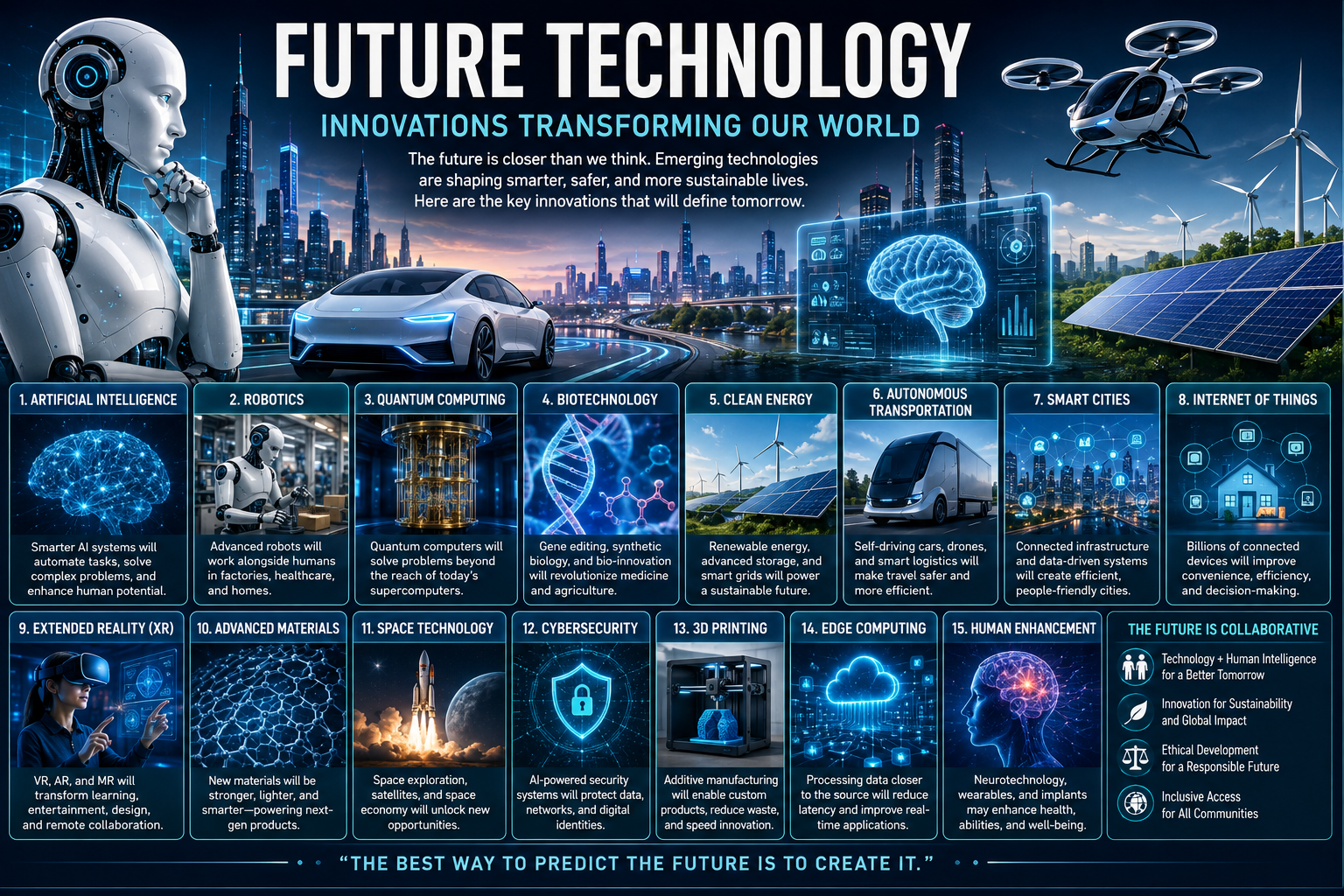
Future technology refers to technologies that are emerging today or are expected to become significantly more capable, affordable, widespread, or influential in the coming years.
The term covers a broad range of fields rather than one specific industry.
These include:
- Artificial intelligence
- AI agents
- Robotics
- Quantum computing
- Biotechnology
- Advanced healthcare technology
- Autonomous transportation
- Clean energy
- Energy storage
- Smart cities
- Internet of Things systems
- Extended and augmented reality
- Advanced manufacturing
- Cybersecurity
- Space technology
- Advanced materials
- Human-computer interfaces
Some of these technologies are already commercially available. Others remain in laboratories or early development.
The distinction matters because future technology should not be confused with technology that is merely futuristic in appearance. A practical future technology is one that eventually solves a real problem at an acceptable cost, with sufficient reliability and safety.
Why Future Technology Matters
Technology becomes important when it changes what people can accomplish.
The internet changed access to information. Smartphones changed communication and computing. Cloud computing changed how organizations operate software and data. Modern artificial intelligence is beginning to change how people create, analyze, search, and automate information.
Future technology could create similar transformations across physical and digital environments.
Technology Is Becoming More Connected
Historically, many technologies developed independently. Today, the boundaries between industries are increasingly blurred.
Artificial intelligence can improve robotics. Robotics can support healthcare. Sensors can feed data into AI systems. Cloud computing can coordinate connected machines. Advanced batteries can enable electric transportation. Quantum research may eventually influence chemistry, optimization, and security.
This means the biggest technological breakthroughs may come from combinations of technologies rather than isolated inventions.
Technology Is Becoming More Autonomous
Another major trend is the movement from tools that wait for instructions toward systems that can interpret objectives and take multiple steps.
Traditional software generally follows predefined instructions.
More advanced AI systems can interpret natural language, analyze information, use software tools, generate content, and potentially complete multi-step workflows.
Robotics extends this idea into the physical world.
The result could be a gradual transition from passive tools to increasingly autonomous systems.
The Most Important Future Technology Trends
The future of technology will not be controlled by one innovation. Several major trends are developing simultaneously.
Artificial Intelligence and Machine Intelligence
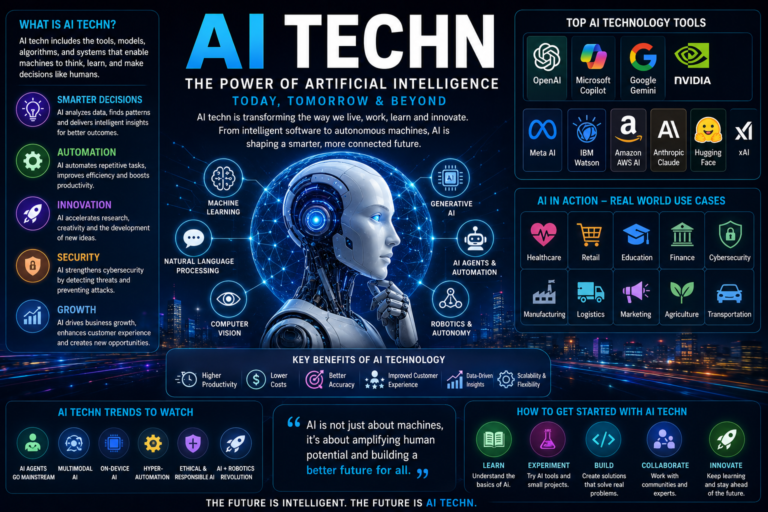
Artificial intelligence is likely to remain one of the strongest forces shaping future technology.
Modern AI systems can already process language, images, audio, video, code, and structured data. Future systems may become more capable at reasoning across different types of information and completing longer sequences of tasks.
AI Agents
AI agents are particularly important because they move beyond simple question-and-answer interactions.
An AI agent can be designed to pursue a goal, determine a sequence of actions, use tools, evaluate results, and continue working toward an objective.
For example, a business agent could potentially:
- Receive a customer request.
- Identify the customer’s problem.
- Search approved company information.
- Check an account system.
- Prepare an appropriate response.
- Escalate unusual cases.
- Record the interaction.
The significance is not that AI can generate text. It is that software may increasingly be able to perform workflows.
Personalized AI Assistants
Future AI assistants may become more useful because they could understand context across multiple tasks.
Instead of asking separate questions, a person might give an assistant a broad objective such as planning a trip, organizing a project, researching a subject, preparing documents, or comparing options.
The assistant could then coordinate several tools.
However, greater autonomy also creates greater responsibility. An AI system with access to email, financial information, business systems, or other sensitive resources needs strong permissions, monitoring, and human oversight.
AI in Business
Businesses may use AI for:
- Customer support
- Data analysis
- Marketing
- Software development
- Document processing
- Financial analysis
- Research
- Supply chain management
- Fraud detection
- Cybersecurity
- Internal knowledge management
- Workflow automation
The strongest applications are likely to be those where AI solves a clearly defined problem rather than being added simply because it is fashionable.
Robotics and Physical AI
Robotics represents the point where artificial intelligence meets the physical world.
A chatbot can produce a response. A robot must perceive its environment, move safely, manipulate objects, and respond to unexpected situations.
Humanoid Robots
Humanoid robots attract enormous attention because their body structure is compatible with environments designed for humans.
Stairs, doors, shelves, tools, vehicles, and factories are generally designed around human physical abilities.
A sufficiently capable humanoid robot could potentially operate in some existing environments without requiring every location to be redesigned.
Potential applications include:
- Manufacturing
- Warehousing
- Logistics
- Inspection
- Maintenance
- Healthcare assistance
- Dangerous environments
- Household tasks
The major challenge is not simply creating a robot that can walk. Reliable manipulation, safety, battery life, cost, perception, and real-world decision-making are much harder problems.
Collaborative Robots
Collaborative robots, often called cobots, are another important direction.
Instead of replacing an entire human workforce, cobots can perform repetitive or physically demanding tasks while people handle judgment, supervision, design, and problem-solving.
This model may become increasingly important in manufacturing and logistics.
Quantum Computing
Quantum computing represents a fundamentally different approach to computation.
Classical computers use bits that represent information using binary states. Quantum computers use quantum bits, or qubits, whose behavior allows quantum algorithms to process certain problems in ways that differ fundamentally from classical computation.
Quantum computers are not simply faster versions of normal computers.
Their potential is strongest for specific classes of problems.
Where Quantum Computing Could Matter
Potential applications include:
- Molecular simulation
- Drug discovery
- Materials research
- Optimization
- Chemistry
- Cryptography
- Financial modeling
- Scientific computing
The technology remains technically challenging. Qubits are sensitive to environmental disturbances, and building useful large-scale quantum systems requires substantial engineering advances.
That means quantum computing should be viewed as a promising long-term technology rather than a replacement for everyday computers.
Quantum Security
Quantum computing also creates a security challenge.
Some future quantum computers could threaten certain cryptographic methods used today.
This has encouraged research into post-quantum cryptography, which aims to create security methods designed to resist attacks from powerful quantum systems.
Biotechnology and Future Healthcare
One of the most profound areas of future technology may be biotechnology.
Computing is increasingly being used alongside biology to understand diseases, analyze biological data, design molecules, and improve medical research.
AI-Assisted Drug Discovery
Developing medicines traditionally requires extensive laboratory research and testing.
AI can help researchers analyze biological data, identify potential molecular candidates, predict properties, and prioritize experiments.
It does not eliminate the need for laboratory validation or clinical trials, but it can potentially make parts of the discovery process more efficient.
Precision Medicine
Future healthcare could become more personalized.
Instead of treating every patient with the same approach, doctors may increasingly combine information such as genetics, medical history, lifestyle, biomarkers, and treatment response.
The goal is to select interventions that are better suited to individual patients.
Wearable Health Technology
Smartwatches and other wearable devices already collect information such as movement and heart-related measurements.
Future wearables may become more capable at continuously monitoring physiological signals and identifying changes that deserve attention.
The challenge will be distinguishing useful signals from noise and ensuring that people do not treat consumer devices as substitutes for professional medical diagnosis.
Brain-Computer Interfaces
Brain-computer interfaces aim to create communication pathways between neural activity and computers.
This is one of the most ambitious areas of future technology.
Potential applications include assisting people with certain disabilities, controlling devices through neural signals, and creating new forms of human-computer interaction.
The Promise of Neural Interfaces
For people who cannot easily communicate or control conventional devices, a reliable brain-computer interface could have enormous value.
Researchers are investigating both implanted and non-invasive approaches.
However, the technology raises difficult questions about privacy, consent, security, medical risk, and ownership of neural data.
The future of brain-computer interfaces will therefore depend not only on technical progress but also on ethical and regulatory frameworks.
Autonomous Vehicles and Future Transportation
Transportation technology is undergoing major changes through electrification, automation, connectivity, and new mobility systems.
Self-Driving Technology
Autonomous driving systems use combinations of cameras, sensors, maps, machine learning, and computing systems to understand road environments.
The ultimate goal is to reduce or eliminate the need for continuous human control in certain driving situations.
The technical challenge is substantial because roads contain unpredictable people, vehicles, weather, construction, and unusual events.
Autonomous transportation may therefore develop gradually, beginning with carefully controlled environments and specific use cases before becoming more widespread.
Electric Transportation
Electric vehicles are another major part of transportation’s future.
Electric drivetrains can offer high energy efficiency and fewer moving parts than conventional combustion systems.
The broader transition also depends on battery manufacturing, charging infrastructure, electricity generation, recycling, and grid capacity.
Future Public Transportation
Cities may increasingly combine:
- Electric buses
- Rail systems
- Autonomous shuttles
- Shared mobility
- Smart traffic management
- Integrated ticketing
- Real-time transportation information
The best transportation systems may not be the ones with the most futuristic vehicles. They may be the systems that connect different transportation methods efficiently.
Clean Energy and Advanced Energy Storage
Future technology cannot develop sustainably without sufficient energy.
Artificial intelligence, data centers, electric transportation, manufacturing, and connected infrastructure all require substantial energy.
Solar and Wind Power
Renewable energy technologies continue to improve through advances in manufacturing, materials, grid integration, and energy management.
Solar and wind power are especially important because they can generate electricity without direct combustion during operation.
However, variable renewable generation creates a storage and grid-management challenge.
Advanced Batteries
Battery technology is critical to electric transportation and renewable energy storage.
Future battery development may focus on:
- Higher energy density
- Faster charging
- Longer life
- Lower cost
- Improved safety
- Reduced dependence on constrained materials
- Better recycling
No single battery chemistry is guaranteed to dominate every application.
Different technologies may serve cars, trucks, homes, aviation, industrial storage, and portable electronics differently.
Smart Energy Systems
The future energy system may become more intelligent.
Homes, vehicles, batteries, solar systems, utilities, and industrial facilities can increasingly communicate with energy-management software.
This could help balance demand and supply.
Smart Cities
A smart city uses connected technology and data to improve urban systems.
Potential applications include:
- Traffic management
- Public transportation
- Energy systems
- Water management
- Waste collection
- Emergency response
- Environmental monitoring
- Public infrastructure maintenance
The Risk of Over-Engineering Cities
Technology alone does not make a city smart.
A city could install thousands of sensors and still provide poor services.
The real objective should be better outcomes: safer streets, cleaner air, efficient transportation, reliable utilities, and improved quality of life.
Technology should support those goals rather than becoming the goal itself.
Internet of Things and Ambient Computing
The Internet of Things connects physical objects to networks.
Examples include:
- Smart appliances
- Industrial sensors
- Connected vehicles
- Wearable devices
- Building systems
- Agricultural equipment
- Security systems
Future systems may become less visible.
Instead of interacting with dozens of separate applications, people may interact with environments that automatically respond to context.
This concept is sometimes described as ambient computing.
The Privacy Challenge
More connected devices mean more data.
That creates an important question: How much information should technology collect simply because it can?
Future systems will need clear privacy controls, strong security, sensible data retention policies, and meaningful user consent.
Extended Reality and Spatial Computing
Virtual reality, augmented reality, and mixed reality are developing toward more natural forms of digital interaction.
Virtual Reality
Virtual reality creates an immersive digital environment.
Potential applications include:
- Gaming
- Training
- Education
- Simulation
- Remote collaboration
- Design
- Therapy
Augmented Reality
Augmented reality places digital information into the user’s physical environment.
For example, a technician could potentially see repair instructions while looking at machinery.
A traveler could receive contextual information about a landmark.
A student could view a three-dimensional scientific model while studying.
Spatial Computing
The broader direction is toward computing that understands physical space.
Instead of treating the screen as the center of computing, spatial systems attempt to combine digital information with the surrounding environment.
Advanced Manufacturing
Manufacturing is becoming increasingly digital.
Modern factories can combine robotics, sensors, computer vision, artificial intelligence, simulation, and additive manufacturing.
Digital Twins
A digital twin is a digital representation of a physical object, system, or process.
It can be used to understand performance, test scenarios, and identify potential problems.
For example, an industrial company could model equipment digitally and use sensor data to monitor how the physical machine is performing.
3D Printing
Additive manufacturing can create complex objects layer by layer.
It can be useful for:
- Prototyping
- Customized products
- Replacement components
- Aerospace components
- Medical devices
- Specialized manufacturing
One important advantage is flexibility. A factory may be able to produce highly customized components without traditional tooling for every design.
Advanced Materials
Many technological breakthroughs depend on materials.
New materials can influence batteries, electronics, buildings, transportation, medical devices, and energy systems.
Research areas include:
- Lightweight materials
- High-strength materials
- Advanced semiconductors
- Nanomaterials
- Smart materials
- New battery materials
- Sustainable materials
A technology may appear revolutionary on paper but remain commercially impractical until the right materials and manufacturing processes become available.
Future Cybersecurity
As technology becomes more connected and autonomous, cybersecurity becomes more important.
A compromised laptop is one problem.
A compromised autonomous vehicle, medical device, industrial robot, energy system, or AI agent could create much larger consequences.
AI-Powered Cybersecurity
AI can help identify unusual patterns, prioritize alerts, analyze large amounts of security information, and support incident response.
At the same time, attackers can also use AI.
This creates an ongoing technological competition between defensive and offensive capabilities.
Security by Design
Future technology should ideally be secure from the beginning rather than protected only after deployment.
Important practices include:
- Strong authentication
- Least-privilege access
- Encryption
- Secure software development
- Continuous monitoring
- Regular updates
- Audit logs
- Human oversight
- Incident response planning
Future Space Technology
Space technology is expanding beyond traditional government-led missions.
Potential areas include:
- Commercial launch systems
- Earth observation
- Satellite communications
- Space-based research
- Lunar exploration
- Robotic exploration
- Space manufacturing
- Deep-space science
Satellites and Global Connectivity
Satellite networks can provide communication services across regions where terrestrial infrastructure is limited.
Earth observation satellites can also support weather monitoring, agriculture, environmental research, navigation, and disaster response.
Moon and Mars Exploration
Human and robotic exploration beyond Earth remains a long-term technological challenge.
The major obstacles include radiation, life support, transportation, energy, communication delays, and resource availability.
Future space exploration will likely depend on many technologies working together rather than a single breakthrough.
How Future Technology Could Change Everyday Life
Technology becomes most meaningful when it reaches ordinary life.
A typical day in the future could involve interconnected systems operating quietly in the background.
A home might optimize heating, cooling, lighting, and energy storage according to occupancy and electricity conditions.
A personal AI assistant could help organize appointments, summarize information, manage routine administrative tasks, and coordinate software applications.
Transportation systems could become more automated and connected.
Healthcare devices could monitor selected health signals continuously.
Workplaces could use AI to handle routine information processing while humans focus more heavily on decisions, relationships, creativity, and complex problems.
The key word is integration.
Future technology may feel less like owning many advanced gadgets and more like living inside an intelligent digital environment.
Future Technology in Education
Education could become more personalized through AI-powered learning systems.
AI Tutors
An AI tutor could explain the same concept in different ways depending on a student’s needs.
For example, one learner may understand a mathematical concept through diagrams, another through examples, and another through step-by-step explanations.
This could supplement teachers rather than replace them.
Immersive Learning
Virtual and augmented reality could make abstract concepts easier to visualize.
Students could explore historical environments, examine virtual scientific models, or practice technical procedures in simulated environments.
The biggest benefit may come from combining technology with good teaching rather than using technology for its own sake.
Future Technology in Business
Organizations will likely use technology to automate repetitive work, improve decision-making, and create new products.
Small Businesses
Future technology may reduce the gap between large organizations and small businesses.
Affordable AI tools could help smaller companies with:
- Customer service
- Marketing
- Bookkeeping
- Market research
- Content creation
- Inventory management
- Scheduling
- Data analysis
This could allow small teams to operate with capabilities that previously required much larger departments.
Large Enterprises
Large organizations may focus more on integrating AI with existing enterprise systems.
The challenge will be governance.
A company may have hundreds of AI tools, but without centralized security, permissions, data standards, and monitoring, complexity can become a liability.
Future Technology for Travelers
Travel is another area where technology can reduce friction.
Potential improvements include:
- AI travel planning
- Digital identity
- Automated translation
- Smart luggage
- Real-time transportation information
- Personalized recommendations
- Immersive destination previews
- Automated hotel services
- Advanced navigation
However, travelers will still value human experiences.
Technology can help someone find a restaurant, navigate a city, or translate a sign. It cannot fully replace the emotional value of discovering a place, meeting people, or experiencing a culture.
Future Technology for Homes
Smart homes may evolve from collections of connected gadgets into integrated systems.
A future home could potentially understand:
- Occupancy
- Energy use
- Temperature
- Lighting
- Appliance activity
- Security conditions
- Maintenance requirements
The ideal system would remain simple from the user’s perspective.
The complexity should exist behind the scenes rather than forcing homeowners to manage dozens of separate applications.
Future Technology for Agriculture
Agriculture may benefit from combining sensors, satellite data, robotics, AI, automation, and precision equipment.
Farmers could use technology to understand soil conditions, weather patterns, crop health, and water requirements.
Precision Agriculture
Instead of treating an entire field identically, precision agriculture can use data to make more targeted decisions.
Potential benefits include improved resource efficiency and better monitoring of crop conditions.
Agricultural Robotics
Robots may eventually handle selected tasks such as monitoring crops, removing weeds, harvesting certain crops, or transporting materials.
Agriculture presents an especially interesting robotics challenge because fields are less predictable than factories.
Future Technology for Climate and Environment
Technology can contribute to environmental monitoring and resource management.
Potential applications include:
- Climate modeling
- Forest monitoring
- Ocean observation
- Water management
- Carbon measurement
- Renewable energy
- Waste reduction
- Smart agriculture
- Environmental sensors
Technology cannot solve environmental problems by itself.
Policy, economics, consumer behavior, infrastructure, and international cooperation remain essential.
The Benefits of Future Technology
Future technology can provide significant benefits when developed responsibly.
Higher Productivity
Automation can reduce repetitive work and allow people to spend more time on tasks that require judgment, creativity, communication, and strategy.
Better Access to Information
AI and connected systems can make complex information easier to search, summarize, translate, and understand.
Improved Healthcare
Technology may support earlier detection, personalized treatment, medical research, remote monitoring, and better access to healthcare services.
Greater Accessibility
Assistive technologies can help people interact with computers, communicate, move through environments, or access information.
More Efficient Energy Use
Smart systems can help optimize energy production, storage, transportation, and consumption.
New Economic Opportunities
New technologies create new industries, careers, services, and business models.
The Risks of Future Technology
The future is not automatically better simply because technology becomes more advanced.
Job Displacement
Automation can reduce demand for some tasks and occupations.
The impact will depend on how organizations deploy technology and how effectively workers can transition into new roles.
The most realistic expectation is often not that entire professions disappear overnight, but that the tasks within professions change.
Privacy Loss
Connected devices and AI systems can collect large amounts of information.
Without effective safeguards, convenience can come at the cost of privacy.
AI Errors
AI systems can generate incorrect information, make poor recommendations, or behave unpredictably in unfamiliar situations.
High-impact decisions require appropriate oversight.
Cybersecurity Threats
More connected systems create more potential attack surfaces.
Security must therefore become a central part of technological design.
Digital Inequality
Advanced technology can create benefits that are not equally distributed.
People without reliable internet, devices, education, infrastructure, or financial resources may be left behind.
Common Mistakes When Thinking About Future Technology
It is easy to misunderstand technological progress.
Mistaking Demonstrations for Finished Products
A prototype may demonstrate that something is technically possible.
That does not mean it is affordable, safe, reliable, scalable, or ready for mass adoption.
Assuming Adoption Happens Immediately
Technology often follows a slower path from invention to widespread use.
Infrastructure, regulations, manufacturing capacity, consumer trust, and economics all matter.
Ignoring Human Behavior
People do not always adopt technology simply because it is better technically.
They adopt technologies that fit their habits, budgets, values, and environments.
Focusing Only on Hardware
Some of the biggest future changes may come from software.
AI agents, cloud systems, operating platforms, digital workflows, and automated services can transform how existing hardware is used.
How to Prepare for Future Technology
Individuals and organizations do not need to predict the future perfectly.
They need to become adaptable.
Build Digital Literacy
Understanding basic concepts such as AI, cybersecurity, cloud computing, data privacy, and automation can help people make better decisions.
Learn to Work With AI
For many professionals, the useful skill may not be building AI systems but knowing how to use them effectively.
This includes:
- Writing clear instructions
- Checking AI outputs
- Protecting confidential information
- Combining AI with human judgment
- Understanding limitations
- Automating repetitive workflows
Develop Human Skills
Technology can automate many technical tasks, but communication, leadership, empathy, creativity, critical thinking, and relationship-building remain valuable.
Focus on Transferable Skills
People should prioritize skills that remain useful across changing technologies.
Problem-solving, learning ability, communication, research, and adaptability are examples.
A Practical Framework for Evaluating New Technology
Before adopting a new technology, ask five questions.
What Problem Does It Solve?
A technology without a meaningful problem is usually a novelty.
Is It Reliable Enough?
Consider accuracy, uptime, security, safety, and failure conditions.
What Does It Cost?
The cost includes more than the purchase price.
Consider training, maintenance, integration, infrastructure, security, and employee time.
What Are the Risks?
Ask what happens if the system fails, is hacked, produces incorrect results, or becomes unavailable.
Can Humans Remain in Control?
For important decisions, organizations should understand when human review is necessary.
This framework can help separate genuine innovation from hype.
Ten Major Technology Brands Shaping the Future
The future technology ecosystem includes companies working across artificial intelligence, computing, cloud infrastructure, semiconductors, robotics, consumer devices, autonomous systems, and digital platforms.
The following comparison is intended as a high-level view rather than a ranking.
| Brand | Major Technology Area | Future Technology Focus | Potential Strength |
|---|---|---|---|
| NVIDIA | AI Computing | AI chips, accelerated computing, robotics | Computing infrastructure |
| Microsoft | Cloud & AI | AI platforms, enterprise automation, cloud | Enterprise ecosystem |
| AI & Cloud | AI models, computing, robotics, research | Research and digital infrastructure | |
| OpenAI | Artificial Intelligence | AI models, agents, multimodal systems | General-purpose AI |
| Apple | Consumer Technology | On-device AI, spatial computing, personal devices | Hardware-software integration |
| Amazon | Cloud & Automation | Cloud AI, logistics, robotics | Infrastructure and commerce |
| Tesla | Automotive & Energy | Electric vehicles, autonomy, energy systems | Transportation and energy integration |
| IBM | Enterprise Technology | AI, hybrid cloud, quantum computing | Enterprise systems and research |
| Meta | AI & Spatial Computing | AI, virtual reality, augmented reality | Social and immersive platforms |
| Samsung | Electronics & Semiconductors | AI devices, chips, displays, connected technology | Consumer hardware and components |
The important point is that these companies do not represent the entire future technology landscape. Universities, startups, governments, research laboratories, manufacturers, and open-source communities also play major roles.
Future Technology for Beginners
People who are new to technology do not need to understand every technical detail.
Start with the major categories.
Learn Artificial Intelligence
Understand what AI can and cannot do.
Focus on practical applications rather than hype.
Learn Cybersecurity Basics
Use strong authentication, software updates, secure passwords, and caution with suspicious messages.
Understand Data Privacy
Know what information your devices and applications collect and how that information is used.
Experiment Carefully
Use new technology for low-risk tasks before relying on it for important decisions.
Future Technology for Professionals
Professionals should focus on how emerging technologies affect their particular industry.
A marketer may need to understand AI-assisted research and content workflows.
A software developer may need to understand AI coding systems and agentic development.
A financial professional may need to understand automation, data analysis, and AI governance.
A logistics manager may need to understand robotics, warehouse automation, and predictive systems.
The goal is not to become an expert in every emerging technology.
It is to understand which technologies are most relevant to your work and how they change the value chain.
Future Technology for Businesses
Businesses should avoid adopting technology simply because competitors are doing so.
A stronger approach is to identify repetitive, expensive, slow, or error-prone processes.
Then evaluate whether technology can improve them.
Start With Small Experiments
A limited pilot is often safer than a large transformation.
Measure:
- Time saved
- Cost reduction
- Accuracy
- Customer satisfaction
- Employee experience
- Security
- Reliability
If the pilot works, expand gradually.
Create Governance
AI and automation systems should have clear ownership.
Organizations should know:
- Who can use the system
- What data it can access
- What actions it can perform
- When human approval is required
- How activity is logged
- How errors are handled
This becomes increasingly important as systems become more autonomous.
The Future of Human and Machine Collaboration
The most interesting future may not be humans versus machines.
It may be humans working with machines.
Computers are strong at processing large amounts of information, detecting patterns, repeating processes, and operating continuously.
Humans are strong at understanding social context, setting goals, exercising judgment, creating meaning, and handling ambiguous situations.
The strongest systems can combine these strengths.
For example, an AI system might analyze thousands of documents while a professional makes the final strategic decision.
A robot might perform repetitive physical work while a technician supervises exceptions.
A medical AI system might identify patterns while a clinician evaluates the patient in context.
This is a more useful way to think about technological progress than simply asking whether machines will replace people.
The Economics of Future Technology
Technology becomes widespread when its benefits justify its cost.
A technically impressive invention can fail commercially if it is too expensive, difficult to maintain, or inconvenient.
Several factors influence adoption.
Cost of Computing
As computing becomes more capable and efficient, advanced applications can become more practical.
Infrastructure Future Technology
New technology often requires supporting infrastructure.
Electric vehicles need charging networks.
AI services need computing infrastructure.
Autonomous vehicles need sensors, maps, communication systems, and regulatory frameworks.
Consumer Trust Future Technology
People must trust technology enough to use it.
Privacy incidents, unreliable systems, or confusing experiences can slow adoption.
Regulation Future Technology
Governments increasingly influence technology through rules involving privacy, safety, competition, cybersecurity, artificial intelligence, transportation, healthcare, and financial services.
Effective regulation must balance innovation with public protection.
The Future Technology Adoption Curve Future Technology
Not every emerging technology will become mainstream.
A common pattern is:
- A new technology attracts attention.
- Early demonstrations create excitement.
- Investment increases.
- Practical limitations become clearer.
- Some projects fail.
- Successful applications become more focused.
- Costs decline or capabilities improve.
- Adoption expands where economics make sense.
This is why it is important to distinguish between technical possibility and practical usefulness.
Future Trends to Watch Future Technology
Several trends deserve particular attention over the coming years.
AI Agents Becoming More Action-Oriented Future Technology
AI is likely to move increasingly toward systems that can perform tasks rather than simply generate responses.
Smaller and More Efficient AI Models Future Technology
Not every AI application needs enormous computing resources.
Smaller models can be useful for devices, specialized applications, privacy-sensitive environments, and lower-cost deployment.
AI Moving Onto Devices Future Technology
More processing may happen directly on phones, computers, vehicles, cameras, and other devices.
This can reduce latency and potentially improve privacy.
Robotics Becoming More Intelligent Future Technology
Advances in computer vision, machine learning, sensors, actuators, and hardware could make robots more useful outside controlled industrial environments.
Energy Becoming a Strategic Technology
As computing demand grows, efficient power generation, storage, cooling, and grid management will become increasingly important.
Cybersecurity Becoming More Automated Future Technology
Security systems may increasingly use AI to detect and respond to threats.
Spatial Computing Becoming More Natural Future Technology
Future interfaces may rely less on traditional screens and more on voice, vision, gestures, spatial awareness, and mixed reality.
Personalized Digital Services Future Technology
AI may allow services to adapt more closely to individual preferences, goals, and context.
Challenges That Could Slow Future Technology
Technological progress is not guaranteed.
Hardware Supply Chains Future Technology
Advanced computing systems require complex semiconductor and manufacturing ecosystems.
Disruptions can affect production and prices.
Energy Requirements Future Technology
Large-scale computing infrastructure can consume significant amounts of electricity and require substantial cooling.
Regulation Future Technology
Unclear or fragmented rules can slow deployment.
Public Trust Future Technology
Technology that people do not trust may struggle even if it works technically.
Skilled Workforce Future Technology
Advanced systems require people capable of designing, deploying, securing, maintaining, and governing them.
The Ethical Future of Technology
The central question should not only be what can we build?
It should also be what should we build, who benefits, who bears the risks, and who remains responsible when something goes wrong?
This is especially important for technologies that affect employment, healthcare, privacy, transportation, education, security, and public infrastructure.
Responsible innovation should consider:
- Safety
- Privacy
- Fairness
- Accessibility
- Accountability
- Transparency
- Environmental impact
- Human control
Technology should improve human capabilities without removing meaningful accountability.
Future Technology and the Environment
The environmental impact of technology is complicated.
Digital services can improve efficiency, but manufacturing devices and operating data centers require energy and materials.
Future technology should therefore focus not only on performance but also on resource efficiency.
Important areas include:
- Energy-efficient computing
- Renewable power
- Battery recycling
- Sustainable manufacturing
- Longer-lasting devices
- Efficient data centers
- Low-carbon transportation
- Smart water systems
- Precision agriculture
The best future technologies may be those that improve capability while reducing resource consumption.
Future Technology and Society
Technology changes social behavior as well as technical systems.
Social media changed communication.
Smartphones changed attention patterns.
Online commerce changed shopping.
Remote work changed how some organizations operate.
AI could create another major shift by changing how people interact with information and software.
The social consequences will depend on how these tools are designed and used.
Human institutions will need to adapt alongside technology.
Education systems may need to rethink assessment.
Companies may need new job structures.
Governments may need new regulatory approaches.
Individuals may need new digital habits.
A Realistic Vision of the Next Technology Era
The future is unlikely to arrive as one dramatic moment.
Instead, thousands of smaller changes will accumulate.
AI will become integrated into software.
Robots will become more capable in selected environments.
Vehicles will become increasingly connected and electrified.
Homes will become more energy-aware.
Healthcare will become more data-driven.
Manufacturing will become more automated.
Computing will become increasingly distributed between cloud infrastructure and local devices.
The result may feel surprisingly ordinary.
People may not wake up one morning and say, “The future has arrived.”
They may simply notice that many tasks that once required several steps now happen automatically
Pros and Cons of Future Technology
Major Advantages Future Technology
- Greater productivity: Automation can reduce repetitive work.
- Better information access: AI can make large amounts of information easier to process.
- Medical progress: Biotechnology and AI may accelerate research and diagnosis.
- Improved accessibility: Assistive technologies can help people overcome barriers.
- Cleaner systems: Renewable energy and efficient technologies can reduce environmental impact.
- Economic innovation: New industries and services can emerge.
- Improved safety: Automation can reduce human exposure to dangerous tasks.
- Personalization: Digital services can become more responsive to individual needs.
Major Disadvantages Future Technology
- Job disruption: Automation can reduce demand for certain tasks.
- Privacy concerns: Connected systems can collect extensive data.
- Cybersecurity risks: More connected devices create more attack surfaces.
- AI errors: Automated systems can produce incorrect or misleading results.
- Digital inequality: Benefits may not be equally accessible.
- Environmental costs: Devices and computing infrastructure require energy and materials.
- Overdependence: Excessive reliance on technology can create vulnerabilities.
- Governance challenges: Regulation can struggle to keep pace with innovation.
A Practical Future Technology Checklist
Before adopting an emerging technology, consider the following:
- Does it solve a real problem?
- Is the technology mature enough?
- Can its performance be measured?
- What data does it require?
- Who owns that data?
- What happens if it fails?
- Can the system be secured?
- Is human oversight available?
- What are the long-term costs?
- Does it improve the user experience?
- Is it accessible to the intended audience?
- What environmental impact does it create?
These questions help transform technology adoption from hype-driven experimentation into thoughtful decision-making.
FAQs
What is future technology?
Future technology refers to emerging or advancing technologies that may significantly change how people live, work, communicate, travel, learn, produce goods, and solve problems. It includes areas such as artificial intelligence, robotics, quantum computing, biotechnology, clean energy, autonomous transportation, advanced manufacturing, and spatial computing.
What will be the most important future technology?
There is no single technology guaranteed to dominate. Artificial intelligence, robotics, advanced computing, clean energy, biotechnology, cybersecurity, and connected systems are among the areas most likely to have broad effects because they can influence many industries simultaneously.
Will AI replace humans?
AI is likely to automate some tasks and change many jobs, but complete replacement of humans across the economy is a much broader and more uncertain claim. In many situations, AI is more likely to change how people perform their work and increase the value of people who can effectively supervise, use, and evaluate AI systems.
What are AI agents?
AI agents are software systems designed to pursue goals by interpreting information, planning steps, using tools, taking actions, and evaluating results. Their importance comes from their ability to perform multi-step workflows rather than only generate individual responses.
Is quantum computing the future?
Quantum computing has significant long-term potential for selected scientific and computational problems, but it is still developing. It is unlikely to replace conventional computers for ordinary everyday tasks.
Will robots replace workers?
Robots can automate physical tasks, especially repetitive, dangerous, or highly structured work. However, many real-world jobs involve unpredictable environments, communication, judgment, and social skills. The more likely outcome is a mixture of task automation, job redesign, and new types of work.
What technology will change healthcare?
AI-assisted research, precision medicine, wearable monitoring, advanced diagnostics, robotics, biotechnology, and improved medical data systems could all influence healthcare. Adoption will depend heavily on clinical evidence, safety, regulation, cost, and privacy.
What will transportation look like in the future?
Transportation is likely to become more electrified, connected, automated, and integrated. Electric vehicles, intelligent public transportation, advanced driver-assistance systems, autonomous systems, and smart infrastructure may all contribute.
Will future technology reduce energy use?
Some technologies can improve efficiency, but advanced computing and digital infrastructure can also increase electricity demand. The overall result will depend on energy efficiency, renewable generation, storage, grid management, and how technology is deployed.
How can people prepare for future technology?
The best preparation is adaptability. Build digital literacy, understand AI and cybersecurity basics, learn to evaluate technology critically, develop transferable skills, and become comfortable working alongside increasingly capable digital tools.
Is future technology always beneficial?
No. Technology can create substantial benefits while also creating risks involving privacy, security, employment, inequality, misinformation, environmental impact, and concentration of power. Responsible development and effective governance are therefore essential.
Conclusion
Future technology will change the world through a combination of powerful systems rather than a single revolutionary invention. Artificial intelligence, robotics, advanced computing, biotechnology, clean energy, connected devices, autonomous transportation, spatial computing, and advanced manufacturing are developing at the same time, creating opportunities for these technologies to reinforce one another. The most important shift may be the transition from isolated digital tools to intelligent, connected systems. Software will increasingly understand context, machines will become more capable of acting in physical environments, and digital services may become more personalized and autonomous. But technological progress should not be measured only by computing power or impressive demonstrations.