
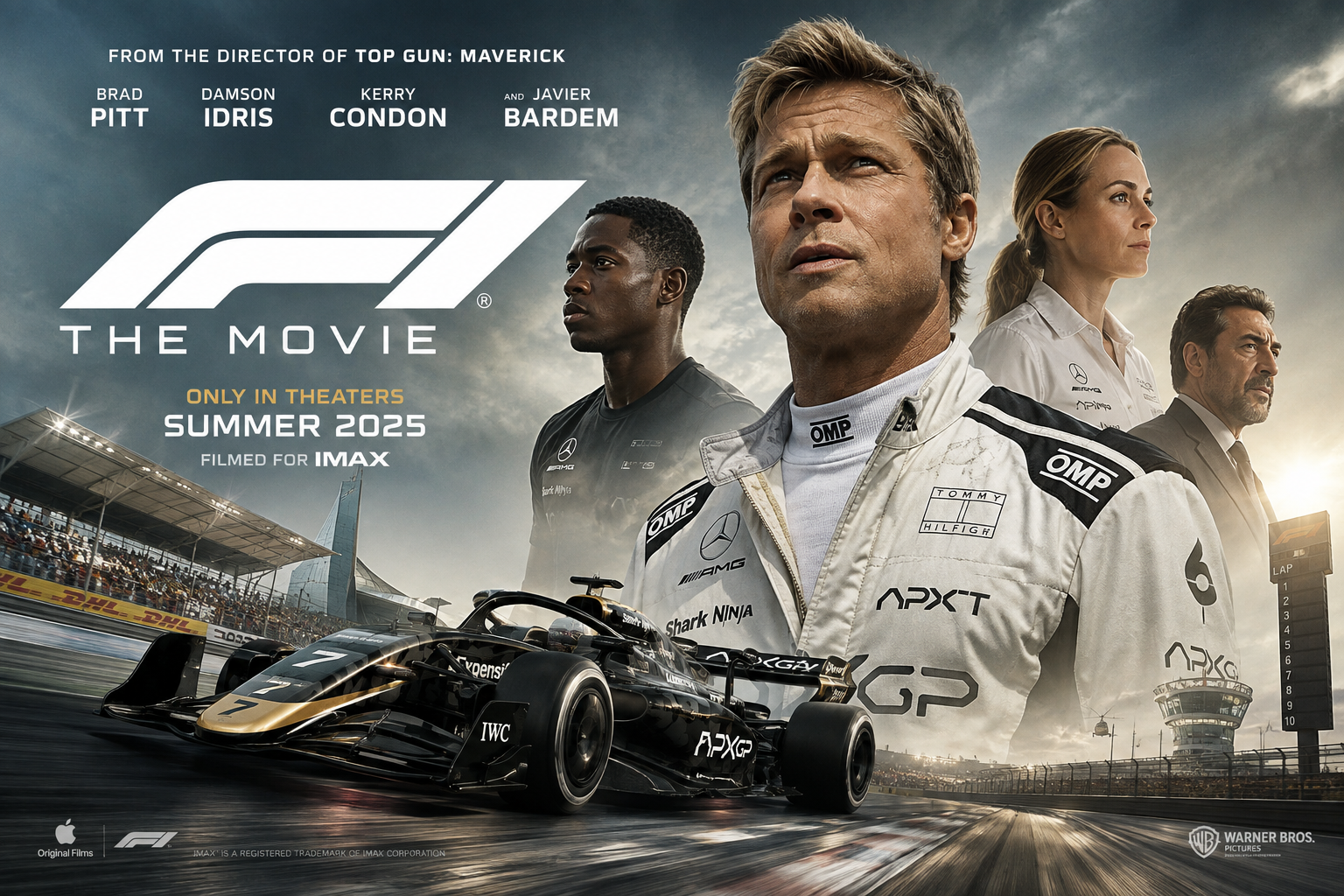
F1 Movie: Cast, Story, Release, Reviews & Formula 1 Guide
What happens when Hollywood stops pretending to understand Formula 1 and actually puts cameras inside the world of Grand Prix racing? The F1 movie, released in 2025, follows former driver Sonny Hayes as he returns to Formula 1 to rescue a struggling fictional team, combining Brad Pitt’s star power with authentic footage and real Grand Prix environments. Directed by Joseph Kosinski and made with significant involvement from Formula 1 and Lewis Hamilton, the film became one of Apple’s biggest theatrical successes and one of the most commercially successful racing movies ever made HydraHD
What Is the F1 Movie About?
At its heart, the F1 movie is a redemption story.
Brad Pitt plays Sonny Hayes, a former Formula 1 driver whose promising career was interrupted by a serious crash in the 1990s. Instead of becoming the world champion many expected him to become, Sonny spends decades away from the sport.
Years later, Sonny is approached by his former teammate, Ruben Cervantes, played by Javier Bardem.
Ruben is now associated with APXGP, a fictional Formula 1 team struggling near the back of the grid.
The team needs experience, speed, and attention.
Sonny agrees to return.
But there is a problem.
He is not coming back to a sport that looks exactly as it did decades earlier.
Formula 1 has changed dramatically.
The cars are different. The technology is different. The competition is different. The physical demands are different. The media environment is different.
Most importantly, Sonny is no longer the young driver who believed he could conquer the world through raw talent.
He is older, experienced, emotionally complicated, and carrying the consequences of his past.
His teammate is Joshua Pearce, played by Damson Idris, a talented young driver who wants to prove that he belongs at the highest level of motorsport.
This creates the movie’s central relationship.
Sonny represents experience.
Joshua represents ambition.
And APXGP becomes the battlefield where those two philosophies collide.
F1 Movie Cast and Characters
The casting is one of the film’s strongest commercial advantages.
Brad Pitt as Sonny Hayes
Brad Pitt plays Sonny Hayes, the fictional veteran driver at the center of the story.
Sonny is deliberately different from the typical young racing protagonist.
He is not trying to establish himself.
He is trying to recover something he lost.
That distinction gives the character emotional weight.
His racing philosophy is based on experience, instinct, risk management, and understanding the psychology of competition.
Rather than simply asking, “How fast can I drive?”, Sonny often approaches racing through a broader question:
What does this particular race require?
That mindset separates him from a driver who believes maximum aggression is always the answer.
Formula 1’s official material describes Sonny as a former driver returning to the sport through APXGP.
Damson Idris as Joshua Pearce
Damson Idris plays Joshua Pearce, the younger APXGP driver.
Joshua is ambitious and fast.
He also wants recognition.
That makes him a natural counterpoint to Sonny.
Where Sonny has already experienced the consequences of racing, Joshua is still discovering them.
His character represents a familiar reality in professional sport: young talent often wants immediate results, while experienced competitors understand that careers are built over years.
Javier Bardem as Ruben Cervantes
Javier Bardem plays Ruben Cervantes, the former teammate who becomes closely connected to APXGP.
Ruben needs Sonny because the team needs results.
But the relationship is more complicated than simply hiring an experienced driver.
Sonny and Ruben share history.
Their past affects their present.
That gives the film a second emotional layer beyond the driver-versus-driver rivalry.
Kerry Condon as Kate
Kerry Condon plays Kate, an important member of the team’s technical and operational world.
Her character helps reinforce an important point about Formula 1:
A racing team is never just its drivers.
Thousands of decisions made away from the steering wheel can influence what happens on Sunday.
Tobias Menzies as Banning
Tobias Menzies plays Banning, another important figure within the Formula 1 environment.
His presence helps expand the story beyond the immediate relationship between Sonny and Joshua.
Hans Zimmer’s Role
The movie’s soundscape is also important.
Hans Zimmer’s music helps transform racing into cinematic drama.
That matters because Formula 1 already has its own soundtrack: engines, tire noise, radio messages, crowd reactions, pit-lane activity, and the constant mechanical sounds of a racing weekend.
The film combines those natural sounds with a traditional blockbuster score.
Who Directed the F1 Movie?
The F1 movie was directed by Joseph Kosinski, the filmmaker behind Top Gun: Maverick.
That connection is significant.
Kosinski is particularly interested in experiences where technology and human performance interact.
In Top Gun: Maverick, the audience is placed inside the world of high-speed aviation.
In F1, the same cinematic philosophy is transferred to motorsport.
The difference is that Formula 1 happens only inches above the asphalt.
A fighter jet moves through three-dimensional space.
An F1 car moves through a narrow racing line while traveling at extreme speeds, surrounded by walls, competitors, tires, and rapidly changing conditions.
That creates a different kind of cinematic tension.
Kosinski also worked with cinematographer Claudio Miranda, editor Stephen Mirrione, and a large technical team to create the movie’s visual identity.
Why the F1 Movie Feels Different From Older Racing Movies
Many racing movies use cars as characters.
The F1 movie goes further by making the entire Formula 1 environment part of the story.
The paddock matters.
The pit lane matters.
The garages matter.
The timing screens matter.
The race strategy matters.
The crowd matters.
Even the presence of real F1 teams and drivers changes the atmosphere.
Formula 1 confirmed that the movie was produced in collaboration with the sport and involved the real F1 community, including all 10 teams, drivers, the FIA, and race promoters.
That level of integration is unusual for a fictional sports movie.
How Was the F1 Movie Filmed?
One of the most interesting parts of the production was its use of real Grand Prix environments.
Instead of creating every race exclusively on a soundstage, the production filmed during actual Formula 1 weekends.
This created an enormous logistical challenge.
The fictional APXGP team had to exist alongside real Formula 1 teams.
The filmmakers needed footage that looked authentic while still allowing the fictional characters and cars to appear as if they belonged in the championship.
Formula 1 reported that more than 185 hours of footage were shot across Grand Prix events and that more than 2,000 hours of F1 broadcast footage were recorded for the movie. It also reported around 1,900 crew members involved in production, with approximately 400 crew working at each race.
These numbers reveal something important.
The racing scenes were not simply a matter of putting a camera on a car and pressing record.
The movie required a production system capable of operating inside one of the world’s most tightly controlled sporting environments.
The APXGP Team Explained
APXGP is fictional.
That distinction is important because viewers unfamiliar with Formula 1 might initially assume it is a real team.
The fictional team exists to give the story freedom.
If the filmmakers had used Ferrari, Mercedes, McLaren, or another real team as the central struggling organization, the story would have had to work around real-world history, contracts, drivers, corporate interests, and competitive realities.
A fictional team removes those restrictions.
APXGP can lose.
APXGP can make mistakes.
APXGP can transform.
And its drivers can have conflicts without rewriting the history of an existing constructor.
The team essentially acts as a blank canvas.
F1 Movie and Real Formula 1 Teams
One of the film’s smartest decisions was placing the fictional APXGP team within the real Formula 1 ecosystem.
This creates a contrast between fiction and reality.
The audience knows that Ferrari is real.
Mercedes is real.
McLaren is real.
Red Bull Racing is real.
APXGP is not.
That contrast makes the fictional story feel more believable because the surrounding environment is authentic.
10 Major F1 Brands Compared
The following table compares ten major Formula 1 team brands that help define the modern competitive landscape.
| Team / Brand | Known For | Typical Strength | Brand Identity | What It Represents |
|---|---|---|---|---|
| Ferrari | Historic F1 legacy | Racing heritage | Passion and tradition | Motorsport heritage |
| Mercedes | Modern-era dominance | Engineering | Precision and technology | Technical excellence |
| Red Bull Racing | Recent championship success | Aerodynamics and execution | Aggressive performance | Modern F1 competitiveness |
| McLaren | Historic racing heritage | Development and driver talent | Innovation and racing culture | Resurgence |
| Aston Martin | Luxury + motorsport | Investment and ambition | Premium performance | Long-term growth |
| Alpine | Renault-linked F1 identity | Engineering and development | French motorsport | National racing heritage |
| Williams | Historic championship legacy | Racing tradition | Independent spirit | Classic F1 identity |
| Haas | American F1 presence | Lean operation | Practical competitiveness | U.S. involvement |
| Racing Bulls | Young-driver development | Driver development | Energy and youth | F1 talent pipeline |
| Sauber / Audi project | Transformation | Engineering transition | German automotive future | F1 expansion and change |
These teams provide useful context for understanding the world surrounding the fictional APXGP.
Ferrari: The Power of History
Ferrari represents something almost no other F1 organization can completely replicate.
It has become a global symbol of motorsport.
The red cars, famous badge, enormous fan base, and decades of championship history mean Ferrari is larger than a racing team.
It is a cultural institution.
For a film about Formula 1, that makes Ferrari part of the visual language of the sport even when the story is not about Ferrari.
Mercedes: Engineering and Precision
Mercedes represents another side of modern Formula 1.
Its identity is strongly connected to engineering, data, efficiency, and technical development.
For new viewers, Mercedes helps explain why F1 cannot be reduced to driver skill.
The driver is crucial.
But the car is a highly optimized engineering platform.
The relationship between driver and machine is one of the sport’s defining characteristics.
Red Bull Racing: Aggression and Innovation
Red Bull Racing has become synonymous with modern F1 competitiveness.
Its identity combines aggressive branding, engineering ambition, driver development, and high-performance execution.
The team’s success also demonstrates how quickly competitive advantages can emerge from technical concepts.
McLaren: A Historic Brand With Modern Momentum
McLaren is one of Formula 1’s most recognizable racing brands.
Its history stretches across decades.
But its importance to the modern sport also comes from its ability to rebuild competitiveness.
McLaren demonstrates a central lesson in F1:
Success is rarely permanent.
Teams must continually develop.
Aston Martin: The Premium Challenger
Aston Martin combines automotive luxury with Formula 1 competition.
Its F1 presence represents the sport’s increasing appeal to global automotive and luxury audiences.
The team also illustrates how Formula 1 can become a platform for a broader automotive brand.
Alpine: The French Connection
Alpine carries a distinctive French motorsport identity.
Its presence demonstrates how Formula 1 remains connected to national automotive traditions while simultaneously operating as a global sport.
Williams: A Symbol of F1 Heritage
Williams has a remarkable historical reputation.
Its story is particularly interesting because it represents the independent-team tradition that has always been part of Formula 1.
The team reminds fans that the sport’s history was not built only by automotive giants.
Haas: America’s Growing Connection to F1
Haas is particularly important from a global marketing perspective.
Its presence reflects the growing commercial importance of Formula 1 in the United States.
That matters to the F1 movie because the film itself was partly designed to introduce the sport to a wider mainstream audience.
Racing Bulls: The Development Pipeline
Racing Bulls represents the driver-development side of modern Formula 1.
Young drivers often need a pathway before reaching a top team.
That makes development teams important to the sport’s ecosystem.
Sauber and the Audi Era
The Sauber organization represents another important trend: Formula 1’s ability to attract major automotive manufacturers.
The transition toward Audi demonstrates how F1 can function as a technology and marketing platform for global automotive companies.
Lewis Hamilton’s Influence on the F1 Movie
Lewis Hamilton’s involvement is one of the film’s most significant behind-the-scenes elements.
Hamilton was not simply a celebrity associated with the movie.
He was involved as a producer through Dawn Apollo Films and provided expertise connected to the world of Formula 1. Formula 1 officially identified Hamilton as one of the producers and described the film as being created in collaboration with the sport.
That involvement helps answer a question many racing fans had before release:
Would Hollywood get Formula 1 right?
No fictional movie can reproduce every detail perfectly.
But having a seven-time world champion involved significantly improves the chances that the film understands the culture and pressures surrounding elite racing.
Hamilton also understands the difference between something that looks exciting to a casual viewer and something that feels credible to a professional driver.
That distinction is critical.
What the F1 Movie Gets Right About Racing
The film’s strongest technical achievement is not necessarily that every fictional event could happen exactly as shown.
It is that the movie understands what makes racing emotionally intense.
Racing Is About Decisions, Not Just Speed
A common misconception among new fans is that the fastest driver automatically wins.
Formula 1 is more complicated.
A race involves:
- Tire strategy
- Fuel considerations
- Weather
- Track position
- Pit stops
- Safety cars
- Overtaking opportunities
- Car setup
- Aerodynamic performance
- Driver confidence
- Team communication
- Reliability
- Penalties
- Traffic
- Timing
A driver can be extremely fast and still lose.
That is what makes Formula 1 suitable for storytelling.
There are dozens of ways a race can change.
Why Tire Strategy Matters
Tires are one of the simplest ways to explain F1 strategy to newcomers.
A driver may have the speed to push hard for several laps, but aggressive driving can increase tire degradation.
Another driver may preserve the tires and attack later.
The best strategy depends on the track, temperature, weather, tire compound, safety-car probability, and overall race situation.
This is why Formula 1 is partly a mathematical contest.
The drivers make decisions.
The engineers interpret data.
The strategists calculate probabilities.
And everyone reacts to events that cannot be perfectly predicted.
The Psychological Battle Between Sonny and Joshua
The relationship between Sonny and Joshua is arguably more interesting than the racing itself.
Joshua wants to prove himself.
Sonny already knows what failure feels like.
That difference creates tension.
The younger driver sees risk as an opportunity.
The veteran sees risk as something that has a price.
This is a common pattern in elite sports.
Young athletes often have physical advantages.
Older athletes can have informational advantages.
Experience teaches competitors what the statistics do not always reveal.
It teaches them when not to attack.
It teaches them how competitors react under pressure.
It teaches them how to recognize danger before it becomes obvious.
F1 Movie as a Story About Aging
This is one of the film’s most interesting themes.
At first glance, F1 is a racing movie.
Underneath, it is also a story about aging.
Sonny has to confront a question that applies far beyond motorsport:
What happens when the thing you were once naturally good at no longer belongs entirely to you?
That question gives the film broader appeal.
A younger audience may see Joshua.
An older audience may identify with Sonny.
Professionals may recognize the challenge of returning to a changing industry.
And general viewers may understand the desire to prove that a past failure does not define an entire life.
Why the Movie Appeals to Non-F1 Fans
A successful sports movie cannot depend entirely on the audience already understanding the sport.
The F1 movie avoids that problem by using familiar storytelling structures.
It has:
- An underdog team
- A veteran comeback
- A young rival
- A mentor relationship
- Personal failure
- Professional pressure
- Team politics
- High-stakes competition
- Redemption
You do not need to know every Formula 1 regulation to understand those ideas.
That makes the movie accessible.
F1 Movie and the Importance of IMAX
Theatrical presentation is particularly important for this film.
Formula 1 cars are visually impressive because of their speed and proximity to the ground.
On a small screen, some of that sensation disappears.
In a large-format cinema, the visual impact increases.
Formula 1 specifically promoted the movie’s IMAX release, highlighting the format’s image and sound capabilities.
This leads to an important distinction:
F1 is a movie you can understand on television, but it was designed to be experienced in a cinema.
The difference is similar to watching a concert recording versus standing inside a concert hall.
The Sound Design of the F1 Movie
Sound is one of the most underrated elements of racing cinema.
A Formula 1 car does not simply move quickly.
It produces an environment of sound.
There are:
- Engine and mechanical noises
- Tire sounds
- Wind
- Gear changes
- Braking
- Radio communications
- Pit-lane activity
- Crowd noise
- Announcements
- Music
The film’s audio design uses these elements to create tension.
A quiet cockpit can be more powerful than a loud engine.
Silence before acceleration creates anticipation.
Radio conversations provide information.
Music tells the audience how to interpret a moment emotionally.
The Technology Behind the Racing Scenes
The film’s production demonstrates how modern cinema increasingly combines practical filmmaking with digital visual effects.
The goal is not necessarily to eliminate CGI.
The goal is to make CGI difficult to notice.
According to production information, Framestore worked on visual effects, including work related to adapting real racing footage to the fictional APXGP cars.
This approach is important because realism comes from layering.
A believable racing scene can combine:
- Real cars.
- Real circuits.
- Real crowds.
- Real Grand Prix environments.
- Specialized camera systems.
- Digital modifications.
- Computer-generated elements.
- Carefully edited sound.
- Performance footage.
- Traditional cinematography.
The audience sees one continuous reality.
Behind the scenes, it may be a combination of many technologies.
F1 Movie Production Challenges
Filming a fictional story during real Formula 1 events creates unusual difficulties.
A normal movie can stop filming if something goes wrong.
A Grand Prix cannot.
The race happens according to a schedule.
The teams are operating under sporting regulations.
The weather can change.
Cars may crash.
Sessions can be delayed.
Drivers have media obligations.
Teams are working under enormous competitive pressure.
The film crew therefore had to adapt to the sport instead of expecting the sport to adapt to the film.
That is a major difference.
The Economics Behind the F1 Movie
The movie was an expensive production.
Reported budget estimates have placed production costs around the $200 million range, with some estimates higher depending on how production and marketing expenses are counted.
That creates substantial financial pressure.
A traditional $50 million movie can potentially recover its investment with a relatively modest theatrical run.
A major blockbuster costing hundreds of millions needs global attention.
The F1 movie therefore needed more than racing fans.
It needed:
- Brad Pitt fans
- Action-movie audiences
- Sports fans
- IMAX audiences
- Casual moviegoers
- International audiences
- Younger viewers
- Existing F1 fans
Its commercial strategy was therefore much broader than simply selling tickets to Formula 1 enthusiasts.
F1 Movie Box Office Success
The film’s theatrical performance was one of its biggest stories.
Formula 1 reported that the film passed $600 million globally and became the highest-grossing Apple film at the time. It also reported that the movie surpassed Cars 2 to become the highest-grossing sports film based on the figures cited by Formula 1.
The reported worldwide total eventually exceeded $600 million, with some industry databases placing the final gross above $630 million.
That is especially significant because the movie was an original story rather than a sequel to a giant existing franchise.
There was no established “F1 movie universe.”
There was no pre-existing fictional character.
The movie had to build its audience.
Why the F1 Movie Succeeded Where Some Other Apple Films Struggled
Apple’s theatrical strategy had produced mixed results before F1.
The company had invested heavily in prestige films and major productions, but theatrical economics are unforgiving.
F1 had several advantages.
1. A Globally Recognized Sport
Formula 1 already has an international audience.
2. Brad Pitt
Brad Pitt provides enormous mainstream recognition.
3. IMAX
The movie was designed around a premium theatrical experience.
4. Lewis Hamilton
Hamilton’s involvement gave the project credibility among racing fans.
5. Joseph Kosinski
His association with Top Gun: Maverick created expectations of immersive action.
6. Real F1 Events
The film had access to authentic Grand Prix environments.
7. Broad Storytelling
The movie was understandable even for viewers who did not follow F1.
These elements created a much stronger theatrical proposition.
F1 Movie Reviews and Audience Reception
The film received generally positive critical and audience reactions.
Formula 1 reported a 97% audience score on Rotten Tomatoes during its 2025 season review and highlighted its strong CinemaScore.
Rotten Tomatoes describes the film as a 2025 action drama centered on Sonny Hayes’ return to Formula 1 and his relationship with rookie teammate Joshua Pearce.
The most common praise focused on:
- Racing sequences
- Visual spectacle
- Brad Pitt’s performance
- Cinematography
- Sound
- Authentic F1 atmosphere
- Accessibility for new fans
The most common criticisms were more likely to involve:
- Hollywood-style plot devices
- Running time
- Predictability
- Dramatic exaggeration
- The difference between movie racing and actual F1 racing
That split is reasonable.
A documentary and a blockbuster have different goals.
Is the F1 Movie Realistic?
The best answer is:
It is authentic in environment and sensation, but it remains a Hollywood drama.
That distinction matters.
The movie uses real Formula 1 locations, real racing environments, and real motorsport participation.
But the story itself is fictional.
That means certain events are designed for dramatic effect.
A real Formula 1 season involves hundreds of people and thousands of technical variables.
A movie must reduce that complexity into understandable characters and conflicts.
So viewers should not treat every dramatic decision as a documentary representation of how F1 teams operate.
Instead, think of it as fiction built on an unusually authentic sporting foundation.
What Beginners Can Learn From the F1 Movie
If you are new to Formula 1, the movie can be a useful entry point.
But you should watch it with a few concepts in mind.
Learn the Basic Terms
Start with:
- Qualifying
- Pole position
- Grid
- Pit stop
- Tire compound
- DRS
- Safety car
- Virtual safety car
- Undercut
- Overcut
- Constructors’ Championship
- Drivers’ Championship
- Race strategy
Understanding these terms makes real F1 much easier to follow.
Understand the Two Championships
Formula 1 effectively has two major championship competitions.
The Drivers’ Championship focuses on individual drivers.
The Constructors’ Championship focuses on teams.
This distinction is important because a driver can have an excellent season even if the team does not win the constructors’ title.
How to Watch Formula 1 After the F1 Movie
If the movie makes you curious about real Formula 1, avoid trying to understand everything immediately.
Start with one race.
Watch qualifying.
Then watch the Grand Prix.
Pay attention to:
- Starting positions.
- Tire choices.
- Pit stops.
- Lap times.
- Weather.
- Safety cars.
- Team radio.
- Overtaking.
- Strategy changes.
After several races, patterns become easier to recognize.
Common Mistakes New F1 Movie Viewers Make
Mistake 1: Assuming Every Event Is Real
The movie is fiction.
The racing environment is authentic, but the central characters and APXGP storyline are fictional.
Mistake 2: Expecting F1 to Work Like NASCAR
Formula 1 has different regulations, tracks, cars, strategies, and competitive structures.
Mistake 3: Thinking the Driver Does Everything
F1 is a team sport.
A driver cannot build the car alone.
Mistake 4: Ignoring Strategy
The winner is not always the driver who appears fastest at every moment.
Mistake 5: Focusing Only on Overtakes
Some of the most important moments happen before the overtake.
Positioning, tire management, pit timing, and energy management can determine whether an overtake becomes possible.
F1 Movie vs Traditional Racing Movies
| Feature | F1 Movie | Traditional Racing Movie |
|---|---|---|
| Real sporting environment | Very high | Varies |
| Real Grand Prix integration | Yes | Usually limited |
| Fictional story | Yes | Usually |
| Professional racing involvement | Extensive | Varies |
| Hollywood drama | Strong | Strong |
| Technology focus | Very high | Medium to high |
| International setting | Strong | Varies |
| Beginner accessibility | High | Varies |
| Theatrical spectacle | Very high | High |
| Formula 1 authenticity | Exceptional for fiction | Depends on film |
The important difference is the relationship between fiction and reality.
The F1 movie does not simply recreate Formula 1.
It inserts fictional characters into the real ecosystem.
Demographic Appeal of the F1 Movie
The film works for different demographic groups for different reasons.
For Teenagers and Young Adults
The movie offers speed, competition, attractive cars, technology, and recognizable stars.
For Formula 1 Beginners
It provides an accessible introduction to the sport’s basic emotional structure.
For Long-Time F1 Fans
The real Grand Prix environment and racing details provide additional value.
For Action-Movie Fans
Joseph Kosinski’s visual approach creates the kind of large-scale spectacle associated with modern blockbuster cinema.
For Brad Pitt Fans
The movie provides a character-driven performance inside an action-heavy story.
For Motorsport Hobbyists
The cars, circuits, strategy, equipment, and racing culture provide another layer of interest.
For Families
The PG-13 classification makes it accessible to a broad audience, although parents should consider the film’s action and language content. Rotten Tomatoes lists the film as PG-13 for action and strong language.
Problem-Solving Angle: Is the F1 Movie Good for Someone Who Knows Nothing About F1?
Yes.
The movie’s biggest advantage for beginners is that the emotional stakes do not require technical expertise.
You do not need to understand aerodynamic downforce to understand Sonny’s desire for redemption.
You do not need to know every tire compound to understand the conflict between experience and youth.
You do not need to memorize every circuit to appreciate a high-speed chase.
The technical details enrich the experience rather than determine whether you can follow the plot.
Problem-Solving Angle: Is the F1 Movie Worth Watching for Existing F1 Fans?
For dedicated F1 fans, the answer depends on expectations.
If you expect a documentary, you may be disappointed.
If you expect a technically perfect simulation of a Formula 1 season, you will find Hollywood exaggerations.
But if you want a cinematic interpretation of Formula 1 using real sporting environments, the movie offers something unusual.
Its value is not that every moment is perfectly realistic.
Its value is that the movie makes Formula 1 feel cinematic without completely disconnecting it from the real sport.
Pros of the F1 Movie
Authentic Motorsport Environment
Real Grand Prix locations give the film unusual credibility.
Strong Lead Performance
Brad Pitt brings charisma and emotional restraint to Sonny Hayes.
Excellent Racing Spectacle
The racing scenes are the primary attraction.
Accessible Story
You do not need advanced F1 knowledge.
Strong Production Values
Cinematography, editing, sound, music, and visual effects combine effectively.
Global Appeal
Formula 1 provides an international audience.
Real Motorsport Participation
The involvement of F1 personnel adds credibility.
Cons of the F1 Movie
Hollywood Dramatic License
Some events are designed for entertainment rather than strict realism.
Long Runtime
At approximately 155 minutes, the movie requires a significant time commitment.
Predictable Sports-Movie Structure
Some story beats may feel familiar to viewers who have watched many underdog sports films.
Technical Simplification
Real F1 is much more complicated than a two-hour-plus movie can explain.
Fictional Team
Some viewers may prefer a documentary centered entirely on real teams and drivers.
The Biggest Strength of the F1 Movie
The movie understands that speed alone is not enough.
The best racing scenes are not simply fast.
They are meaningful.
The audience understands who is racing.
The audience understands what they could lose.
The audience understands why a particular corner matters.
The audience understands why a teammate can be both an ally and an enemy.
That is storytelling.
A racing movie succeeds when the audience cares about the result before the checkered flag.
The Biggest Weakness of the F1 Movie
Its biggest weakness is also the unavoidable limitation of the genre.
Real Formula 1 is complicated.
A Grand Prix can last around 90 minutes, but the story behind it may involve days of preparation.
A movie needs compression.
Therefore, characters sometimes have to make decisions faster than real teams would.
Conflicts must become clearer.
Relationships must develop quickly.
And races must provide dramatic turning points.
That is not necessarily bad filmmaking.
It is simply the cost of translating a complex sport into mainstream cinema.
What the F1 Movie Says About Modern Sports
The movie reflects a broader change in how sports are consumed.
Sports are no longer confined to live broadcasts.
Fans now experience sports through:
- Documentaries
- Social media
- Short videos
- Podcasts
- Streaming platforms
- Video games
- Behind-the-scenes content
- Movies
The F1 movie belongs to that larger ecosystem.
It does not merely promote a sport.
It turns the sport into entertainment that can reach people who may never watch a full Grand Prix.
The F1 Movie and the Growth of Global Motorsport Culture
Formula 1 has become increasingly international in its audience.
The sport operates across multiple continents and attracts viewers with different cultural backgrounds.
A movie gives that global audience a common fictional narrative.
Someone in Europe can watch Sonny’s story.
Someone in Asia can watch it.
Someone in North America can watch it.
Someone who has never attended a Grand Prix can experience the visual atmosphere of one through cinema.
That makes the movie culturally significant beyond its box office.
F1 Movie and the Future of Racing Films
The success of F1 could encourage studios to invest in more motorsport projects.
But there is an important lesson.
Future racing movies cannot simply copy the surface.
Audiences now expect authenticity.
They want to see real environments.
They want believable cars.
They want credible strategy.
They want better sound.
They want immersive cameras.
And they want stories that understand the people behind the machines.
The next generation of racing films may therefore become increasingly connected to real sporting events.
Will More Sports Movies Use Real Events?
Probably.
The F1 movie demonstrates the commercial and creative potential of using real sporting environments as production assets.
However, this approach has limits.
It is expensive.
It requires complicated scheduling.
It can interfere with sporting operations.
And it requires cooperation from leagues, teams, athletes, and broadcasters.
But when it works, the authenticity is difficult to reproduce on a soundstage.
The Future of F1 Movies and Motorsport Entertainment
The future is likely to involve more integration between sport and entertainment.
Possible developments include:
- More fictional films based around real sports.
- Greater athlete involvement in film production.
- More real-event filming.
- Virtual production combined with live footage.
- Advanced onboard cameras.
- Immersive cinema formats.
- Interactive racing entertainment.
- Expanded sports documentaries.
- Crossovers between gaming and cinema.
- Greater use of motorsport technology in storytelling.
The F1 movie is therefore part of a larger entertainment trend.
Why Authenticity Has Become a Competitive Advantage
Modern audiences can identify fake environments quickly.
High-resolution cameras, social media, onboard footage, livestreaming, and documentaries have given fans unprecedented access to professional sports.
A Formula 1 fan may already know what a real pit lane looks like.
They may know how a car behaves.
They may recognize a circuit.
They may know what team equipment looks like.
That means filmmakers cannot rely only on generic racing imagery.
Authenticity has become part of the product.
F1 Movie and Artificial Intelligence
Future racing films may also use artificial intelligence in post-production, simulation, visual effects, localization, and audience personalization.
However, AI is unlikely to replace the value of real-world racing footage.
There is a difference between generating an image of a Formula 1 car and filming a real racing car at a real circuit with thousands of spectators around it.
The future will probably combine both.
Real footage provides authenticity.
Digital technology provides flexibility.
AI and visual effects can modify environments, extend shots, create background elements, improve post-production workflows, and help filmmakers construct scenes that would otherwise be prohibitively expensive.
F1 Movie as a Marketing Case Study
From a marketing perspective, the movie is especially interesting.
It combined several audiences that do not always overlap.
Audience One: F1 Fans
They came for authenticity.
Audience Two: Brad Pitt Fans
They came for the star.
Audience Three: Action Fans
They came for the spectacle.
Audience Four: IMAX Audiences
They came for the experience.
Audience Five: General Moviegoers
They came for a sports drama.
That is smart positioning.
Instead of selling the movie as “a film only for Formula 1 fans,” the marketing could present it as a major action movie that happens to take place inside Formula 1.
How the F1 Movie Could Influence New Fans
A person who watches the movie may become curious about real Formula 1.
They may search for:
- F1 race schedules
- F1 teams
- F1 drivers
- F1 standings
- F1 rules
- Formula 1 cars
- Grand Prix locations
- Racing strategy
- F1 qualifying
- F1 documentaries
This creates a funnel.
Cinema introduces the audience.
Real sport retains them.
That is one reason sports organizations have increasingly embraced entertainment partnerships.
F1 Movie for Beginners: A Simple Viewing Guide
If you are watching for the first time, focus on five things.
1. Sonny’s Motivation
Ask why he came back.
2. Joshua’s Ambition
Watch how his attitude changes.
3. APXGP’s Position
The team is not simply trying to win.
It is trying to survive and become competitive.
4. Strategy
Notice that the race is not only about speed.
5. Relationships
Pay attention to the conflict between teammates, because that is central to the story.
F1 Movie for Professionals and Motorsport Enthusiasts
Professionals may approach the film differently.
Instead of simply watching the plot, they may examine:
- Driver positioning
- Car behavior
- Pit-wall communication
- Strategy
- Racing lines
- Team dynamics
- Engineering culture
- Media pressure
- Sponsorship
- Driver psychology
That makes the film rewatchable.
A casual viewer watches the story.
An experienced motorsport viewer may watch the details.
A Practical Way to Compare the F1 Movie With Real F1
When evaluating authenticity, divide the movie into three categories.
Category 1: Real Environment
Circuits, F1 events, teams, crowds, and sporting infrastructure.
These can provide substantial authenticity.
Category 2: Fictional Narrative
Sonny, Joshua, APXGP, and the central dramatic storyline.
These exist primarily for storytelling.
Category 3: Cinematic Exaggeration
Some events are amplified because movies require dramatic peaks.
This is normal.
Once viewers understand these three categories, they can enjoy the film without confusing entertainment with documentary evidence.
What Makes the F1 Movie Important?
Its importance goes beyond entertainment.
The film demonstrates that Formula 1 can function as a cinematic subject without losing its sporting identity.
It shows that racing can carry themes of:
- Failure
- Redemption
- Aging
- Ambition
- Teamwork
- Technology
- Competition
- Risk
- Identity
- Legacy
It also demonstrates the commercial power of combining major sports brands with Hollywood storytelling.
Final Verdict: Is the F1 Movie Worth Watching?
For most audiences, yes.
If you love Formula 1, the film offers an unusually immersive fictional interpretation of the sport.
If you are new to F1, it provides an entertaining gateway into the world of Grand Prix racing.
If you enjoy action movies, Joseph Kosinski’s direction provides spectacle.
If you enjoy character-driven sports stories, Sonny and Joshua give the film an emotional core.
And if you simply enjoy watching fast cars on a giant screen, the movie delivers exactly what its title promises.
The film’s greatest achievement is not that it makes Formula 1 completely fictional or completely realistic.
It occupies the space between those two ideas.
It uses real Formula 1 locations, technology, people, and sporting environments to support a fictional story about a driver attempting to rewrite his legacy.
That balance is what makes the F1 movie stand out.
FAQs
Is the F1 movie based on a true story?
No. The central story of Sonny Hayes, Joshua Pearce, and the fictional APXGP team is fictional. However, the film was created with extensive involvement from Formula 1 and was filmed around real Grand Prix environments.
Is APXGP a real F1 team?
No. APXGP is a fictional Formula 1 team created for the movie.
Is Brad Pitt really a Formula 1 driver?
No. Brad Pitt plays fictional driver Sonny Hayes.
Did the F1 movie use real F1 races?
The production filmed at real Grand Prix events and used real Formula 1 environments as part of the filmmaking process.
Is Lewis Hamilton in the F1 movie?
Hamilton’s major contribution was behind the camera as a producer and Formula 1 expert rather than simply serving as the movie’s fictional protagonist. Formula 1 officially lists him among the film’s producers.
Who directed the F1 movie?
Joseph Kosinski directed the film.
Who plays Sonny Hayes?
Brad Pitt plays Sonny Hayes.
Who plays Joshua Pearce?
Damson Idris plays Joshua Pearce.
Who plays Ruben Cervantes?
Javier Bardem plays Ruben Cervantes.
How long is the F1 movie?
The film has a runtime of approximately 155 minutes, or 2 hours and 35 minutes.
What is the F1 movie rated?
In the United States, the film is rated PG-13 for action and strong language.
Was the F1 movie successful?
Yes. Formula 1 reported worldwide box-office revenue above $600 million and described it as the highest-grossing Apple film at the time.
Is the F1 movie good for people who do not watch Formula 1?
Yes. The story is designed to work as a sports and action drama even if the viewer does not understand every technical detail of Formula 1.
Is the F1 movie realistic?
It is unusually authentic in its racing environment and production approach, but the story remains a fictional Hollywood drama.
Is the F1 movie suitable for children?
The movie is PG-13 in the United States because of action and strong language. Parents should make their own decision based on the age and sensitivity of their children.
Conclusion
The F1 movie represents a significant moment for both motorsport entertainment and Hollywood filmmaking. Directed by Joseph Kosinski, starring Brad Pitt and Damson Idris, and produced with major involvement from Lewis Hamilton and Formula 1, the film combines fictional characters with real-world racing environments in a way that few racing movies have attempted at this scale. Its commercial performance demonstrates that Formula 1 has become more than a niche motorsport property. The movie’s worldwide box office surpassed $600 million, making it a major theatrical success for Apple and one of the most commercially successful racing films ever released.